ISO 17025–ACCREDITED LABORATORY ENVIRONMENT

Bioanalysis of Challenging Compounds and Complex Matrices

In the intricate landscape of early-stage drug discovery, approximately 40% of novel chemical entities (NCEs) are deemed "un-analyzable" due to extreme physicochemical liabilities or inherent instability within biological systems. Standard, off-the-shelf bioanalytical assays often fall short when faced with molecules that exhibit poor chromatographic retention, rapid ex-vivo degradation, or severe matrix interference.

Creative Proteomics DMPK specializes in breaking these technical bottlenecks. By integrating advanced de novo method engineering, sophisticated stabilization protocols, and high-resolution mass spectrometry (HRMS), we provide precise quantitative support for polar molecules, reactive scaffolds, and challenging matrices such as cerebrospinal fluid (CSF), bile, and various tissue homogenates.

Overcoming Polarity Challenges

Specialized HILIC and PGC separation for analytes with LogP < 0.

Analyte Stabilization

Proactive quenching and enzymatic inhibition for unstable scaffolds.

Complex Matrix Expertise

Advanced cleanup protocols for CSF, bile, and high-lipid tissues.

Core Challenges Specialized Engineering Case Study Bioinformatics Demo Results Sample Requirements Why CP DMPK FAQ

Core Challenges: Overcoming the Barriers of "Un-analyzable" Molecules

When routine Single Drug Quantification Services encounter technical hurdles, the symptoms typically include insufficient sensitivity, high baseline noise, or poor batch-to-batch reproducibility. Our specialized platform is designed to target the three fundamental pain points of complex bioanalysis:

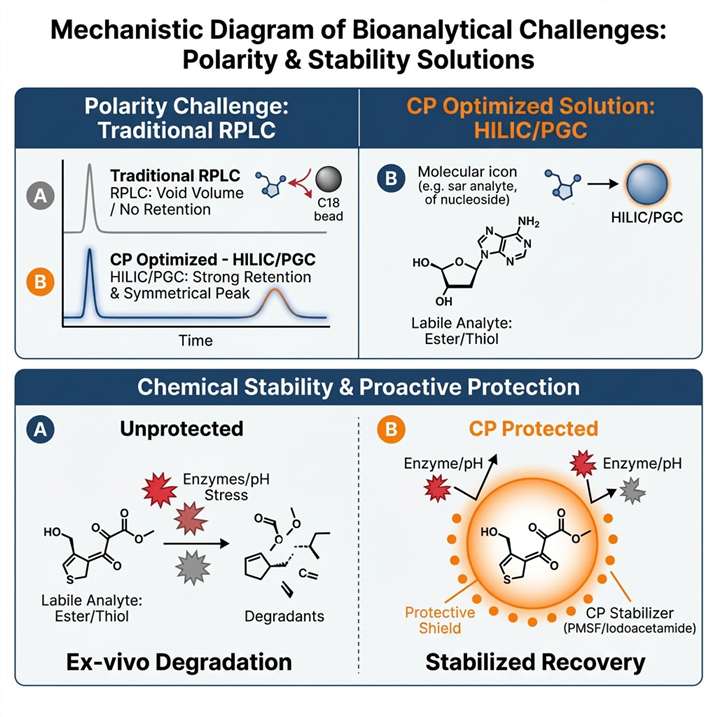
  • Extreme Polarity and Poor Retention: Highly polar analytes, such as nucleosides and small organic acids, often show negligible retention on traditional reversed-phase (RPLC) columns. This leads to co-elution with matrix interferences, causing massive ion suppression.
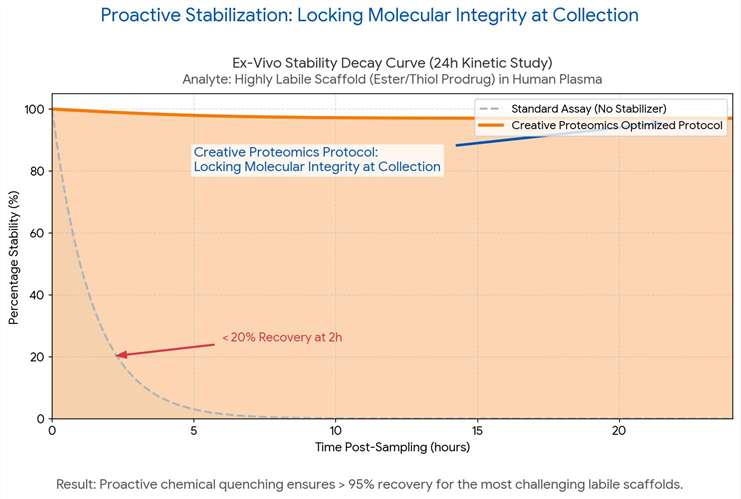
  • High Reactivity and Chemical Instability: Compounds featuring ester bonds, thiol groups, or prodrug scaffolds can undergo rapid enzymatic or chemical degradation within minutes of sample collection.
  • Extreme Matrix Effects: The bioanalysis of cerebrospinal fluid (CSF) is plagued by non-specific adsorption (NSA) to container walls, while bile and fecal matrices contain high concentrations of phospholipids, salts, and pigments that drastically obscure target signals.

Mechanistic visualization of HILIC retention for polar compounds and chemical stabilization for labile analytes

Specialized Engineering for Complex Projects

1. Agile De Novo Method Engineering

We do not rely on pre-existing assay templates for novel molecules. Instead, we initiate a bottom-up de novo method development process for every unique scaffold.

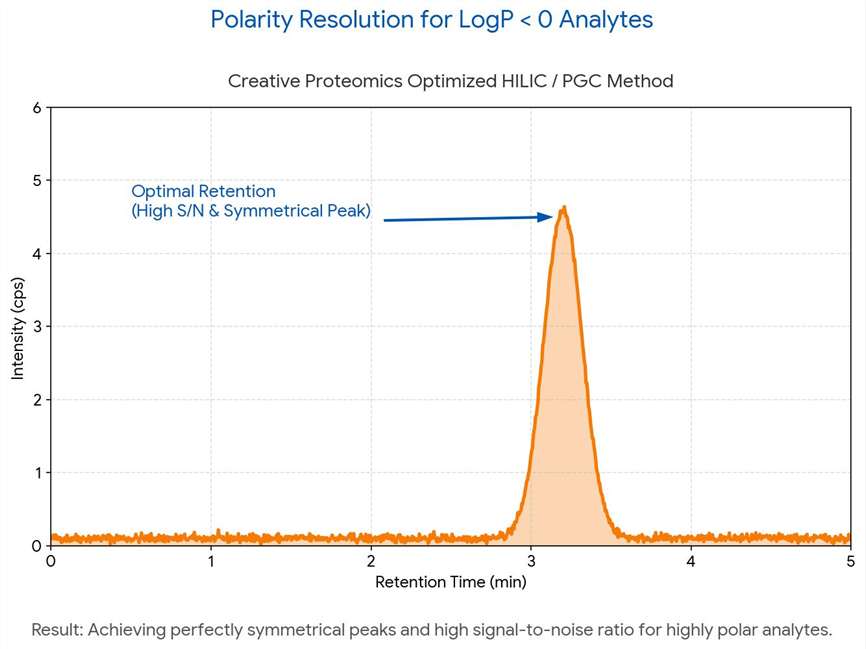
  • Multidimensional Separation Science: Beyond standard C18 chemistry, we deploy specialized separation strategies, including Hydrophilic Interaction Liquid Chromatography (HILIC), Ion-pairing chromatography, and Porous Graphitic Carbon (PGC) columns. This ensures that even the most polar analytes achieve optimal retention and symmetric peak shapes for reliable quantification.
  • Precision Derivatization Protocols: For molecules with inherently low ionization efficiency, we offer custom chemical derivatization. By introducing highly ionizable tags via targeted chemical reactions, we can transform microgram-level detection limits into picogram-level (pg/mL) sensitivity.

2. Physicochemical Liability Mitigation

We possess deep expertise in handling molecules that are biologically "fragile" or physically "sticky."

  • Multifaceted Stabilization Technologies: In addition to standard pH adjustment, we introduce specialized free-radical scavengers for oxidation-sensitive drugs and deploy specific covalent inhibitors (e.g., Iodoacetamide for thiol protease inhibition) for enzymatically labile compounds.
  • Non-specific Adsorption (NSA) Engineering: To solve the critical issue of container wall adsorption often seen with lipophilic molecules in Tissue and Cell Lysate Quantification, we use tailored ratios of non-ionic surfactants and blocking agents to ensure extraction recoveries exceed 90%.

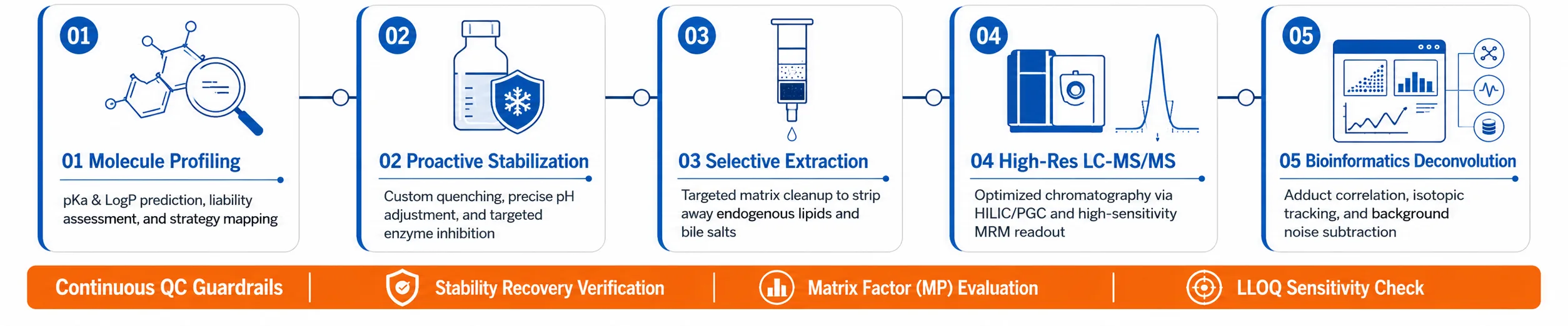
Custom Bioanalytical Workflow

Our workflow is inquiry-driven, adapting to the specific scientific needs of global researchers.

5-step de novo bioanalytical workflow for challenging small molecules

In-depth Case Study: Eliminating Endogenous Multi-Component Interference

Project Background: A biotechnology firm required the precise quantification of 24 polar endogenous bile acids across multiple biological matrices. The technical complexity was dual-fold: bile acids exist as numerous isobaric isomers, and the matrices (bile and high-fat plasma) contained extreme concentrations of bilirubin, free hemoglobin, and high-abundance triglycerides. Standard LC-MS/MS methods suffered from Matrix Effect (ME) fluctuations exceeding 50%, completely obscuring the biological signal.

Technical Execution & Innovation:

  1. Extraction Protocol Development: We evaluated PPT, LLE, and SPE. The optimal solution was a two-stage Micro-SPE workflow. By fine-tuning the eluent polarity, we successfully isolated the target acids while stripping away over 95% of the high-abundance phospholipid components .
  2. Ultra-High Resolution Separation: Utilizing sub-2 µm core-shell column technology, we achieved a high theoretical plate count. This allowed for the baseline separation of all 24 isomers—including multiple epimers—within a 12-minute runtime.
  3. Matrix Correction Logic: We implemented an isotope dilution strategy, using stable-labeled internal standards to provide real-time monitoring of the matrix factor for every single batch, ensuring total data consistency.

Results and Scientific Impact: Excellent linearity was achieved from 5 ng/mL to 5000 ng/mL with R2 values consistently greater than 0.998. The method was validated for robustness through three cycles of Freeze-Thaw Stability Testing, with concentration deviations $< 5\%$. The high-fidelity data successfully distinguished subtle concentration shifts in primary vs. secondary bile acids, providing the client with decisive evidence for their metabolic pathway modeling.
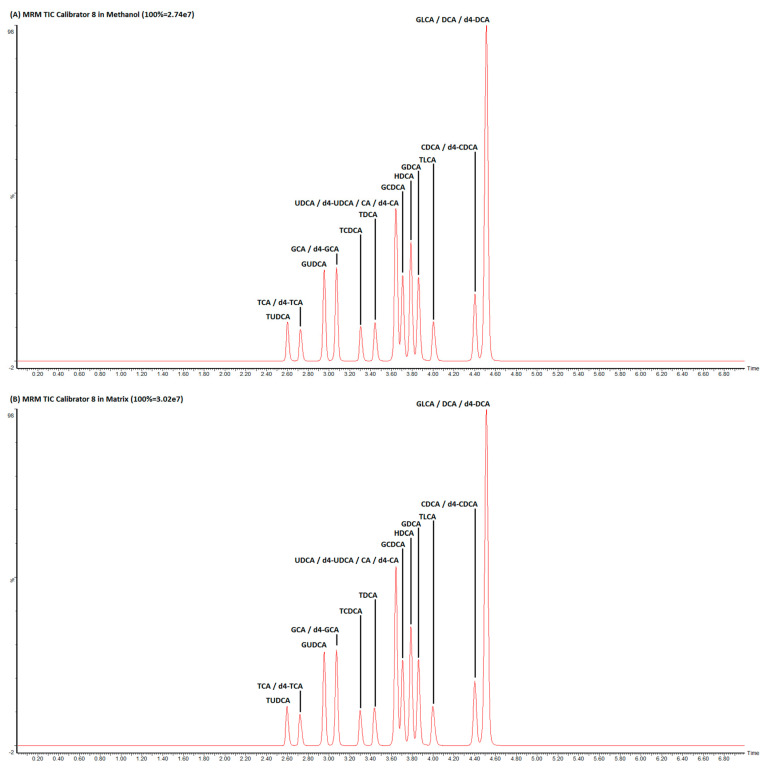
LC-MS/MS chromatogram showing baseline separation of 24 bile acid isomers

Advanced Bioinformatics Support: Deep Data Mining

Our data interpretation extends beyond mere concentration values. We utilize a proprietary bioinformatics pipeline to extract deeper scientific insights:

  • Multidimensional Deconvolution: Leveraging high-resolution mass spectrometry (HRMS) data, our algorithms automatically identify and subtract isobaric interference peaks with mass deviations as small as 5 ppm, resolving "false positive" quantification issues.
  • Automated Adduct and Isotope Identification: Our system correlates sodium/potassium adducts and characteristic isotope distributions. This ensures total peak area integration and prevents the systematic bias often caused by varied adduct formation in complex matrices.
  • Correlation Modeling and Pathway Prediction: By integrating quantitative data with structural insights from Metabolite Identification (MetID) Services, we build dynamic models of clearance rates vs. metabolite generation. This supports early-stage structural optimization strategies.

Demo Results: Performance Benchmarks for Challenging Assays

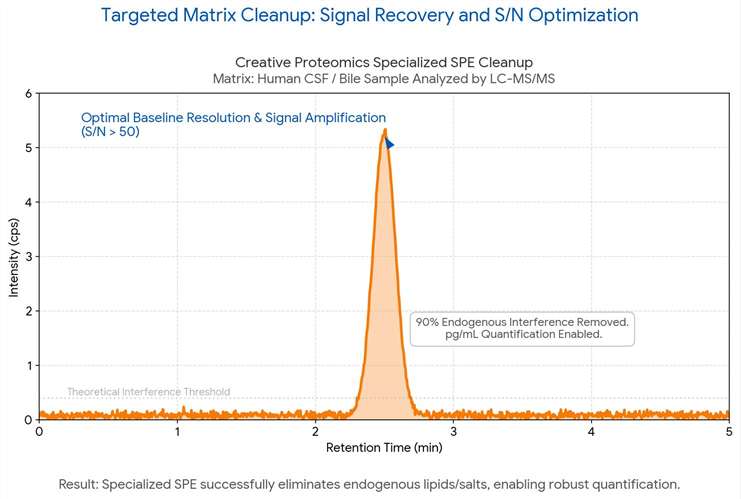
We deliver data that supports critical go/no-go decisions in drug discovery. Our optimized LC-MS/MS extraction methodology maintains exceptional recovery and limits inter-day variance (CV%) to low single digits.

Challenge Scenario Target Analyte / Matrix Key Technical Approach Performance (LLOQ / Precision)
Extreme Polarity (LogP < 0) Nucleosides & Polar Metabolites HILIC + Ion-pairing 100 pg/mL; CV < 5%
Trace Level Matrices Cerebrospinal Fluid (CSF) Micro-injection + Derivatization 25 pg/mL; S/N > 20
Highly Labile (Unstable) Ester-based Prodrugs Quenching + Ice-point Extraction > 95% stability over 24h
Complex Homogenates Brain, Liver, Adipose Tissue Multi-stage SPE Cleanup Matrix Factor 0.85 - 1.15
Comparison of LC-MS/MS chromatograms showing 90% reduction in ion suppression

Sample Specifications and Handling: Specialized Matrix Guide

To ensure the integrity of Stability and Forced Degradation Studies, we recommend following these matrix-specific handling protocols:

Matrix Type Min. Suggested Volume Recommended Stabilization Shipping Requirements
Bile 50 µL 5-10x dilution and acidification to prevent adsorption/precipitation Dry Ice
CSF 30 µL Addition of 0.05% Tween-20 to mitigate non-specific adsorption Dry Ice
Tissue Homogenate 100 mg (Tissue block) Immediate snap-freezing in liquid nitrogen; avoid freeze-thaw Dry Ice
Hyperlipidemic Plasma 100 µL Note lipid levels; we apply specialized lipid-stripping protocols Dry Ice

Deep EEAT: Why Global R&D Teams Trust Our Analysis

  • Extreme Resource Integration: We possess a unique platform flexibility. Depending on the precision requirements of your project, we can mobilize the world's most advanced LC-MS/MS hardware, ensuring the technical ceiling is never reached.
  • Expertise-Driven Methodology: Our team is led by Ph.D. analytical chemists with decades of experience in understanding the chemical behavior of complex molecules across diverse biological environments.
  • Transparent Data Delivery: While focused on early-stage discovery (RUO), every data point is generated under a framework of rigorous scientific evaluation, ensuring the absolute authenticity and reproducibility of your results for peer review.

Explore Related Bioanalytical Services

To build a complete pharmacokinetic profile, you may synergize this service with our other specialized platforms:

Frequently Asked Questions (FAQ)

Q: What alternative chromatographic strategies do you have for highly polar compounds that fail on C18?

In addition to HILIC, we have extensive experience with ion-pairing agents and Porous Graphitic Carbon (PGC) columns. These allow us to establish robust retention for the majority of strongly acidic or basic polar molecules that otherwise elute in the solvent front.

Q: How do you manage compounds that degrade instantaneously during extraction?

Our scientists will coordinate a pre-emptive sampling plan with you. This typically involves on-site addition of our specialized stabilization cocktails, strictly controlled cold-environment processing, and the use of ultra-fast extraction techniques (such as online SPE) to minimize analyte exposure time.

Q: What level of data transparency is provided in your final reports?

We provide a comprehensive technical report for every study, including representative raw chromatograms, standard curves, precision and accuracy (P&A) data, and detailed assessments of matrix factors. Our goal is to provide a transparent reflection of every scientific detail, giving you a solid foundation for internal evaluation.

Ready to Quantify Your Lead Compound or Metabolite?

Share your matrix type, sample count, and expected range—feasibility routing will confirm whether direct quantification is fit-for-purpose or method development is recommended.

inquiry
Online Inquiry