ISO 17025–ACCREDITED LABORATORY ENVIRONMENT

Transporter Interaction Bioanalysis Services

Evaluating transporter-mediated interactions is a critical milestone in early drug development. Membrane transporters, particularly within the ATP-binding cassette (ABC) and solute carrier (SLC) families, govern the absorption, distribution, and excretion of therapeutics. When a novel chemical entity acts as a substrate or inhibitor of these proteins, it can dramatically alter the pharmacokinetic profile of co-administered drugs, leading to severe drug-drug interactions (DDIs).

At Creative Proteomics DMPK, our transporter interaction bioanalysis services provide the definitive data required to navigate these risks. Utilizing high-sensitivity LC-MS/MS platforms, we provide precise quantification of probe substrates to facilitate fast, data-driven decisions for your preclinical pipeline.

Broad Transporter Coverage

Support for major ABC and SLC transporters including P-gp, BCRP, OATP1B1/1B3, OAT1/3, OCT2, and MATE1/2-K.

Quantitative LC-MS/MS Readout

Sensitive bioanalytical workflows for probe substrates, intracellular accumulation, uptake clearance, and inhibition curve analysis.

Decision-Ready Study Outputs

Structured reports with transporter-specific interpretation, QC checkpoints, and result formats aligned to DDI evaluation workflows.

Overview Supported Transporters Standardized Workflow Demo Results Sample Requirements Selection Strategy Case Study FAQ

What Transporter Interaction Bioanalysis Supports in DDI Evaluation

Transporter-mediated disposition plays a central role in hepatic uptake, renal secretion, and tissue penetration, including permeability across the blood-brain barrier. Advanced preclinical evaluations emphasize the early identification of transporter liabilities to prevent costly pipeline attrition. Our Drug-Drug Interaction (DDI) Support services help research teams identify whether a candidate compound is a "victim" (whose metabolic clearance depends heavily on a specific transporter) or a "perpetrator" (which inhibits transporters, potentially altering the pharmacokinetic profiles of co-administered substances).

Through customized in vitro assay design, rigorous mass balance tracking, and high-resolution mass spectrometry, we deliver definitive kinetic constants. These workflows are specifically optimized for researchers who require absolute metabolic clarity before advancing compounds into complex in vivo models or broader pharmacological safety assessments.

Transporters and Interaction Types We Support

We support a comprehensive panel of relevant transporters, catering to both substrate identification and inhibition assessment. Our validated assay systems map directly to critical physiological barriers and clearance pathways.

Transporter Family Key Transporters Primary Localization Supported Assay Types
ABC (Efflux) P-gp (MDR1), BCRP, BSEP Intestine, Liver, Kidney, BBB Substrate (Efflux Ratio), Inhibition (IC50)
SLC (Hepatic Uptake) OATP1B1, OATP1B3, OATP2B1, NTCP Liver (Sinusoidal & Canalicular) Substrate (Uptake Clearance), Inhibition (IC50)
SLC (Renal Uptake/Efflux) OAT1, OAT3, OCT2, MATE1, MATE2-K Kidney (Proximal Tubules) Substrate (Uptake Clearance), Inhibition (IC50)
SLC (Intestinal) PEPT1, ASBT, MCT1 Intestine, Liver Substrate Assessment, Inhibition Profiling

By employing specialized cell-based monolayers (e.g., Caco-2, MDCK, or HEK293 transfected cell lines) and inside-out membrane vesicular systems, we ensure the optimal test system is matched to the specific transport mechanism being evaluated.

Standardized Workflow for Transporter Bioanalysis Projects

Our analytical operations follow a strict, logic-driven workflow to ensure high-throughput efficiency and absolute data traceability.

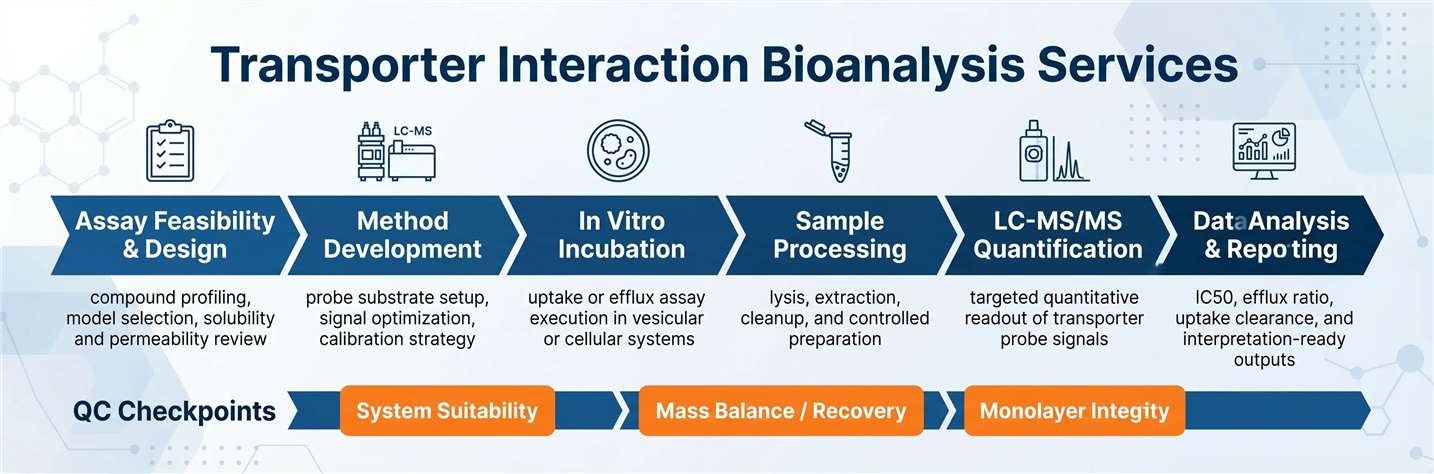
  1. Assay Feasibility & Design: Initial assessment of compound solubility, passive permeability, and non-specific protein binding to select the optimal vesicular or cellular model.
  2. Method Development: Rapid establishment and partial validation of LC-MS/MS methods for the test article and transporter-specific probe substrates.
  3. In Vitro Incubation: Controlled execution of bidirectional transport or uptake assays across multiple concentration gradients and defined time points.
  4. Sample Processing: Cell lysis, buffer extraction, and protein precipitation utilizing high-precision liquid handling to eliminate cross-contamination.
  5. LC-MS/MS Quantification: High-sensitivity targeted analysis of intracellular, apical, and basolateral compartment concentrations.
  6. Data Analysis & Reporting: Non-linear regression to calculate apparent permeability (Papp), efflux ratios (ER), uptake clearance, and IC50.

QC Checkpoints Built into the Workflow

  • System Suitability: Validation of functional transporter expression using known positive control substrates and selective inhibitors prior to testing novel compounds.
  • Mass Balance / Recovery: Strict tracking of compound recovery (>80% required) to rule out significant non-specific binding to assay plates or cellular accumulation independent of active transport.
  • Monolayer Integrity: Continuous monitoring of Lucifer Yellow permeability and Transepithelial Electrical Resistance (TEER) values in Caco-2/MDCK models to guarantee tight junction integrity.

Standardized 6-step workflow and QC checkpoints for transporter interaction bioanalysis

Typical Demo Results and Reporting Outputs

We provide interpretation-ready data packages that allow DMPK scientists to seamlessly integrate findings into broader safety evaluations. Our standard deliverables include:

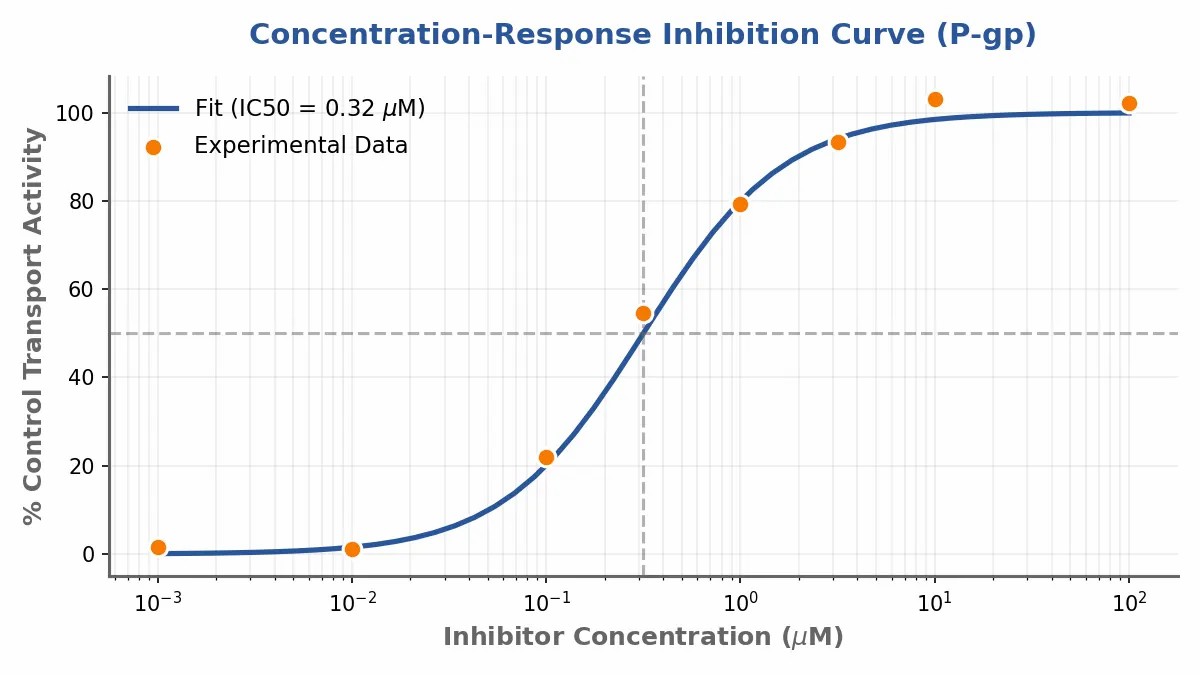
  • Concentration-Response Inhibition Curves: High-resolution sigmoidal plots detailing the percentage of control transport activity against logarithmic inhibitor concentrations. This enables precise IC50 determination for key transporters like P-gp or OATP1B1, highlighting the potency of the interaction.
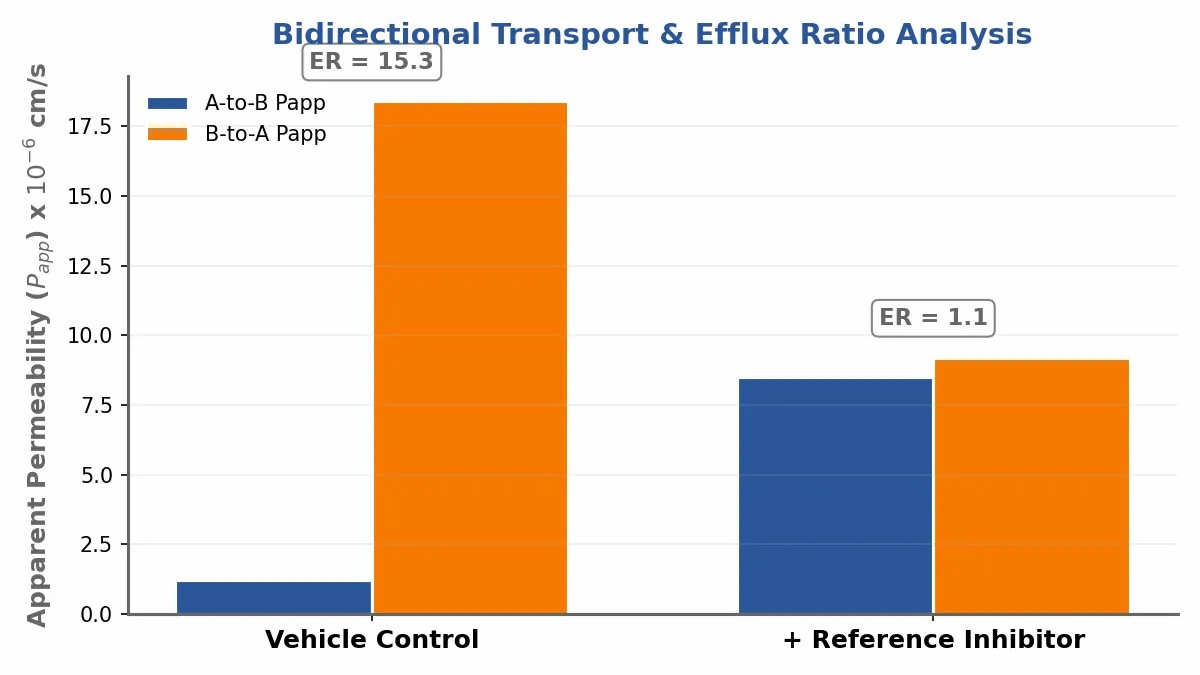
  • Efflux Ratio (ER) Summaries: Bidirectional transport data calculating A-to-B and B-to-A apparent permeability (Papp). An ER greater than 2.0—coupled with a significant reduction in the presence of a reference inhibitor—provides definitive proof that a compound is an active efflux substrate.
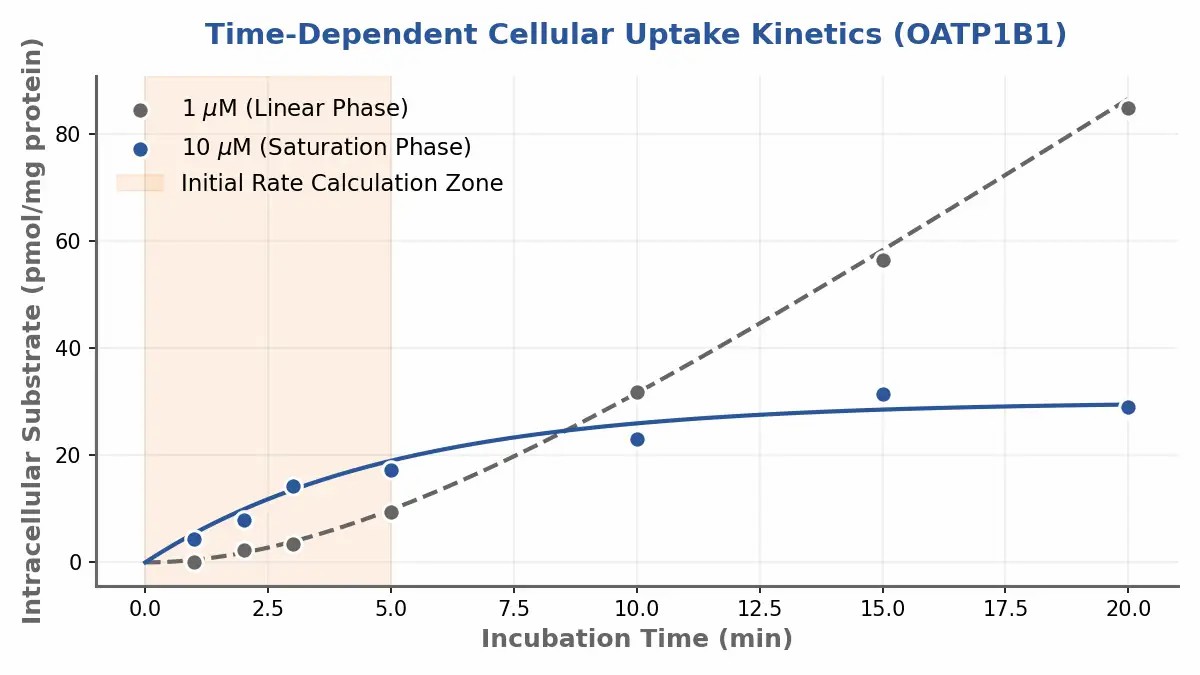
  • Time-Dependent Uptake Plots: Linear and non-linear kinetic visualizations of intracellular substrate accumulation over time. These plots are essential for calculating uptake clearance (CLuptake) in single-transfected SLC models, helping characterize hepatic or renal entry.
Concentration-Response Inhibition Curve
Efflux Ratio Summary Bar Chart
Time-Dependent Uptake Kinetics Plot

Sample Requirements and Study Planning

To ensure the highest accuracy for mechanistic studies, providing precise physicochemical data upfront prevents matrix interference and poor solubility during incubations.

Study Goal Test Article Form Required Amount Critical Information Needed
Inhibition Assay (IC50) Solid powder or 10 mM DMSO stock 2-5 mg Exact MW, solubility limit in assay buffer, expected protein binding
Substrate Assay (Efflux/Uptake) Solid powder or 10 mM DMSO stock 3-5 mg Passive permeability estimate, LogP/LogD, chemical stability data
Endogenous Biomarker Panel Biological Matrix (Plasma, Urine) 0.5-1 mL Species, collection method, anticoagulant used, freeze-thaw history

How to Choose the Right Transporter Bioanalysis Strategy

Selecting the correct assay depth is critical for balancing research timelines with the required mechanistic certainty.

  • Define the Objective: Utilize Substrate Studies to determine if a transporter governs your drug's clearance or limits tissue penetration. Utilize Inhibition Studies to assess if your candidate acts as a perpetrator that could elevate the plasma levels of co-medications.
  • Select the Appropriate Model System: Inside-out membrane vesicular assays are highly efficient for assessing ABC efflux transporters (e.g., MDR1, BCRP). Conversely, functionally active transfected cell lines (e.g., HEK293 or CHO) are strictly necessary for assessing SLC uptake transporters (e.g., OATP, OAT, OCT).
  • Integrate with a Broader DDI Strategy: Transporter data rarely exists in a vacuum. Coordinate your transporter interaction assays with CYP Inhibition (IC50/Ki), CYP Induction, and Time-Dependent Inhibition (TDI) screening to construct a holistic metabolic liability profile.

Case Study: Efflux Transporter Interaction Analysis

Source Paper

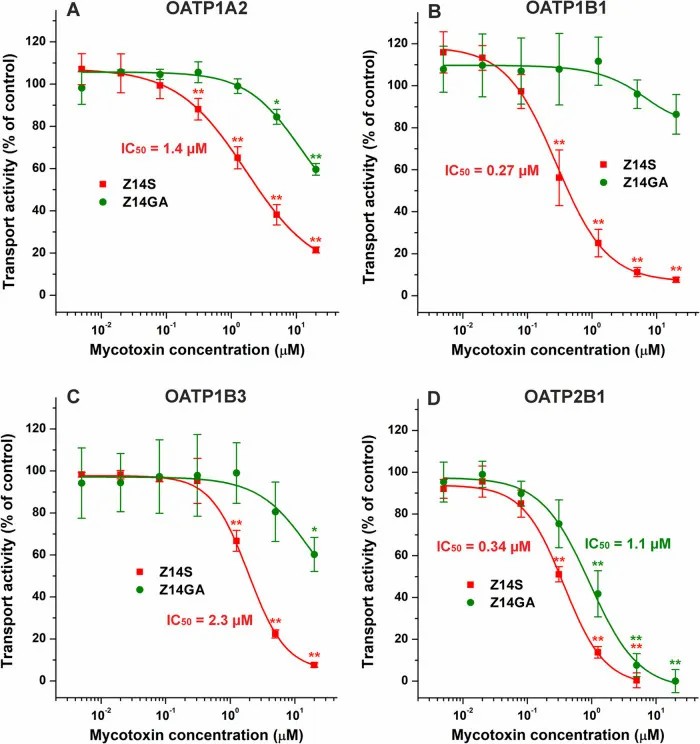
Adapted from Zhang et al., Toxins 2025, doi:10.3390/toxins17070432

Background

Differentiating the specific affinity of xenobiotics for key efflux transporters like MDR1 (P-gp) and BCRP is vital for understanding intestinal absorption restrictions and potential transport barriers.

Methods

Researchers utilized an ATPase activity assay to evaluate the interaction between test compounds and transporter-expressing membrane vesicles. Because ABC transporters utilize ATP hydrolysis to move substrates across membranes, quantifying the release of inorganic phosphate (Pi) provides a direct, highly sensitive measurement of transporter activation or inhibition across a concentration gradient.

Results

The kinetic modeling revealed that specific compound analogs exhibited concentration-dependent stimulation of MDR1 ATPase activity, confirming robust substrate-like behavior. However, the exact same compounds demonstrated distinct, non-stimulatory profiles in BCRP-expressing vesicles, indicating a highly selective efflux mechanism.

Conclusion

By utilizing isolated vesicular systems alongside quantitative phosphate readouts, researchers can unambiguously pinpoint specific efflux liabilities. Extracting these precise functional differences allows pharmacokineticists to structurally optimize leads, mitigating poor absorption profiles prior to costly in vivo screening.

This article is licensed under a Creative Commons Attribution 4.0 International License (CC BY 4.0).

MDR1 P-gp ATPase Activity Curve adapted from Zhang et al., 2025

Frequently Asked Questions

When should transporter bioanalysis be included in DDI studies?

Transporter screening should be initiated during the hit-to-lead and lead optimization stages to flag severe disposition liabilities early. Definitive IC50 and substrate profiling must be fully completed to guide the design of downstream ADME models.

What is the difference between substrate and inhibition transporter studies?

Substrate studies determine if your candidate drug is actively moved by a transporter, which significantly impacts its own absorption and clearance (evaluating victim potential). Inhibition studies determine if your candidate drug blocks a transporter, which could elevate the plasma levels of other co-administered substances (evaluating perpetrator potential).

Which transporters are most commonly evaluated?

Based on standard ADME guidelines, the evaluation panel typically includes P-gp (MDR1) and BCRP for efflux mechanisms, alongside OATP1B1, OATP1B3, OAT1, OAT3, OCT2, MATE1, and MATE2-K for uptake mechanisms, covering the most critical hepatic, renal, and intestinal interfaces.

Ready to Quantify Your Lead Compound or Metabolite?

Share your matrix type, sample count, and expected range—feasibility routing will confirm whether direct quantification is fit-for-purpose or method development is recommended.

inquiry
Online Inquiry