ISO 17025–ACCREDITED LABORATORY ENVIRONMENT

High-Resolution Metabolite Quantification Services for Early Drug Discovery

Metabolite quantification represents a critical pillar in the architecture of early-stage drug discovery. To accurately evaluate the systemic viability of a novel chemical entity, researchers must look beyond the parent compound and precisely map the concentration of its downstream metabolites.

We provide specialized metabolite quantification services tailored for the high-sensitivity requirements of biotech R&D and academic research. By leveraging advanced LC-MS/MS platforms within an ISO 17025 certified laboratory, we help researchers overcome severe analytical bottlenecks, delivering robust, highly reproducible concentration data for complex preclinical matrices.

De Novo Method Development

Expert design of customized extraction, chromatography, and MS protocols for completely novel chemical entities (NCEs) and complex molecules.

High-Throughput Screening

Robust infrastructural capacity designed to process large-scale discovery sample batches with stable, batch-to-batch consistency.

ISO 17025 Traceability

All quantitative data is generated within a rigorously certified QMS, ensuring unparalleled documentation for fundamental scientific research.

Navigating Complexity Workflow & QC Demo Results ISO 17025 Advantage Sample Requirements Related Services Case Study FAQ

Navigating the Complexity of Metabolic Profiling and Quantification

In the critical phases of early drug discovery, transitioning a promising lead compound into a viable developmental candidate requires an in-depth understanding of how its metabolites behave within complex biological systems. Unlike parent drug quantification, identifying and measuring metabolites introduces profound analytical hurdles. Metabolites typically exist at significantly lower systemic concentrations than the parent drug. Furthermore, Phase I metabolites (such as those resulting from oxidation, reduction, or hydrolysis) and Phase II metabolites (such as glucuronide or sulfate conjugates) often share extreme structural similarities with both the parent molecule and endogenous biological background components.

These factors result in narrow linear dynamic ranges, challenging chromatographic separations, and massive ion suppression during mass spectrometry analysis. If the analytical method is not perfectly tuned, matrix effects can completely mask the target analyte or produce false-positive quantitative readouts.

Our platform addresses these specific chemical challenges through inquiry-driven custom delivery. We reject "one-size-fits-all" methodologies. Instead, our bioanalytical scientific team meticulously evaluates the unique physicochemical properties of your target analytes—such as pKa, lipophilicity (LogP), and molecular weight—alongside the specific biochemical challenges of your biological matrix. Whether you are extracting targets from lipid-dense brain tissue, enzyme-rich liver homogenates, or protein-heavy plasma, we engineer a bespoke quantification strategy that ensures absolute accuracy, baseline stability, and reproducibility.

Robust Analytical Workflow & QC Checkpoints

To ensure batch-to-batch consistency and accurate data delivery for hundreds or thousands of samples, our bioanalytical workflow incorporates stringent quality control checkpoints at every critical juncture.

Step 1: Specialized Sample Preparation & Matrix Clean-up

Process: We implement precise extraction techniques (Protein Precipitation, Solid-Phase Extraction, Liquid-Liquid Extraction, or Chemical Derivatization) to strip away complex matrices while preserving target metabolites.

QC Checkpoint: Visual confirmation of homogenate clarity and, where required, total protein normalization to ensure concentration data is representative across varying sample volumes.

Step 2: De Novo Method Development & Optimization

Process: For novel chemical entities (NCEs), we develop customized LC-MS/MS methods from the ground up, selecting optimal mass transitions and optimizing complex chromatographic gradients.

QC Checkpoint: Rigorous evaluation of the Matrix Effect (ME%) and absolute Extraction Recovery rates using surrogate matrices to ensure stability across biological batches.

Step 3: High-Sensitivity LC-MS/MS Analysis

Process: We utilize a dual-track approach. Triple Quadrupole (QQQ) systems are deployed for targeted MRM quantification, while High-Resolution Mass Spectrometry (HRMS) is used for exact mass confirmation and structural elucidation.

QC Checkpoint: Validation of calibration curve linearity (strictly maintaining R² > 0.99) and establishing the LLOQ explicitly tailored to your expected accumulation levels.

Step 4: Data Interpretation & Reporting

Process: Processing raw MS data using industry-validated software for precise peak integration, regression analysis, and final concentration calculation.

QC Checkpoint: Comprehensive verification of intra-day and inter-day precision using matrix-matched Quality Control samples (Low, Mid, and High QC levels).

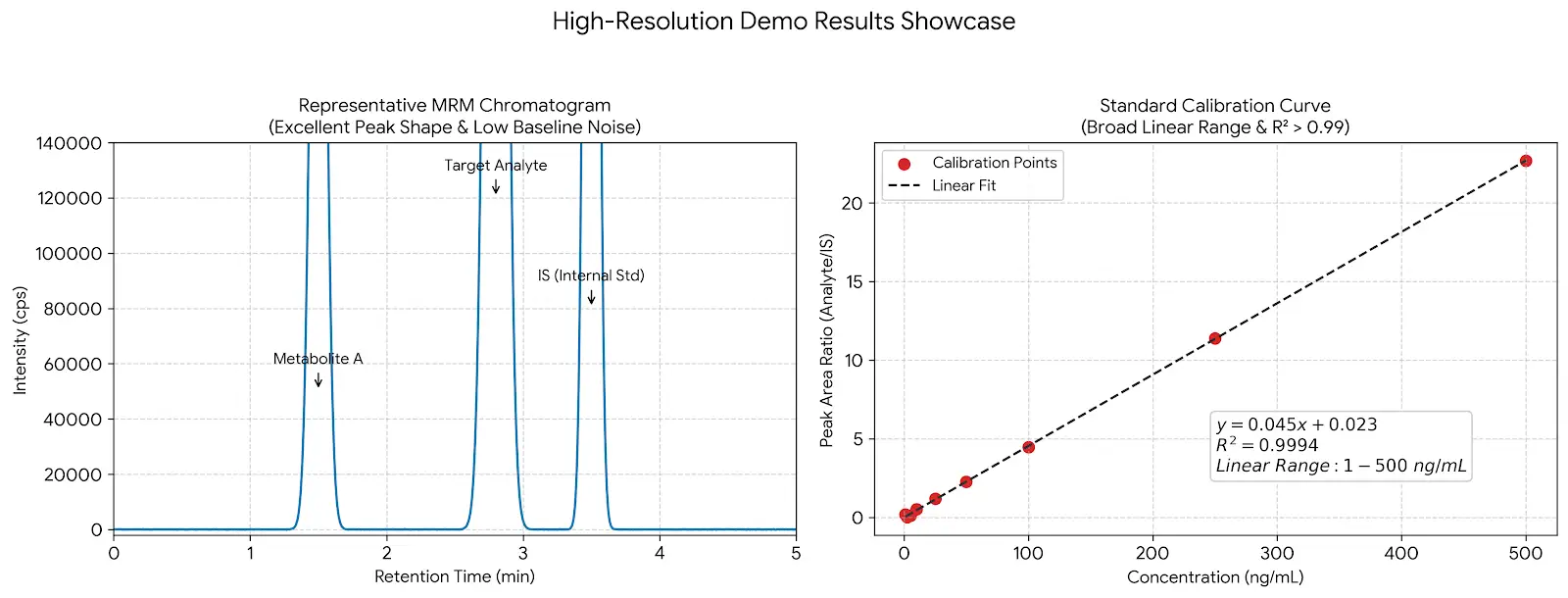
High-Resolution Demo Results Showcase

We provide objective experimental evidence of our analytical rigor. Our standard data packages include the exact quantitative and qualitative metrics required by advanced researchers to verify the success of a complex quantification study:

  • Representative MRM Chromatograms: Visual proof demonstrating clear baseline separation of the target metabolite from dense endogenous background noise, proving the specificity of the chromatography.
  • Standard Calibration Curves: Detailed linear or quadratic regression plots demonstrating the analytical range, weighting factors, and absolute sensitivity (LLOQ) of the established method.
  • Accuracy & Precision Data: Quantitative tables summarizing the intra-day (within-run) and inter-day (between-run) Coefficient of Variation (CV%), proving the reproducibility of the assay.
  • Matrix Effect & Recovery Evaluations: Empirical scientific data showing how the specific Liquid-Liquid or Solid-Phase extraction process effectively mitigated ion suppression or enhancement from the target tissue matrix.
  • Summary Spreadsheet: Final calculated concentration data rigorously formatted for immediate integration into your internal research reports, grant applications, or scientific publications.

High-Resolution LC-MS/MS Demo Results Showcase including MRM Chromatograms and Calibration Curves

Technical Strengths: The ISO 17025 Advantage

When quantifying early-stage metabolites, researchers frequently face a critical decision: relying on generic commercial bioassay kits or investing in advanced instrumental LC-MS/MS analysis. Operating within an ISO 17025 certified laboratory environment provides our platform with decisive, verifiable technical advantages over standard methodologies.

While generic kits offer speed for common markers, they rely on antibody binding, which is notoriously susceptible to cross-reactivity. A kit designed for a parent drug may blindly bind to a structurally similar Phase I metabolite, yielding artificially inflated concentration data. LC-MS/MS eliminates this biological ambiguity by identifying compounds based on their exact mass-to-charge (m/z) transitions. Furthermore, our ISO 17025 framework ensures that every pipette used is calibrated, every instrument undergoes strict preventative maintenance, and every data point is fully traceable.

Dimension ISO 17025 LC-MS/MS Platform Standard Generic/ELISA Kits
Analytical Specificity Absolute structural identification via exact mass-to-charge (m/z) transitions. High risk of cross-reactivity with structurally similar downstream metabolites.
Platform Customization Fully adaptable for completely novel chemical structures and proprietary NCEs. Restricted exclusively to pre-fixed targets; cannot be adapted for new discoveries.
Matrix Mitigation Controlled effectively via de novo extraction protocols (SPE/LLE) and SIL-IS correction. Highly susceptible to massive false positives or negatives in complex tissue or serum.
Data Depth & Traceability Provides absolute concentration, structural confirmation, and rigorous QC documentation. Often provides only relative optical density data with minimal mechanistic insight.

Selection Strategy: Choose high-resolution LC-MS/MS quantification when analyzing novel molecules that lack existing commercial assays, or when extreme molecular specificity is required to successfully distinguish between parent drugs and their structurally similar metabolites in complex, dense biological matrices.

Sample Submission Requirements

Metabolites are frequently unstable outside of their native biological environment. To maintain the structural integrity of your target analytes and ensure highly accurate quantification, we enforce specific guidelines for sample preparation and shipping.

Matrix Type Minimum Volume/Weight Preparation Instruction Shipping Condition
Plasma / Serum 50 – 100 µL Use EDTA or Heparin as an anticoagulant. Centrifuge promptly to separate and immediately aliquot the supernatant. Ship on Dry Ice
Solid Tissue 20 – 50 mg Rinse briefly in cold saline to remove surface blood contamination. Snap-freeze in liquid nitrogen immediately after collection. Ship on Dry Ice
Cell Lysates 100 µL Avoid mass-spec incompatible detergents (e.g., high concentrations of SDS or Triton X-100). Specify the exact lysis buffer composition used. Ship on Dry Ice
CSF / Urine 50 µL Collect in specialized low-protein binding microcentrifuge tubes to prevent analyte adsorption to the plastic walls. Ship on Dry Ice

Comprehensive early discovery research requires meticulously tracking compounds across multiple distinct biological compartments. Expand your analytical strategy by exploring our integrated, specialized quantification capabilities:

Proven Success: De Novo Quantification of CBD and Metabolites in Brain Tissue

Background

In early-stage Central Nervous System (CNS) research, understanding how a compound and its active metabolites distribute across the highly restrictive blood-brain barrier (BBB) is paramount. A research team investigating novel lipid-based drug delivery systems needed to accurately quantify Cannabidiol (CBD) alongside its primary downstream metabolites (7-OH-CBD and 6-OH-CBD) directly within intact rat brain tissue. Brain tissue is notoriously difficult to analyze due to its exceptionally high lipid content, which causes severe ion suppression if not properly managed.

Methods & Results

To overcome the inherent chemical hurdles of the solid brain matrix, a highly customized UHPLC-MS/MS method was developed. The analytical team bypassed standard protein precipitation, implementing a targeted mechanical homogenization protocol coupled with an optimized Liquid-Liquid Extraction (LLE) strategy. The de novo method successfully validated the simultaneous quantification of 18 distinct phytocannabinoids and their metabolites within the brain matrix, achieving an exceptionally tight Matrix Effect (ME%) window.

Conclusion

This application clearly demonstrates the immense value of customized LC-MS/MS methodology in resolving severe matrix interference in CNS research, enabling researchers to confidently optimize formulation strategies.

Source: Pharmacokinetics of Cannabidiol in Rat Brain Tissue (MDPI). Licensed under CC BY 4.0.
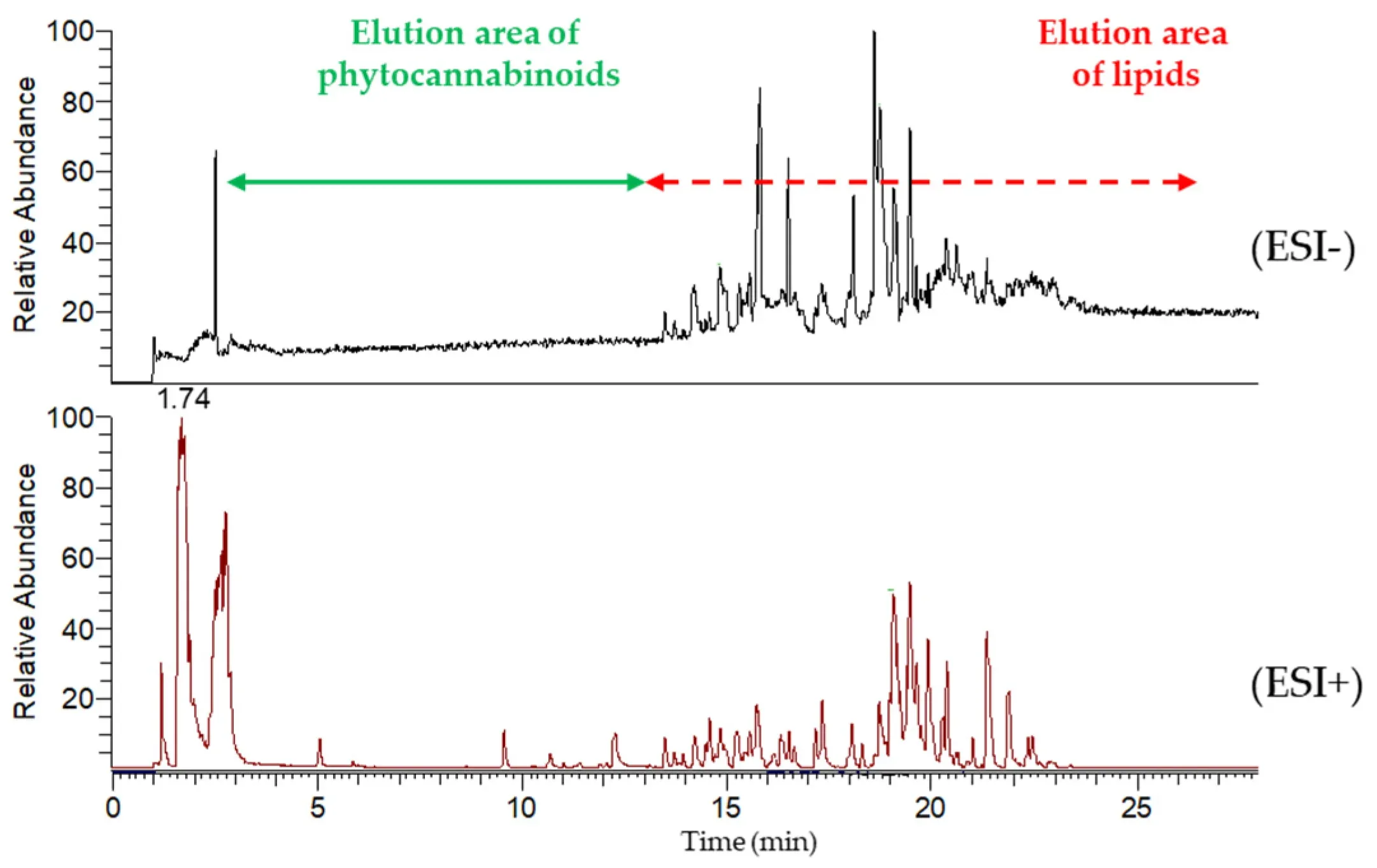
Chromatography and regression curves of CBD metabolite quantification in rat brain tissue homogenates

Frequently Asked Questions

1. Can you develop a quantification method if I do not possess a commercial reference standard?

Yes. While having a pure reference standard is ideal for absolute quantification, we routinely support projects involving completely novel structures. In these scenarios, we can perform relative quantification across your sample groups or utilize closely related structural analogs as surrogate standards. Our core strength lies in executing outstanding customized method development for novel discovery molecules where no established protocols or commercial kits exist.

2. How do you handle highly unstable metabolites that are prone to degradation during the sample preparation phase?

Unstable analytes require specialized stabilization strategies implemented at the very moment of sample collection and homogenization. Depending on the molecule's specific degradation pathway, we utilize targeted chemical derivatization, precise pH adjustment buffers, or the strategic addition of specific enzyme inhibitors directly into the homogenization matrix. This ensures the transient metabolite remains entirely intact for subsequent LC-MS/MS analysis.

3. What specific lysis buffers are compatible with your downstream LC-MS/MS analytical systems?

Mass spectrometers are highly sensitive to strong ionic detergents. We strongly recommend avoiding high concentrations of reagents like SDS, CHAPS, or Triton X-100, as these agents cause massive, irreversible ion suppression and severely contaminate the chromatography columns. If a buffer must be utilized for cellular extraction, we prefer mild, mass-spec compatible options, volatile buffers like ammonium acetate, or simple mechanical cell lysis in purely aqueous solutions.

4. How do you distinguish between a parent drug and a Phase II glucuronide metabolite during analysis?

Phase II metabolites, such as glucuronides, are highly polar and often exhibit poor retention on standard reverse-phase columns, risking co-elution with matrix void volume. We solve this by optimizing the chromatographic stationary phase (such as using HILIC columns) and carefully selecting unique MRM transitions. Because glucuronides often undergo in-source fragmentation back into the parent drug inside the mass spectrometer, strict chromatographic separation prior to ionization is absolutely essential to prevent false parent-drug readings.

References

Disclaimer: All products, protocols, and bioanalytical services provided by Creative Proteomics DMPK are strictly for Research Use Only (RUO). They are not intended for, nor validated for, use in diagnostic procedures, clinical trials, or direct therapeutic decision-making. The quantitative data and scientific information presented herein are intended exclusively to support fundamental scientific research and early-stage laboratory discovery.

Ready to Quantify Your Lead Compound or Metabolite?

Share your matrix type, sample count, and expected range—feasibility routing will confirm whether direct quantification is fit-for-purpose or method development is recommended.

inquiry
Online Inquiry