ISO 17025–ACCREDITED LABORATORY ENVIRONMENT

Custom HPLC-UV Method Development for Drug Quantification

ISO 17025–accredited custom HPLC-UV method development for preclinical drug quantification on Agilent, Waters, and Shimadzu platforms. We engineer de novo bioanalytical assays for small-molecule drugs in plasma, tissue, and research matrices — delivering ICH M10-aligned validation with a seamless LC-MS/MS upgrade path.

Multi-Platform HPLC-UV/DAD

Full-spectrum 190–800 nm wavelength scouting on Agilent, Waters, and Shimadzu systems.

De Novo Method Engineering

Custom column screening, mobile phase optimization, and ICH M10-aligned fit-for-purpose validation.

Seamless LC-MS/MS Upgrade

Transition to mass spectrometry detection from the same reference material batch — no re-contracting required.

Why Choose Our Approach Method Development Workflow Performance Data Sample Requirements Case Study Integrated Solutions

Why Choose Our HPLC-UV Method Development Approach

Is HPLC-UV Right for Your Compound?

Three criteria clarify if HPLC-UV fits: does your compound have a UV chromophore above ~210 nm (most aromatic, conjugated, and carbonyl-containing drugs do); are expected plasma levels in the high ng/mL to µg/mL range (routine LLOQ 5–50 ng/mL from 100 µL plasma); and would a 40–60% per-sample cost saving versus LC-MS/MS benefit your budget? If yes, HPLC-UV delivers robust quantification without SIL-IS or LC-MS-grade solvents. If not, we recommend our custom LC-MS/MS method development service, initiated from the same reference batch.

Laboratory Infrastructure That Sets Us Apart

Our HPLC-UV capacity is built on platform diversity — Agilent 1200/1260/1290 Infinity II, Waters Alliance e2695 with 2998 PDA, and Shimadzu Nexera XR — and an extensive column chemistry arsenal spanning C18, C8, HILIC, phenyl-hexyl, Porous Graphitic Carbon, and ion-pair phases. We match column chemistry to your molecule's properties rather than forcing every compound onto a single C18 method. Sample preparation options include protein precipitation, liquid-liquid extraction, solid-phase extraction on Oasis HLB/C18/mixed-mode sorbents, and 96-well supported liquid extraction. All work is performed under ISO 17025 accreditation, with auditable QC acceptance criteria (±15% at all levels, ±20% at LLOQ).

Built-In LC-MS/MS Upgrade Path

If HPLC-UV data reveal lower-than-anticipated exposures, we transition your method to LC-MS/MS on the same API batch. Column chemistry, mobile phase, and sample preparation optimized during HPLC-UV development carry forward directly — eliminating the 2–4 week restart delay typical of switching CROs.

How We Develop and Validate Your HPLC-UV Method

Our method development follows a four-stage engineering process — each stage defined by a specific scientific question, not a checkbox.
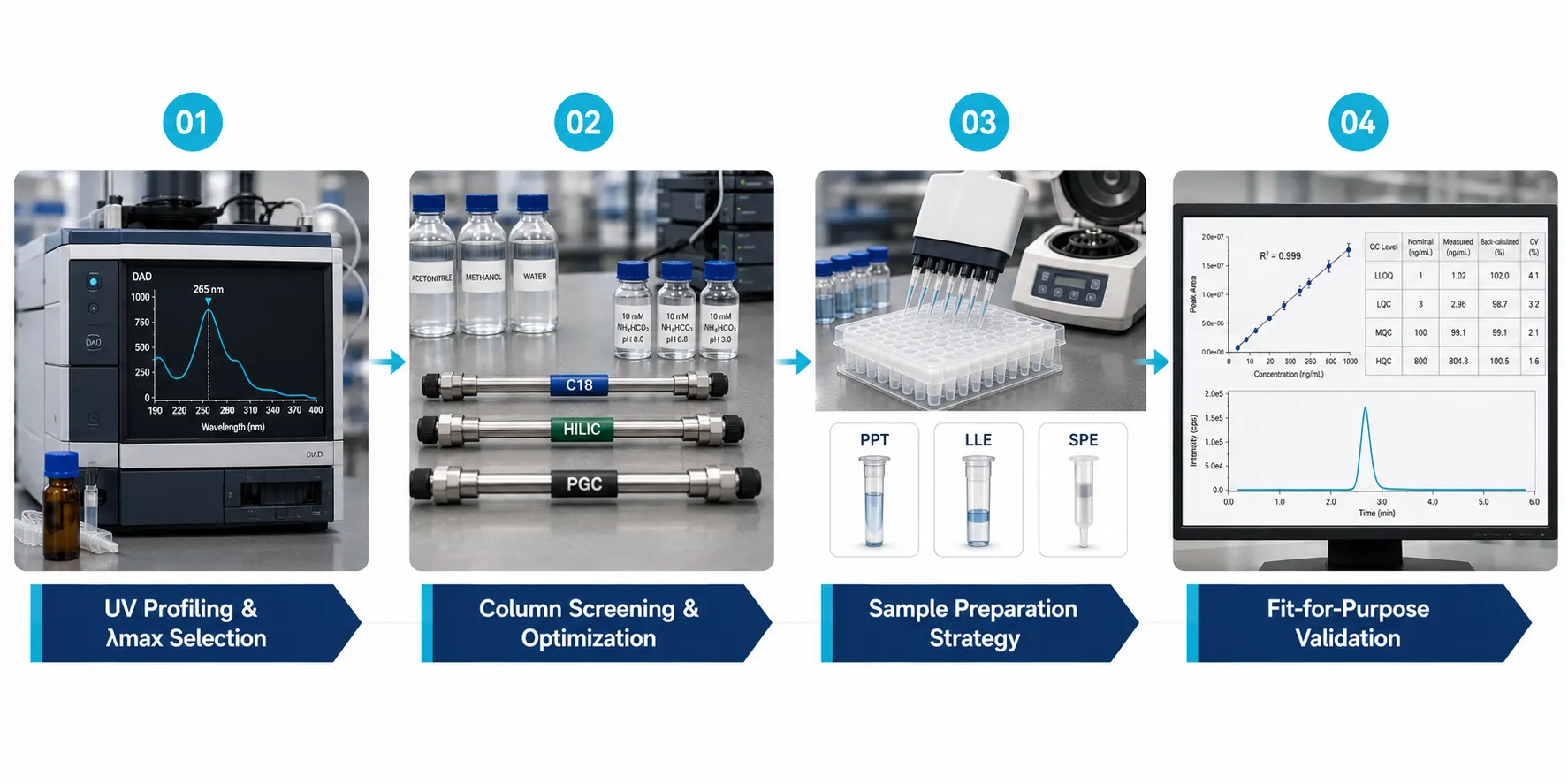
HPLC-UV method development workflow: UV absorption profiling, column screening, sample preparation, and fit-for-purpose validation

Stage 1: UV Absorption Profiling and λmax Selection

Full 190–400 nm UV absorption scan on DAD to identify λmax and confirm no overlap with mobile phase solvent cut-offs. For non-chromophoric compounds, we candidly recommend LC-MS/MS.

Stage 2: Stationary Phase and Mobile Phase Optimization

We systematically evaluate retention and selectivity across C18, C8, HILIC, phenyl-hexyl, and PGC chemistries. Mobile phase pH (2.0–7.5), organic modifier (acetonitrile vs methanol), gradient or isocratic composition, flow rate (0.3–1.5 mL/min), and column temperature (25–45 °C) are optimized targeting resolution Rs > 2.0, tailing factor 0.8–1.5, and retention time reproducibility ±2% across six replicates.

Stage 3: Sample Preparation Strategy

PPT with acetonitrile/methanol for plasma (> 85% recovery), LLE with MTBE or ethyl acetate for lipophilic compounds (> 90%), SPE on Oasis HLB/C18/mixed-mode for tissue and bile, and 96-well SLE for high-throughput. ≤100 µL per replicate for rodent PK. Structural analog IS is sufficient — no costly SIL-IS required.

Stage 4: Fit-for-Purpose Method Validation

Validation follows ICH M10-aligned fit-for-purpose principles. The core package includes calibration linearity (≥6 standards, R2 > 0.99), intra-day and inter-day accuracy/precision at four QC levels (CV < 15%, < 20% at LLOQ), extraction recovery (> 85% with CV < 10%), selectivity screening across six blank matrix lots, and bench-top / freeze-thaw / autosampler stability. Each validation report includes raw chromatograms, calibration plots, and QC back-calculation tables.

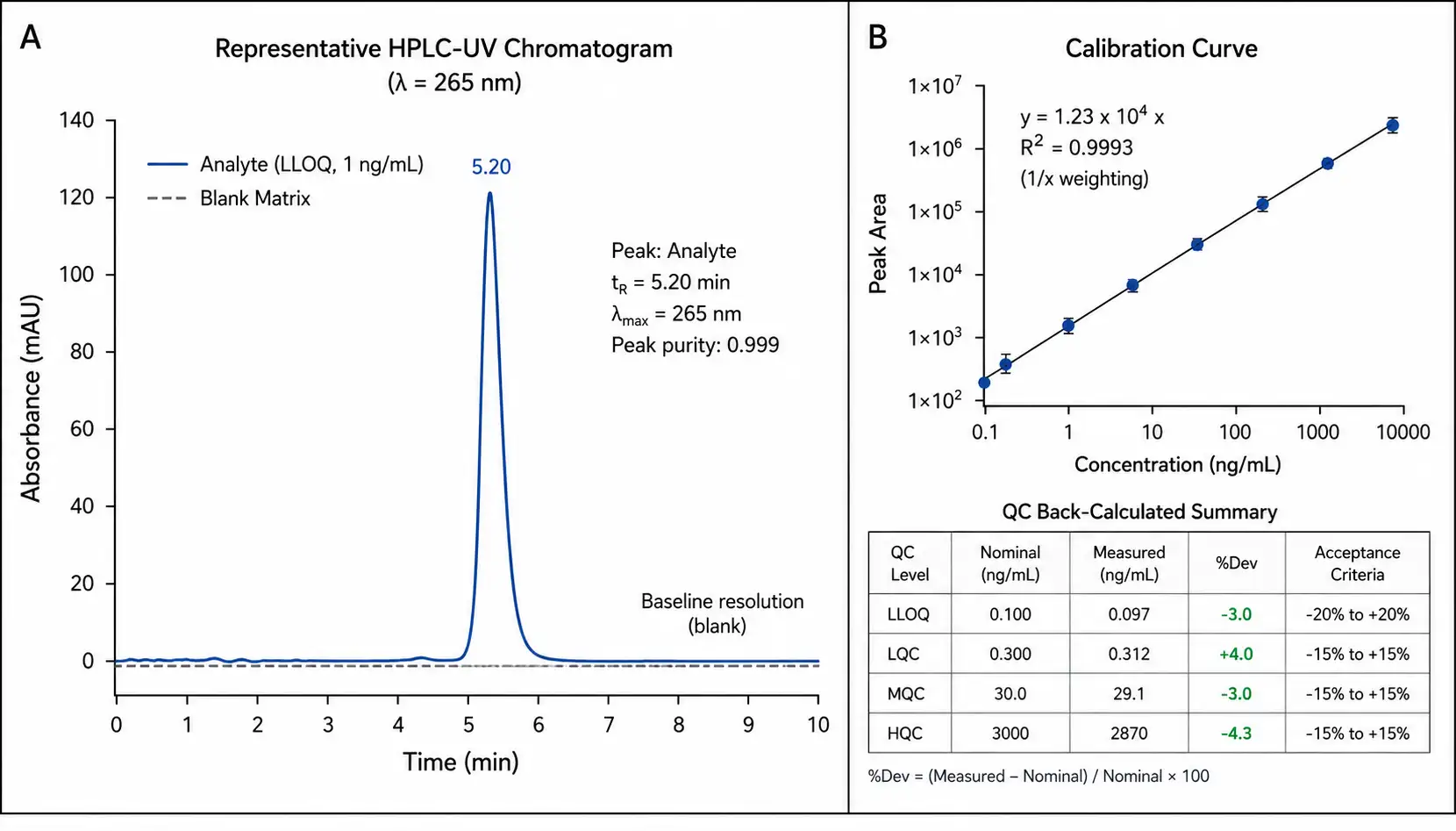
What Our HPLC-UV Methods Deliver: Representative Performance Data

Representative performance envelope achieved for small-molecule drugs with moderate-to-strong UV chromophores in plasma:

Performance Parameter Typical Range
LLOQ (moderate UV chromophore, ε > 5,000 M-1cm-1) 5–50 ng/mL
Linear dynamic range 3–4 orders of magnitude
Calibration R2 > 0.99
Intra-day precision (mid/high QC) CV < 5%
Intra-day precision (LLOQ) CV < 15%
Inter-day precision (3 runs) CV < 10%
Accuracy (all levels) 95–105% of nominal
Extraction recovery (PPT) > 85%
Extraction recovery (LLE/SPE) > 90%
Autosampler stability ≥ 24 h at 4 °C
Retention time reproducibility ±2% across ≥6 injections
Representative HPLC-UV chromatogram showing baseline separation with blank matrix overlay and calibration curve

What to Send Us to Initiate HPLC-UV Method Development

1–2 mg of pure API is typically sufficient for the entire method development and validation package.

Sample Type / Material Minimum Quantity (Method Dev) Minimum Quantity (Sample Analysis) Preparation & Storage Guidelines Shipping Condition
Pure API / Reference Standard ≥ 1 mg powder ≥ 10 mg (for extended studies) High-purity (>95%) powder or stock solution in HPLC-grade solvent. Provide MW, salt form, λmax if available. Room temperature or dry ice
Internal Standard (structural analog) ≥ 1 mg ≥ 5 mg Structural analog with similar UV chromophore and retention behavior. SIL-IS not required for HPLC-UV. Room temperature
Blank Biological Matrix 2–5 mL 10 mL or more Species-, strain-, and anticoagulant-matched to study samples. Dry ice
Study Samples N/A Per study protocol Clearly labeled with collection date, matrix type, anticoagulant. Ship after method validation is complete. Dry ice

Note: If your compound has known stability concerns (light sensitivity, hydrolysis, oxidation), communicate these upfront so appropriate precautions are incorporated from the outset.

Case Study: HPLC-UV Quantification of an Anticancer Agent for Preclinical PK

Source Paper: Mateen A, Khan A, Khan I, Khalil SK, Ahmad L, Junaid M, Jehan S, Anwar MS, Faheem M, Salam A. HPLC-UV method development and validation for anticancer drug sorafenib and the co-prescribed drug dexamethasone: application to pharmacokinetic evaluation of sorafenib nanoformulations. Frontiers in Pharmacology. 2025;16:1442762. DOI: 10.3389/fphar.2025.1442762

What the Paper Reports: A reversed-phase HPLC-UV method for simultaneous quantification of sorafenib and dexamethasone in human plasma was developed (LLOQ 26 ng/mL, R2 = 0.999, recovery ≥ 98%). Applied to a rabbit PK study, the nanoformulation increased AUC0–t ~8.7-fold (15.0 to 129.8 µg·h/mL) and extended half-life from 9.5 h to 332.5 h.

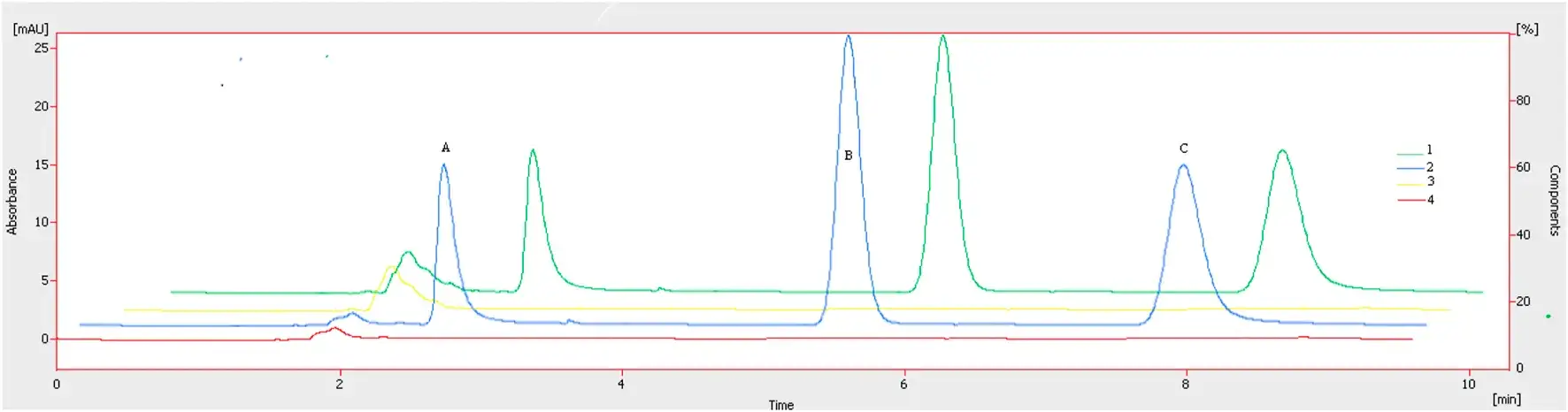
Figure 3 from Mateen et al. 2025: Representative HPLC-UV chromatograms of sorafenib, dexamethasone, and meloxicam in spiked human plasma

Integrated DMPK Solutions Built on Your HPLC-UV Method

Once your HPLC-UV method is developed and validated, we deliver end-to-end DMPK support within the same laboratory infrastructure:

Frequently Asked Questions

What is the typical LLOQ achievable with HPLC-UV in plasma?

For compounds with ε > 5,000 M-1cm-1, we routinely achieve LLOQ of 5–50 ng/mL from 100 µL plasma. Weaker chromophores typically give 50–200 ng/mL, extendable via larger injection volumes or optimized wavelength selection.

How long does custom HPLC-UV method development take?

A standard de novo method — including λmax scouting, column and mobile phase optimization, sample preparation refinement, and validation — is typically completed within 3 to 5 weeks from receipt of reference materials.

What if my compound does not have a strong UV chromophore?

We recommend transitioning to LC-MS/MS. Since both platforms operate within the same laboratory, we initiate both paths from the same reference material batch — no re-shipping or re-contracting required.

Can HPLC-UV separate parent drug from phase I and II metabolites in the same run?

Yes — we routinely achieve Rs > 2.0 between parent drug and major metabolites including glucuronide and sulfate conjugates through multi-dimensional scouting of column chemistry, mobile phase pH, and gradient slope.

Do I need a stable isotope-labeled internal standard (SIL-IS) for HPLC-UV?

No. UV detection does not suffer from matrix-induced ion suppression. A structural analog with similar UV absorption and retention behavior is sufficient, eliminating the $5,000–$15,000 cost and 4–8 week lead time of custom SIL-IS procurement.

What HPLC platforms and column chemistries do you have available?

We are equipped with Agilent Infinity II, Waters Alliance e2695 with 2998 PDA, and Shimadzu Nexera XR systems. Column portfolio spans C18, C8, HILIC, phenyl-hexyl, PGC, and ion-pair chromatography — detection includes single-wavelength UV, full-spectrum DAD, and fluorescence.

References

  1. Mateen A, Khan A, Khan I, Khalil SK, Ahmad L, Junaid M, Jehan S, Anwar MS, Faheem M, Salam A. HPLC-UV method development and validation for anticancer drug sorafenib and the co-prescribed drug dexamethasone: application to pharmacokinetic evaluation of sorafenib nanoformulations. Frontiers in Pharmacology. 2025;16:1442762. DOI: 10.3389/fphar.2025.1442762
  2. Hashim M, Ahmad L, Khan A, Faheem M. Development and validation of a reversed-phase HPLC-UV method for simultaneous determination of levosulpiride and omeprazole in human plasma: applicability for PK drug-drug interaction evaluation. PLOS ONE. 2024;19(8):e0309453. DOI: 10.1371/journal.pone.0309453
  3. International Council for Harmonisation (ICH). ICH M10 Guideline on Bioanalytical Method Validation and Study Sample Analysis. European Medicines Agency. 2022. ICH M10 Guideline

Ready to Quantify Your Lead Compound or Metabolite?

Share your matrix type, sample count, and expected range—feasibility routing will confirm whether direct quantification is fit-for-purpose or method development is recommended.

inquiry
Online Inquiry