ISO 17025–ACCREDITED LABORATORY ENVIRONMENT

Highly Polar & Lipophilic Compound Analysis

Precision LC-MS/MS quantification for extreme analytes, overcoming retention bottlenecks and carryover hurdles in complex biological matrices.

Orthogonal Separation

HILIC & PGC for "Zero Retention" polars.

Carryover Mitigation

Specialized wash protocols for "Sticky" lipophilics.

Matrix Excellence

Advanced EMR-L cleanup for high-lipid samples.

Service Overview Why Choose Us Bioanalytical Workflow Demo Results Case Study Technical Selection Sample Requirements FAQ

Service Overview

In the current landscape of early-stage drug discovery, the trend toward extreme molecular polarity is no longer an outlier—it is a central challenge for bioanalytical scientists. As medicinal chemistry pushes the boundaries of molecular space to enhance potency, target selectivity, and membrane permeability, researchers increasingly encounter "problematic" molecules that defy standard analytical conventions. Whether it is high-polarity nucleotide-based drugs mimicking natural products or ultra-lipophilic macrocycles designed for high binding affinity, these molecules present formidable hurdles for standard LC-MS/MS single drug quantification services.

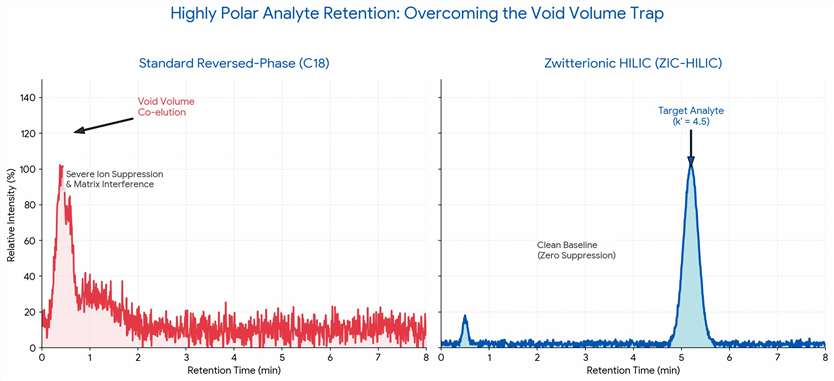
Highly polar analytes often elute within the "void volume" of traditional reversed-phase columns, co-eluting with matrix salts and endogenous interferences, which leads to catastrophic ion suppression. Conversely, strongly lipophilic molecules exhibit "sticky" physical characteristics, causing excessive system carryover, non-specific adsorption to labware, and unacceptably low extraction recoveries. Creative Proteomics DMPK provides a sophisticated analytical defense system specifically engineered for these extremes. By operating within a rigorous ISO 17025 compliant framework, we ensure that your pharmacokinetic and metabolic profiling data meets the highest standards of scientific integrity and reproducibility required for high-stakes research decisions.

Why Choose Our Challenging Compound Services

Overcoming the physicochemical limits of these molecules requires a departure from standard off-the-shelf assays. We provide de novo method development through specialized chromatographic and sample preparation pathways.

HILIC & PGC Platforms for Polar Analytes

For molecules with a LogP < -1.5, conventional reversed-phase liquid chromatography (RPLC) is often a futile exercise, as these compounds lack the hydrophobic surface area necessary to interact with C18 chains. We shift the paradigm toward Hydrophilic Interaction Liquid Chromatography (HILIC) and Porous Graphitic Carbon (PGC). HILIC utilizes a water-rich layer to retain polar analytes via partition mechanisms, providing superior peak shape and enhancing MS desolvation efficiency. PGC leverages planar geometric interactions to resolve compounds that even HILIC struggles to separate, which is vital when performing high-resolution metabolite quantification in early discovery.

Synergistic Anti-Adsorption Protocols for Lipophilic Drugs

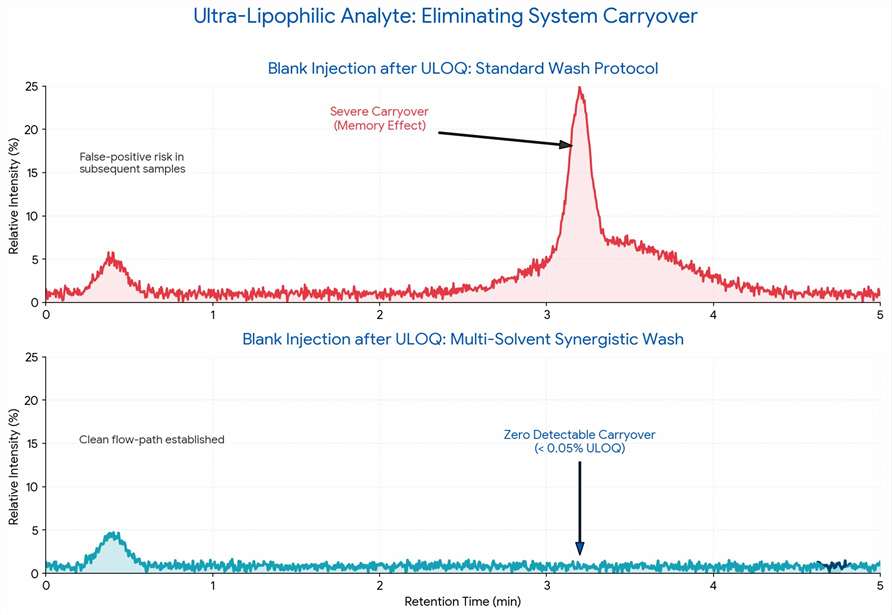
Molecules with a LogP > 5.5 introduce "flow-path management" challenges. They tend to form non-specific bindings with PEEK tubing and autosampler needles, leading to persistent carryover and false-positive results. To combat this, we have developed a Multi-Solvent Synergistic Needle Wash protocol. This system cycles through a sequence of organic modifiers with varying polarities to "scrub" the system between samples. We further implement anti-adsorptive labware and customized centrifugal strategies, ensuring that plasma and serum drug quantification for lipophilic candidates remains robust and reproducible.

Bioanalytical Workflow

Challenging Compound Bioanalytical Workflow

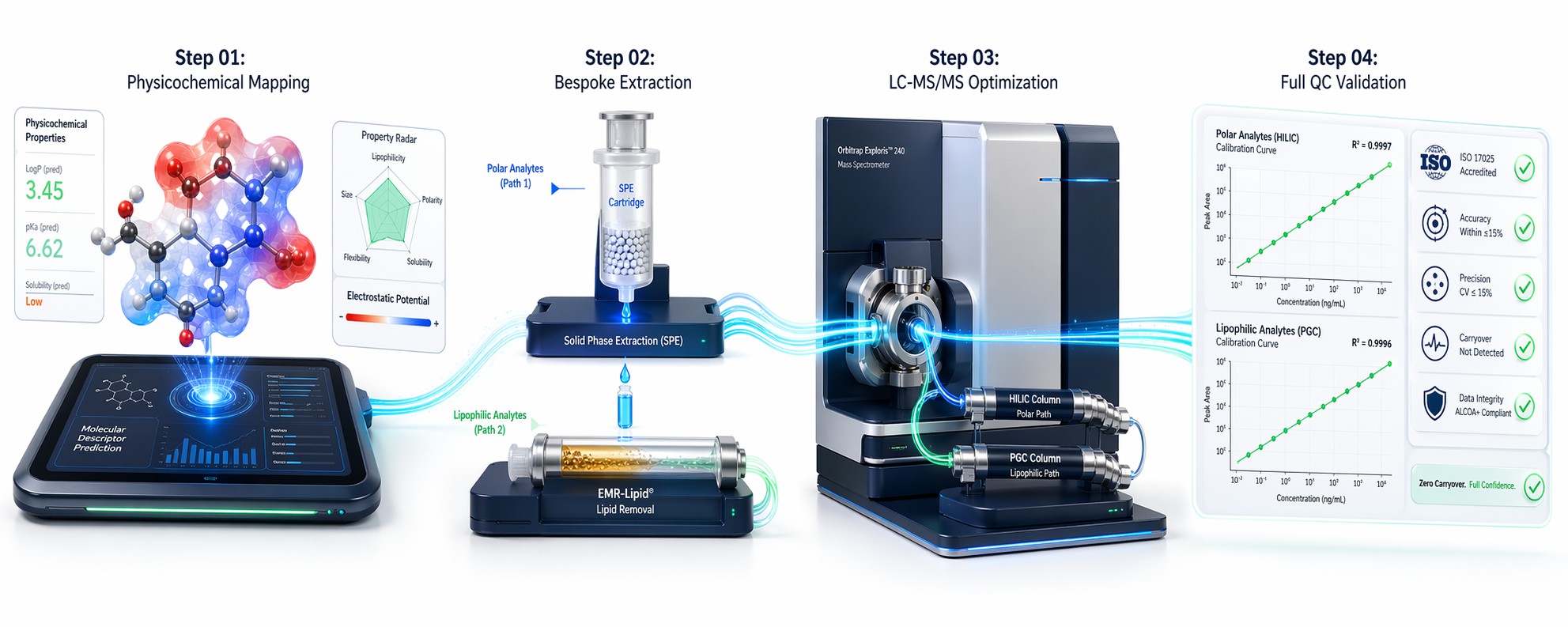
01

Physicochemical Mapping & Solubility Testing

Every project begins with a deep dive into the molecule's theoretical and empirical properties. We utilize computational tools to predict solubility boundaries across different solvent systems, preventing the molecule from crashing out of solution. This stage is critical for designing custom drug panels that require simultaneous detection of multiple analytes with divergent polarities.

02

Bespoke Extraction Design

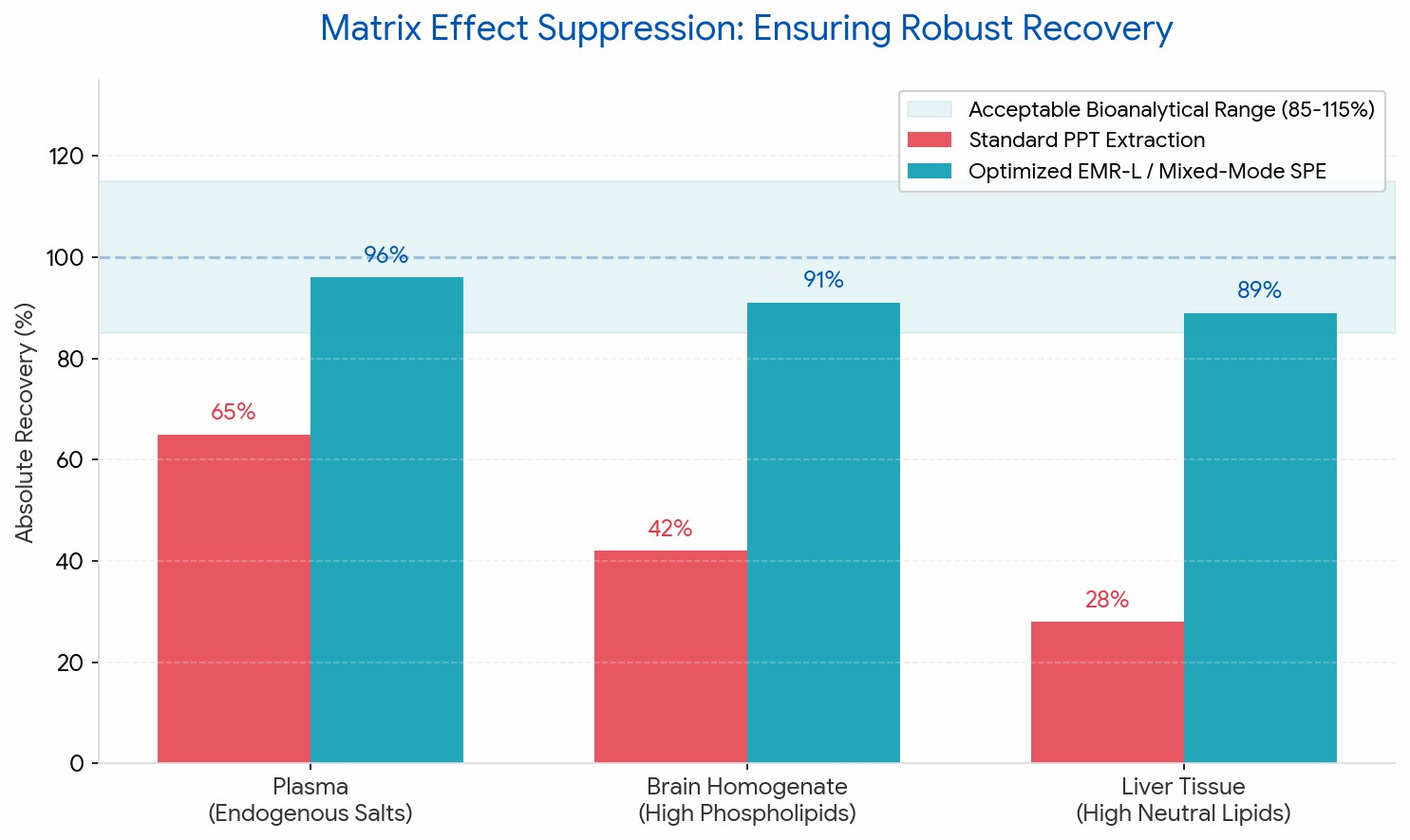
For polar analytes, we bypass standard protein precipitation in favor of Mixed-Mode Solid Phase Extraction (SPE), trapping ions while washing away suppressive salts. For lipophilic molecules, we apply Enhanced Matrix Removal (EMR-Lipid) technology. This specialized sorbent strips lipids from the matrix while preserving the target drug candidate, ensuring a clean baseline.

03

High-Precision LC-MS/MS Optimization

We tune ESI source parameters—such as sheath gas flow and auxiliary gas temperature—to balance the thermal instability often found in polar metabolites. We also optimize the collision energy for Multiple Reaction Monitoring (MRM) transitions to maximize sensitivity.

04

Full Performance Validation

Our laboratory environment requires rigorous testing of Matrix Factor (MF) and recovery stability. We perform "stress tests" for cross-contamination at the upper limits of quantitation (ULOQ) to guarantee that our carryover mitigation protocols are effective for high-throughput screening environments.

Demo Results

Our platform routinely delivers discovery-grade data with a coefficient of determination (R2) exceeding 0.99 for both polar and lipophilic calibration curves. We consistently achieve LLOQ in the pg/mL to low ng/mL range, even in challenging matrices. By applying our advanced retention and extraction protocols, we can suppress matrix interference to below 15% and establish a linear dynamic range of 3 to 4 orders of magnitude.

HILIC Retention Breakthrough
Carryover Elimination Proof
Matrix Recovery Heatmap

Case Study: HILIC-MS/MS Tracking of Polar Nucleotides in Complex Biological Matrices

Background: Highly polar nucleotides such as ATP, ADP, AMP, and related adenine metabolites are notoriously difficult to quantify using conventional reversed-phase LC methods because of weak retention, poor peak shape, and a high risk of co-elution with matrix components. In a published study by Hiefner et al. (Frontiers in Immunology, 2023), a HILIC-HPLC-MS/MS workflow was developed to solve this for simultaneous analysis across multiple biological matrices, including plasma, liver, adipose tissue, cells, and cell culture supernatants.

Method: The researchers employed an amino-phase HILIC separation coupled to tandem mass spectrometry. They optimized buffer concentration, flow rate, and solvent gradient to improve retention and peak shape for highly hydrophilic analytes. The method was validated for linearity, accuracy, precision, matrix effects, and carryover before application to biological models.

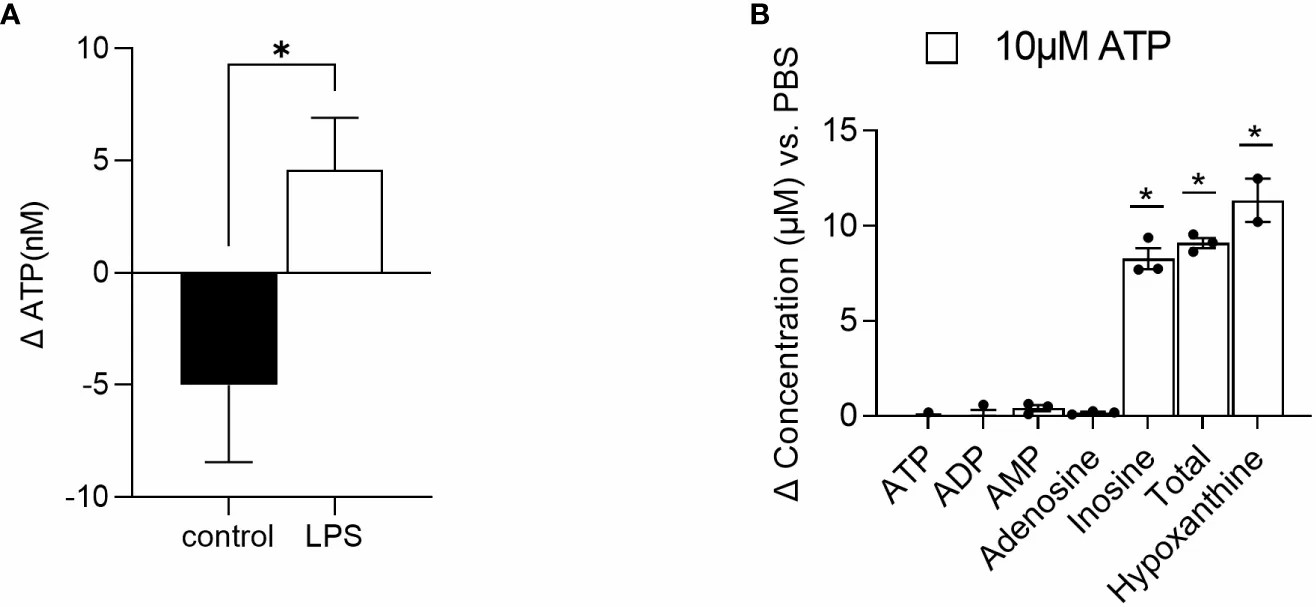
Results: The validated method enabled reliable quantification of ATP, ADP, AMP, adenosine, NAD, and NADH. In the application study (Figure 4), ATP release in LPS-stimulated RAW264.7 cells was quantified, and exogenously added ATP in human intestinal organoid supernatants was shown to degrade rapidly, with accumulation of inosine and hypoxanthine after 48 hours. These results demonstrated that HILIC-MS/MS supports robust tracking of polar nucleotide turnover in complex systems.

Conclusion: This study provides a strong literature-backed example of how HILIC-LC-MS/MS overcomes the retention and matrix-interference limitations associated with polar nucleotide analysis. It is highly relevant for research involving intracellular uptake, extracellular signaling, and metabolic pathway interrogation in challenging biological matrices.

Application of HILIC-HPLC-MS/MS for quantifying ATP release and degradation

Application of a HILIC-HPLC-MS/MS method for quantifying extracellular ATP release and nucleotide degradation products. Adapted from Hiefner et al., Frontiers in Immunology (2023), licensed under CC BY.

Technical Selection Matrix

Molecular Property Typical Examples Primary Matrix Challenge Recommended Strategy
Extreme Polarity (LogP < -1.5) Glycans, Organic Acids, Nucleotides Signal Quenching, Salt Interference HILIC + Mixed-Mode SPE
Strong Lipophilicity (LogP > 5.5) Macrocycles, Steroids, Lipids Severe Carryover, Protein Adsorption EMR-L Cleanup + Multi-Solvent Wash
Multicharged Zwitterions Aminoglycosides, Peptidomimetics Peak Tailing, Recovery Loss Mixed-Mode LC + Silanized Labware

Supported Matrices and Sample Requirements

Matrix Type Minimum Volume/Amount Collection & Protection Technical Note
Plasma / Serum 150 µL EDTA-K2 Anticoagulant, Ice bath Monitor hemolysis strictly for polars.
Tissue (Liver, Muscle, etc.) 100 mg Flash-frozen, Dry ice shipping Add antioxidants for lipophilic compounds.
Cell Lysates 1 x 10^6 cells Dry ice shipping Use MS-compatible lysis buffers.

Frequently Asked Questions

Why is HILIC more sensitive for polar molecules than reversed-phase?

HILIC uses high percentages of organic mobile phases, facilitating efficient solvent evaporation (desolvation) in the ESI source, resulting in stronger ion current signals compared to aqueous-heavy reversed-phase environments.

How long does it take to develop a HILIC or PGC method from scratch for a novel polar compound?

A standard de novo method — including column screening (amide, diol, zwitterionic, PGC), mobile phase optimization, and performance verification — is typically completed within two to three weeks from receipt of reference material. Extremely small or multicharged analytes requiring PGC or mixed-mode approaches may extend to four weeks. For compounds entering regulated studies, method validation can follow immediately without re-development.

What if my compound is both highly polar and chemically unstable — can you handle both challenges at once?

Yes. We combine HILIC/PGC retention strategies with the stabilization protocols from our chemically unstable compound analysis service — pH-controlled extraction, antioxidant addition, sub-ambient autosampler temperature (4°C), and light-protected handling — in a single integrated method. The key is to screen stabilizers under HILIC-compatible conditions (high organic, volatile buffers) to avoid compromising retention.

Ready to Quantify Your Lead Compound or Metabolite?

Share your matrix type, sample count, and expected range—feasibility routing will confirm whether direct quantification is fit-for-purpose or method development is recommended.

inquiry
Online Inquiry