ISO 17025–ACCREDITED LABORATORY ENVIRONMENT

Method Validation — Full, Partial, and Cross-Validation Services

Formal method validation is the regulatory gate between a working assay and a submission-ready dataset. We perform full-scope validation, targeted partial re-validation, or cross-validation for data alignment between laboratories — without requiring method re-development. Our laboratory operates within an ISO 17025-aligned quality system; every validation report is structured for direct inclusion in regulatory submissions.

Full-Scope Validation

All ten core parameters evaluated across three independent accuracy and precision runs with calibration standards and QC replicates at four levels.

Targeted Partial Validation

Scope limited to parameters affected by your method modification — new matrix, new species, or changed sample volume.

Cross-Validation Between Methods

Two-method comparison with ≥30 incurred samples; Bland-Altman analysis and formal interchangeability conclusion included.

Decision Framework Full Validation Partial Validation Cross-Validation Performance Data Sample Requirements

When Does Your Method Need Validation?

Full, Partial, or Cross — A Decision Framework

Full validation applies when a bioanalytical method is established for the first time for its intended use — typically a new chemical entity entering regulated studies — and evaluates all core parameters.

Partial validation applies when a previously fully validated method undergoes a defined modification (new matrix, new species, changed anticoagulant, reduced sample volume). The scope is limited to parameters affected by the change.

Cross-validation compares two methods — typically required when transitioning between CROs — to establish data interchangeability.

If your method was established through our custom LC-MS/MS method development service, the transition from development to validation is seamless — method conditions transfer directly into the validation run design.

Full Method Validation

Core Parameters We Evaluate

A comprehensive validation evaluates ten core parameters — selectivity, calibration curve, accuracy, precision, matrix effect, recovery, stability, dilution integrity, carryover, and sensitivity (LLOQ). The parameter reference table in Section 5 details each with its acceptance criterion and our evaluation method.

Validation Run Structure

A typical full validation includes three accuracy and precision runs with calibration standards and QC replicates at four levels, plus selectivity from six matrix sources. Stability, matrix effect, and recovery are evaluated in separate batches. The complete validation spans approximately two to three weeks, with the report delivered within two weeks of the final injection.
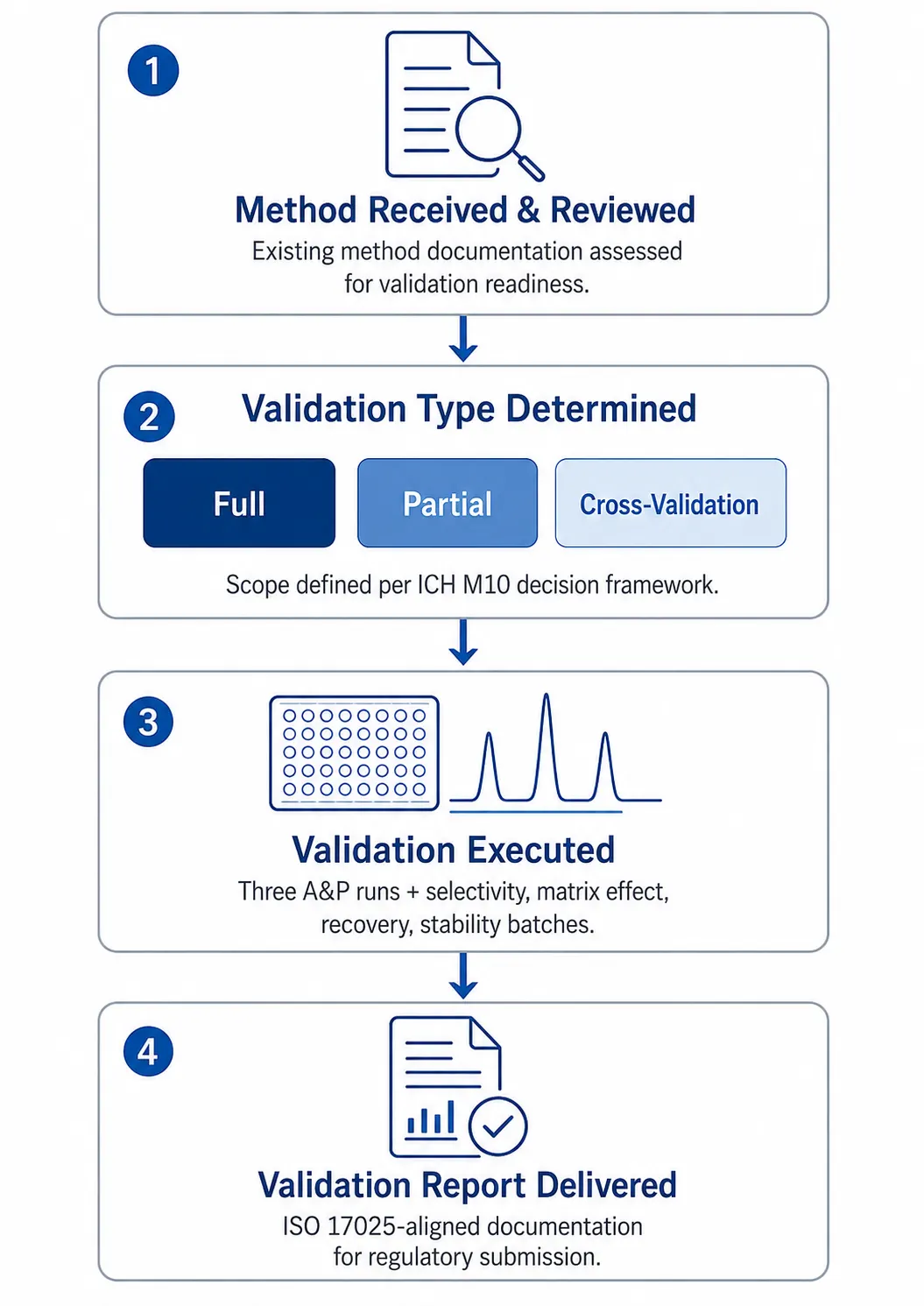
Three-tier method validation workflow: Method Received → Assessment (Full/Partial/Cross) → Validation Execution → Report Generation

Partial Validation

When Partial Validation Applies

Partial validation evaluates only the parameters affected by a specific method modification. The guiding principle is proportionality — validate what changed.

Common Partial Validation Scenarios

New biological matrix. Extending a validated plasma method to tissue homogenate requires selectivity (≥6 sources), matrix effect (6 lots), recovery, and accuracy/precision at relevant QC levels. Calibration range and stability carry forward from the primary validation.

New species. Validating a rat method for dog or mouse requires re-establishing selectivity and matrix effect — phospholipid profiles differ between species. We verify calibration curve performance with one accuracy and precision run.

Reduced sample volume. If a validated method uses 100 µL and a pediatric program requires 25 µL, we evaluate LLOQ at the reduced volume and confirm recovery and matrix effect remain acceptable. Relevant for tissue and cell lysate quantification where sample mass is limited.

Other modifications. Changing anticoagulant requires matrix effect comparison; adding a freeze-thaw cycle requires stability verification; switching extraction chemistry requires full accuracy/precision, recovery, and matrix effect re-evaluation.

Cross-Validation

When Two Methods Must Agree

Cross-validation is required when data from two methods — or the same method in two laboratories — must be pooled for PK analysis. Without it, a 15% systematic bias can shift AUC more than individual variability in a crossover study.

How We Run a Cross-Validation

We use the two-method comparison approach. For incurred samples: ≥30 study samples analyzed by both methods — acceptance requires ≥67% of paired results within ±20% of the mean. For spiked QC: low, mid, high levels split between methods; bias within ±15% (±20% at LLOQ) supports interchangeability. The report includes Bland-Altman plots and a formal interchangeability conclusion.

Validation Parameters and Acceptance Criteria

Parameter What It Tests Acceptance Criterion How We Evaluate It
Selectivity Absence of interference at analyte/IS retention time No significant interference from ≥ 6 matrix lots Blank matrix from 6+ individual donors, screened at LLOQ
Calibration Curve Relationship between concentration and instrument response ≥ 6 non-zero standards; ≥ 75% of back-calculated values within ±15% (±20% at LLOQ) Weighted (1/x²) linear regression; correlation coefficient reported
Accuracy Closeness of measured value to true concentration value Within ±15% of nominal (±20% at LLOQ) QC samples at 4 levels, ≥ 3 independent runs
Precision Reproducibility of repeated measurements CV ≤ 15% (≤ 20% at LLOQ) Intra-run and inter-run CV from QC replicates
Matrix Effect Influence of matrix components on ionization IS-normalized MF consistent across lots (CV ≤ 15%) Post-extraction spike vs. neat solution; 6+ matrix lots
Recovery Extraction procedure efficiency Consistent across concentration range Pre-extraction vs. post-extraction spike at 3 QC levels
Stability Analyte integrity under storage and handling Mean concentration within ±15% of nominal Bench-top, freeze-thaw (3 cycles), short-term, long-term, autosampler
Dilution Integrity Accuracy after dilution of above-ULOQ samples Accuracy within ±15%; CV ≤ 15% QC above ULOQ diluted with blank matrix, replicate analysis
Carryover Signal in blank after high-concentration sample ≤ 20% of LLOQ response Blank injected immediately after ULOQ standard
Sensitivity (LLOQ) Lowest quantifiable concentration with acceptable A&P Accuracy ±20%, CV ≤ 20% Lowest standard meeting A&P criteria, S/N ≥ 5

Representative Validation Performance

Aggregate outcomes from methods validated in our laboratory (client-confidentiality preserved).

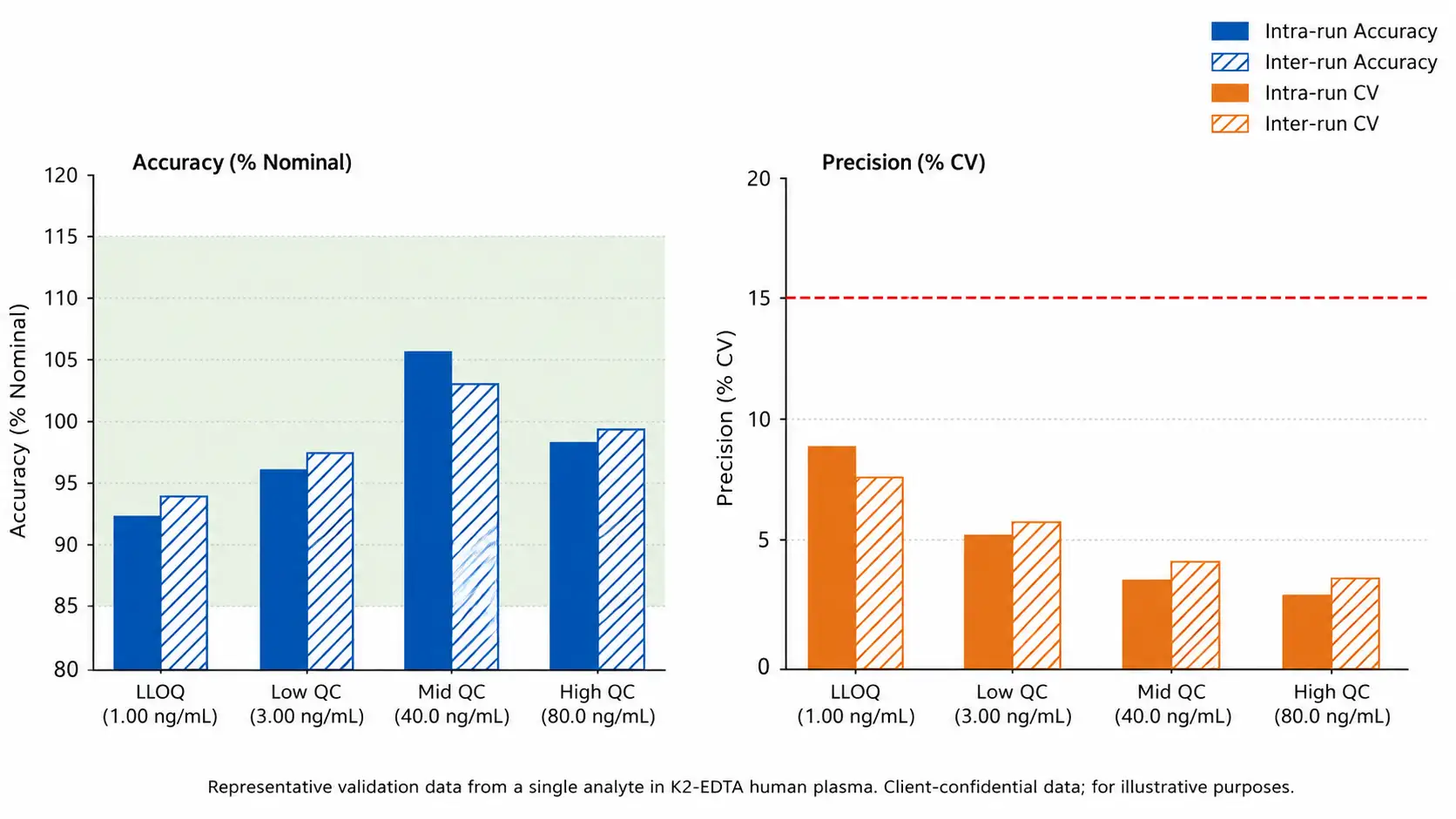
Accuracy/precision across four QC levels (LLOQ: 1.00 ng/mL; Low: 3.00; Mid: 40.0; High: 80.0 ng/mL, three runs): intra-run accuracy 92.3–105.7%, inter-run 94.1–103.2%; intra-run CV 2.8–8.9%, inter-run CV 4.1–7.6%. Calibration curve 1.00–100 ng/mL (eight standards): mean r = 0.9987; all back-calculated values within ±10.3%. Matrix effect (six K2-EDTA lots): IS-normalized MF 0.96–1.05 (CV 4.7%). Mean recovery: 88.6%, 91.2%, 89.7% at low, mid, high QC. Stability confirmed under bench-top (6 h, 96.8–103.2%), three freeze-thaw cycles (95.1–101.9%), short-term (7 days, 97.3–104.5%), and autosampler (48 h, 98.6–102.8%).

Representative validation performance: intra-day and inter-day accuracy (% nominal) and precision (% CV) across 4 QC levels for a validated bioanalytical assay

What to Send Us

To initiate a method validation project, we require reference material (≥ 5 mg API, ≥ 95% purity), internal standard (SIL-IS preferred, ≥ 1 mg), blank biological matrix (10–20 mL, same species/anticoagulant as study samples), and existing method documentation.

If your method was developed in our laboratory through sample preparation method development, documentation is on file. For externally developed methods, we review the provided materials and contact you if clarification is needed.

Ship reference standards and matrix on dry ice via overnight courier. For validated methods proceeding to sample analysis, our single drug quantification services accept the validated method directly without re-optimization.

Frequently Asked Questions

What is the difference between full, partial, and cross-validation?

Full validation evaluates the full parameter set for a new method. Partial validation re-evaluates only the parameters affected by a specific modification. Cross-validation compares two methods or laboratories to establish data interchangeability.

Can you validate a method that was developed at another laboratory?

Yes. We accept externally developed methods — in your lab or at another CRO. We review the documentation and execute the validation as a standalone service.

What validation parameters are evaluated in a comprehensive bioanalytical method validation?

Selectivity, calibration curve (linearity and range), accuracy, precision, matrix effect, recovery, stability (bench-top, freeze-thaw, short-term, long-term, autosampler), dilution integrity, carryover, and sensitivity (LLOQ).

How many analytical runs are required for a full validation?

A minimum of three independent accuracy and precision runs with calibration standards and QC replicates at four levels. Stability, matrix effect, and recovery are evaluated in separate batches — typically two to three weeks total.

What happens if a validation run does not meet acceptance criteria?

We conduct a root-cause investigation before repeating. Common causes include degraded reference standard, pipetting error, or matrix interference — documented transparently in the validation report.

Do I need a stable isotope-labeled internal standard for validation?

SIL-IS is the gold standard for correcting matrix effects. When unavailable — common for novel compounds — we evaluate a structural analog and document the scientific justification, with additional scrutiny on matrix effect assessment.

How is cross-validation between two laboratories performed?

≥30 incurred study samples (or spiked QC at low, mid, high) analyzed by both methods. Acceptance: ≥67% of paired results within ±20% of the mean. Report includes Bland-Altman plot and formal interchangeability conclusion.

References

  1. International Council for Harmonisation (ICH). ICH M10 Guideline on Bioanalytical Method Validation and Study Sample Analysis. 2022. ICH M10 Guideline
  2. European Medicines Agency. Guideline on Bioanalytical Method Validation. 2011 (revised 2023). EMA Guideline

Ready to Quantify Your Lead Compound or Metabolite?

Share your matrix type, sample count, and expected range—feasibility routing will confirm whether direct quantification is fit-for-purpose or method development is recommended.

inquiry
Online Inquiry