ISO 17025–ACCREDITED LABORATORY ENVIRONMENT

Simultaneous Parent Metabolite Quantification Service

Simultaneous quantification of a parent drug and its metabolites in a single LC-MS/MS run requires more than simple multi-analyte detection. It requires a workflow that can manage large concentration gaps, polarity mismatch, matrix interference, and metabolite instability within one validated method.

We provide unified quantitative analysis for parent compounds and biotransformation products, helping DMPK teams generate cleaner PK profiles, stronger exposure comparisons, and more reliable metabolite-to-parent ratio data.

Wide Dynamic Range

Quantify abundant parent compounds and trace metabolites in one run.

Reliable M/P Ratios

Generate directly comparable exposure data from the same aliquot.

Recovery Across Polarity

Maintain extraction performance for both lipophilic and polar analytes.

PK Interpretation Physiochemical Conflicts Workflow & QC Demo Results Sample Requirements Bioanalytical Strategy Case Study FAQ

Why Simultaneous Monitoring Changes Your PK Interpretation

In early discovery and preclinical development, measuring the parent drug alone is often not enough. Many compounds form active, toxic, or exposure-relevant metabolites that directly affect efficacy and safety interpretation. If parent and metabolite are quantified in separate assays, the parent-metabolite ratio, or M/P ratio, becomes less reliable and less useful for PK decision-making.

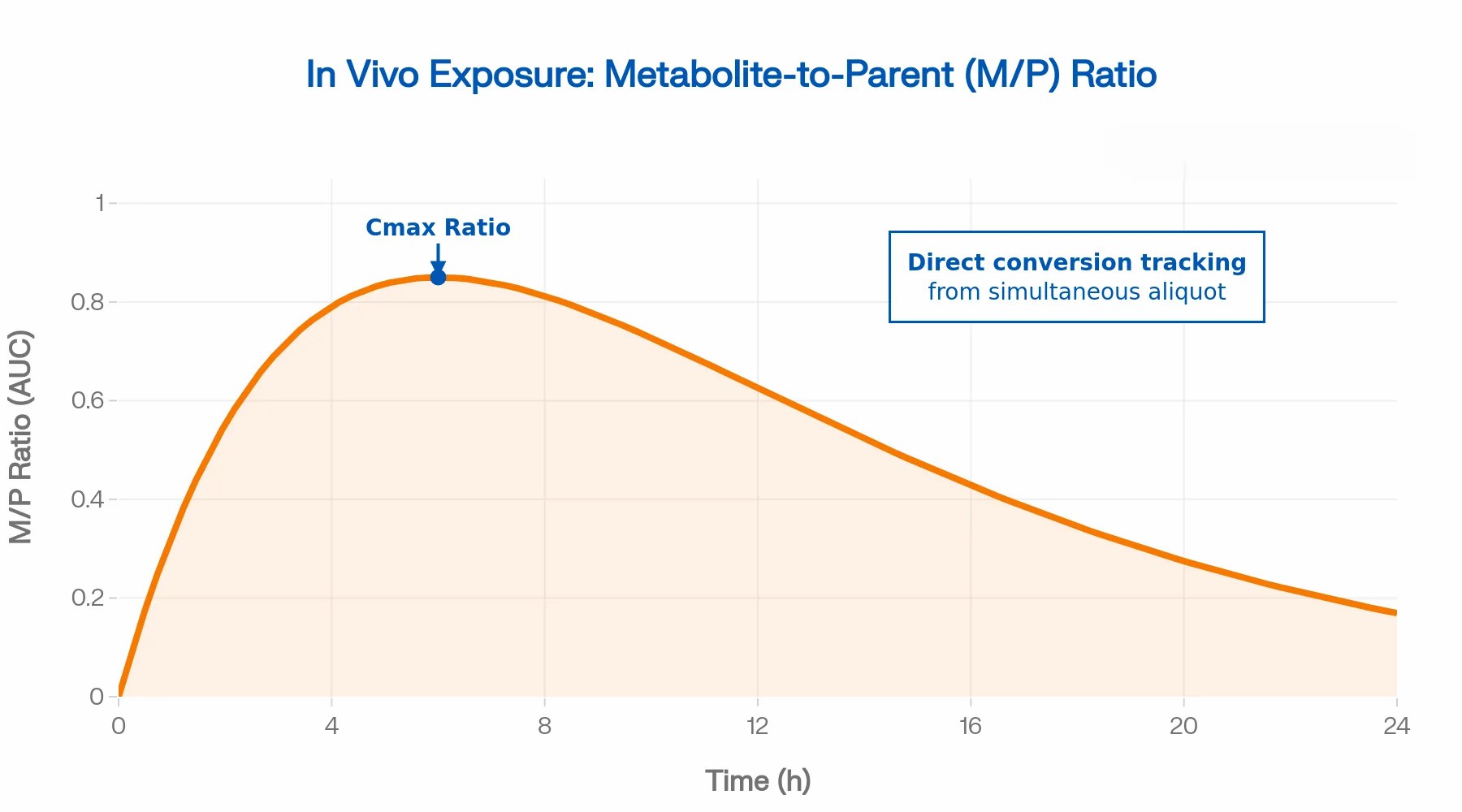
When both analytes are measured from the same biological sample at the same time point, the resulting ratio reflects the real balance between systemic parent exposure and metabolic conversion. A high M/P ratio may indicate that downstream pharmacology is being driven substantially by the metabolite. A low M/P ratio in a prodrug program may indicate incomplete activation. That is why simultaneous quantification is often built into our preclinical PK panels, especially when teams need parent exposure, metabolite burden, and time-matched PK interpretation in one dataset.

Simultaneous analysis also improves comparability by removing batch-to-batch and aliquot-to-aliquot variation. Parent and metabolite data generated from one extraction batch are aligned from the start, which makes downstream AUC comparison, conversion assessment, and candidate ranking more dependable. For sponsors expanding from one analyte pair to a broader screening design, the same logic also supports customized multi-analyte panel development and custom drug panels.

Resolving Parent-Metabolite Physiochemical Conflicts

The hardest part of simultaneous parent-metabolite analysis is not simply instrument sensitivity. It is the fact that structurally related molecules often behave very differently during extraction, chromatography, and ionization.

Conflict I: The Concentration Gap

In many in vivo studies, the parent compound is present at high nanogram or microgram levels, while metabolites may only appear at trace concentrations. A single LC-MS/MS method must therefore cover a wide linear range without overloading the detector for the parent or losing sensitivity for the metabolite. We address this through transition selection, dwell-time optimization, and response balancing inside a purpose-built custom LC-MS/MS method development workflow.

Conflict II: Polarity Mismatch

Parent compounds are often lipophilic, while Phase I and Phase II metabolites—especially glucuronides, sulfates, or oxidized products—can be significantly more polar. A precipitation method that works well for the parent may under-recover the metabolite. To avoid that tradeoff, we design hybrid extraction strategies that combine matrix-specific precipitation, liquid-liquid extraction, or SPE cleanup as needed. This same philosophy is central to our method development and validation strategies and broader custom drug panels.

Conflict III: Instability and In-Source Conversion

Some metabolites are chemically labile and may degrade during storage, preparation, or ionization. Others can partially convert back to the parent compound in the source, creating false parent signal. For these analytes, chromatographic separation becomes a core control point rather than a cosmetic improvement. Our team engineers retention and resolution specifically to separate unstable metabolites from parent peaks before they reach the ion source, reducing the risk of artifactual quantification.

Analytical Workflow with QC Checkpoints

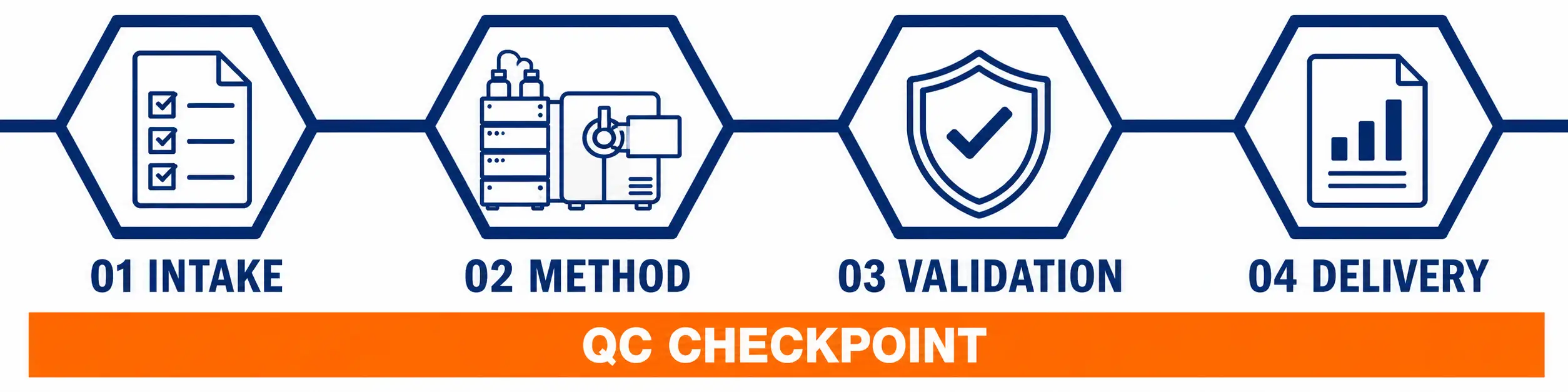
Our simultaneous quantification workflow is built around the analytical relationship between the parent molecule and its metabolite set, rather than forcing both into a generic multi-analyte template.

  • Biotransformation Review: We assess the parent structure, known or predicted metabolites, and expected matrix behavior before method design.
  • Internal Standard Planning: Wherever possible, we assign analyte-specific stable isotope-labeled internal standards to the parent and key metabolites.
  • Extraction Optimization: Sample preparation methods (PPT, LLE, SPE workflows), solvent composition, and reconstitution conditions are tuned until both parent and metabolite recoveries meet expectations.
  • Chromatographic Separation: Column chemistry and gradient design are optimized to separate parent and metabolite peaks, especially where instability or in-source conversion is a risk.
  • MRM Validation: Each transition is evaluated for selectivity, response, interference risk, and linearity across the intended range.
  • Matrix Effect Testing: Post-extraction experiments confirm that ion suppression does not distort low-level metabolite channels in high-parent samples.
  • PK Data Interpretation: Final deliverables can include parent concentration, metabolite concentration, M/P ratio, and exposure-level interpretation.

Typical QC Checkpoints Include

  • Recovery consistency across analytes.
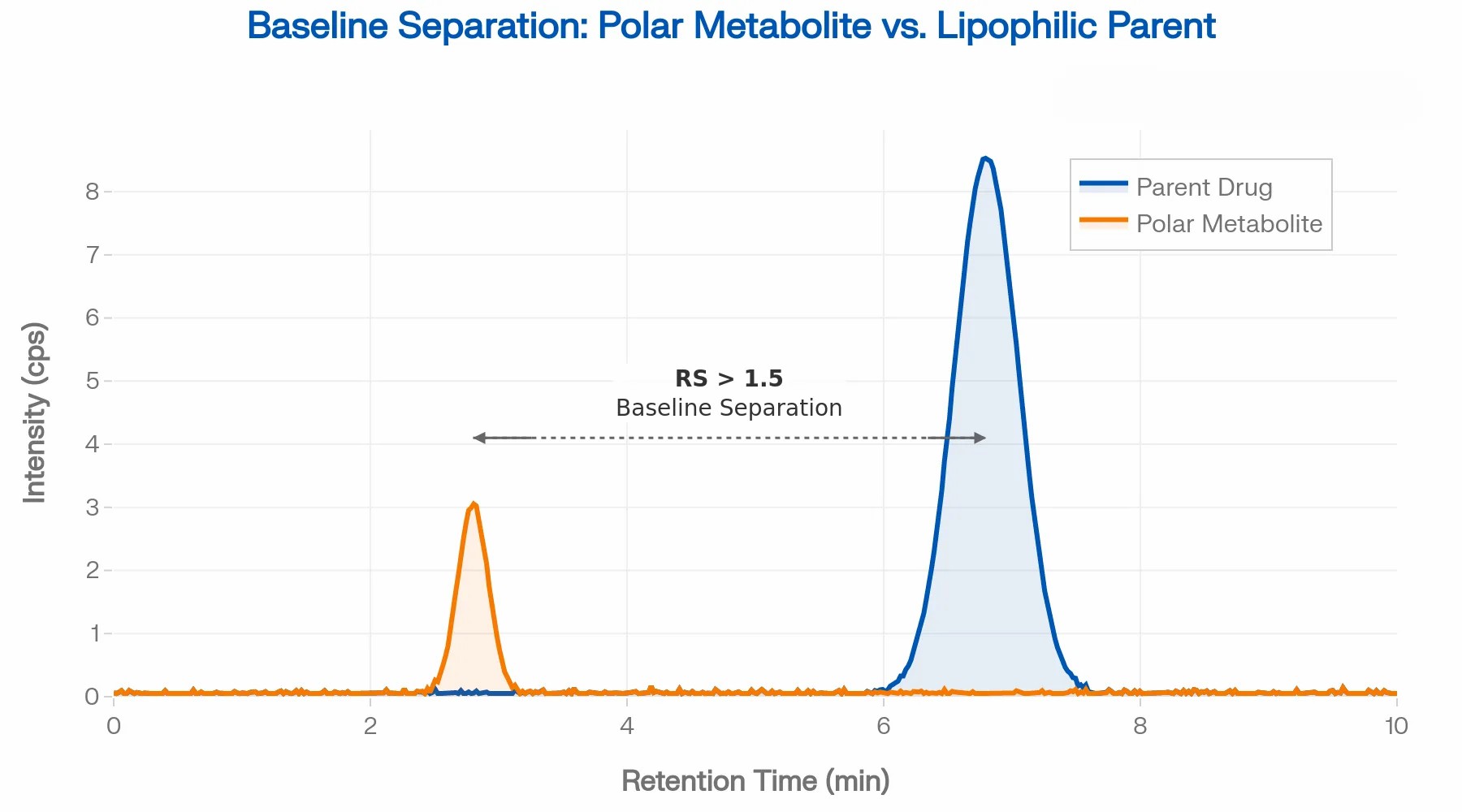
  • Baseline separation for critical parent/metabolite pairs.
  • Stable calibration performance across broad concentration ranges.
  • Precision and accuracy acceptance in relevant matrices.

Horizontal workflow diagram for simultaneous parent-metabolite LC-MS/MS quantification with QC checkpoints

This workflow can serve as a focused parent-metabolite assay or scale into broader custom drug panels when several metabolites, co-dosed agents, or pathway-relevant compounds must be measured together.

Demo Results: Proof of Simultaneous Quantification

The value of a simultaneous method should be visible in the data, not just described in the method summary. For that reason, our reporting package is designed to show both analytical integrity and PK usefulness.

Typical Outputs Include

  • Overlay chromatograms showing parent and metabolite peak separation.
  • Calibration curves demonstrating analyte-specific linearity across high and low concentration bands.
  • Recovery comparison plots confirming that extraction does not favor one polarity class over another.
  • Accuracy and precision tables reported independently for parent and metabolite.
  • M/P ratio trend plots showing how metabolic conversion evolves across PK sampling points.

These outputs help study teams judge whether a metabolite signal is biologically meaningful, whether exposure shifts over time, and whether further preclinical PK panel expansion or follow-up custom LC-MS/MS method development is warranted.

Representative LC-MS/MS chromatogram and metabolite-to-parent ratio trend plot

Sample Requirements & Preservation Guidelines

Because many metabolites are less stable than their parent compounds, pre-analytical handling is often the difference between a valid assay and a misleading result. Sample preservation strategy should therefore be aligned with the expected metabolite class before collection begins. We routinely manage stability through rigorous in vitro compound stability and forced degradation profiling.

Matrix Minimum Volume / Amount Shipping Condition Preservation Note
Plasma / Serum 50–100 µL Dry Ice (-80°C) Add esterase inhibitors when ester-linked metabolites are expected; acidification may be needed for unstable acyl glucuronides.
Tissue Homogenates 50 mg Dry Ice (-80°C) Flash freeze immediately after collection and avoid repeat freeze-thaw cycles.
Cell Lysates 1 × 10⁶ cells Dry Ice (-80°C) Specify lysis buffer composition and avoid incompatible detergents such as SDS when possible.
Urine / Bile 100 µL Dry Ice (-80°C) pH control may be recommended to reduce hydrolysis of phase II conjugates.

These considerations are especially important for intracellular studies and complex matrices such as LC-MS/MS drug quantification in tissue and cell lysates. They also create natural continuity with related complex biological matrices analysis and LC-MS/MS plasma & serum drug quantification services.

Simultaneous vs. Sequential: Choosing the Right Bioanalytical Strategy

Not every project requires a simultaneous assay, but many discovery-stage programs benefit from one.

Evaluation Dimension Sequential Single-Analyte Assays Simultaneous Parent–Metabolite Panel
M/P Ratio Accuracy Derived indirectly from separate runs. Calculated directly from the same aliquot and time point.
Sample Volume Higher, because each assay consumes separate material. Lower, because one preparation supports both readouts.
Inter-Assay Variability More vulnerable to batch effects. Reduced through shared extraction and run conditions.
Method Complexity Simpler per analyte. More complex to develop, but richer in output.
Best Fit Late-stage isolated validation or narrow single-analyte needs. Early PK screening, high-resolution metabolite quantification, prodrug activation, and mechanism-focused studies.

As a rule, simultaneous quantification is the better choice when sample volume is limited, when the metabolite contributes to pharmacology, or when the M/P ratio will influence go/no-go decisions. A sequential strategy may still be appropriate when regulatory isolation of methods is the primary requirement, but for early discovery programs a linked preclinical PK panel or a tailored custom drug panel usually provides more decision value.

Case Study (Research Summary)

Simultaneous Intracellular Quantification of Abemaciclib and EZH2 Inhibitors

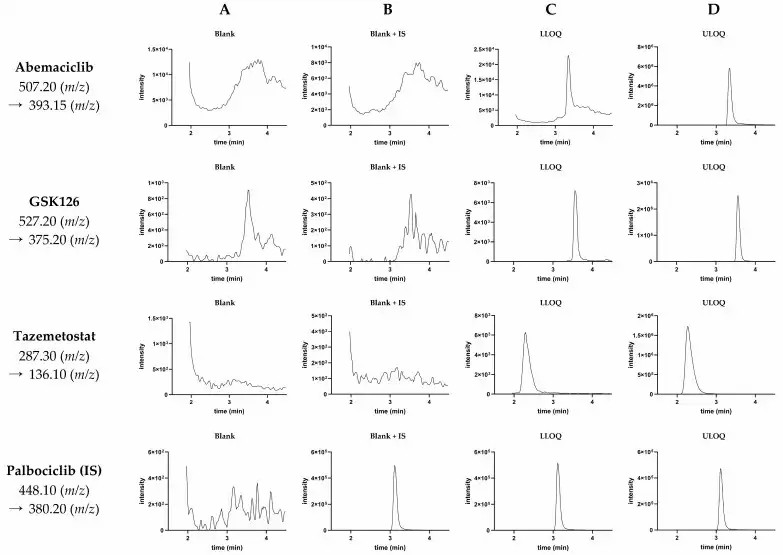
A published validation study described an LC-MS/MS method for the simultaneous intracellular quantification of abemaciclib, GSK126, and tazemetostat in cell lysates, with validation performed in accordance with ICH M10 guidance. The method used protein precipitation sample preparation, reversed-phase chromatographic separation, and positive-mode MRM detection, with a total runtime of 7.5 minutes.

According to the paper, all validation acceptance criteria were met, the calibration curves were linear with R2 > 0.99, and the assay showed high and reproducible recovery for the analytes tested. The same study then applied the validated method to glioblastoma cell lines and reported increased intracellular accumulation of tazemetostat in the presence of abemaciclib in both GBM models examined.

As a real-world example, this case shows why simultaneous workflows can deliver a more coherent intracellular exposure picture than separate single-analyte assays, particularly when transport effects or combination-treatment interactions are under investigation.

Source Paper: Scientific Reports (2024) 14:11018, doi:10.1038/s41598-024-61522-4

Case Study Data

Frequently Asked Questions

How do you handle very high parent levels and trace metabolites in the same assay?

We adjust transition selection, dwell time, and instrument response so the parent signal stays within range while the metabolite channel remains sensitive enough for trace quantification.

Can unstable metabolites still be measured accurately?

Yes, but only if stability risk is addressed during sample handling, chromatographic design, and source-level interference control. In many cases, separation strategy is the key factor. For further confirmation, we often perform bench-top and processed sample stability studies.

Why is simultaneous analysis better for M/P ratio calculation?

Because the ratio is only truly comparable when both values come from the same sample aliquot, prepared together and analyzed in the same run. For highly specific characterization, we also refer clients to our advanced drug metabolite identification (MetID) services.

Ready to Quantify Your Lead Compound or Metabolite?

Share your matrix type, sample count, and expected range—feasibility routing will confirm whether direct quantification is fit-for-purpose or method development is recommended.

inquiry
Online Inquiry