ISO 17025–ACCREDITED LABORATORY ENVIRONMENT

LC-MS/MS Single Drug Quantification Services

Precise quantification of single active pharmaceutical ingredients (APIs) and their metabolites is critical for early pharmacokinetics. Our platform delivers high-throughput screening and de novo method development, overcoming severe matrix interference to provide reliable, high-sensitivity analytical data for your preclinical research.

High-Sensitivity Detection

MRM mode tracking capable of robust pg/mL range quantification.

De Novo Method Development

Custom extraction and mass transition optimization for novel molecules.

Strict QC Checkpoints

Verified extraction recovery, zero carryover, and batch-to-batch consistency.

High-Res Bioanalysis Workflow & QC Supported Matrices Demo Results Technology Selection Sample Requirements Case Studies FAQ

High-Resolution Bioanalysis for Early Drug Discovery

In the landscape of early-stage drug discovery, obtaining accurate pharmacokinetic (PK) profiles hinges on the precise measurement of target molecules. Our LC-MS/MS single drug quantification services are specifically engineered to support rigorous scientific research. Whether you are screening hundreds of candidate compounds or require in-depth evaluation of a complex novel molecule, our laboratory leverages high-resolution mass spectrometry to ensure uncompromising sensitivity and specificity.

End-to-End Quantification Workflow & QC Checkpoints

To ensure batch-to-batch consistency and high data reliability, our analytical workflow integrates strict quality control (QC) checkpoints at every phase of the quantification process.

Step 1: Advanced Sample Preparation & Extraction

Process: Protein precipitation, SPE, or LLE tailored to the specific compound.

QC Checkpoint: Matrix effect assessment and extraction recovery evaluation.

Step 2: De Novo Method Development

Process: Accessing pre-validated assay libraries or designing custom mass transitions.

QC Checkpoint: Verification of analytical specificity and minimization of cross-talk.

Step 3: High-Throughput LC-MS/MS Analysis

Process: Utilization of MRM mode for high-specificity tracking against background noise.

QC Checkpoint: Calibration curve linearity (R² validation) and stable internal standard tracking.

Step 4: Data Interpretation & Reporting

Process: Integration of chromatographic peaks and calculation of final concentrations.

QC Checkpoint: Intra-batch and inter-batch precision and accuracy verification.

Comprehensive Biological Matrices Supported

Small molecule distribution and clearance can vary drastically depending on the biological environment. We have optimized our LC-MS/MS protocols to extract and quantify active compounds across a wide array of matrices. Explore our targeted matrix approaches below:

Our targeted approaches include plasma and serum drug quantification for systemic circulation studies, tissue and cell lysate quantification for localized distribution profiling, and metabolite quantification to map compound biotransformation pathways.

Plasma & Serum

Targeted quantification specifically optimized for systemic circulation studies and standard PK profiling.

Tissue & Cell Lysate

Specialized extraction overcoming severe matrix effects for localized distribution and intracellular uptake.

Metabolite Quantification

Advanced methodologies designed to accurately map compound biotransformation pathways and clearance.

Typical Analytical Deliverables & Demo Results

Transparency in data delivery is central to our service. Researchers receive a comprehensive analytical package designed to integrate seamlessly into internal PK models and scientific reports.

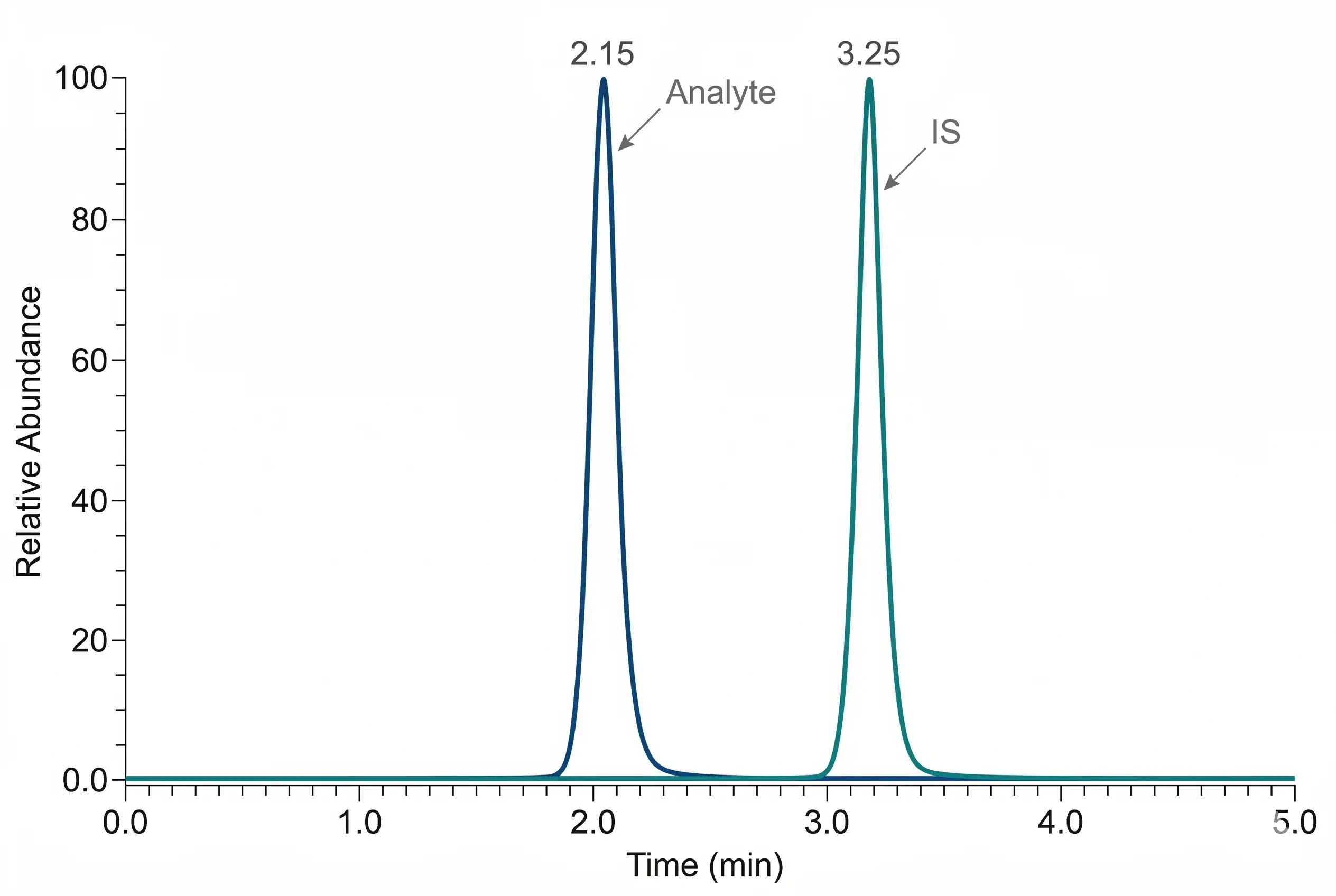
Typical LC-MS/MS MRM chromatogram overlay demonstrating high signal-to-noise ratio and baseline separation of the analyte and internal standard.

  • MRM Chromatograms: Visual confirmation of peak separation and absence of matrix interference.
  • Calibration Curves: Detailed graphs displaying the broad linear dynamic range and corresponding regression equations.
  • Accuracy & Precision Reports: Tabulated data demonstrating intra- and inter-assay reproducibility.
  • Carryover Assessment: Proof of zero cross-contamination between high and low concentration injections.

Technology Selection: Why LC-MS/MS for Single Drug Quantification?

Selecting the appropriate analytical platform is crucial when dealing with limited sample volumes or trace-level concentrations.

Analytical Dimension LC-MS/MS (Our Platform) Conventional HPLC-UV
Specificity Exceptional (Monitoring specific precursor-to-product ion transitions) Moderate (Relies solely on retention time and UV absorbance)
Sensitivity pg/mL to low ng/mL range High ng/mL to µg/mL range
Throughput Capability High (Short run times with multiplexing potential) Low (Longer chromatographic separation required)
Matrix Independence High (Isotope-labeled internal standards correct for matrix effects) Low (Highly susceptible to co-eluting biological impurities)

Selection Strategy: We strongly advise LC-MS/MS methodologies when target compound concentrations are expected to be extremely low, or when working with highly complex matrices where conventional UV detection cannot separate the analyte from background noise.

Sample Submission Requirements

Matrix Type Minimum Volume / Weight Preparation Notes Shipping Condition
Plasma / Serum 50-100 µL Avoid hemolysis; separate promptly after collection. Dry Ice (-70°C)
Tissue Samples 50-100 mg Rinse with cold PBS to remove excess blood before snap-freezing. Dry Ice (-70°C)
Cell Lysates 1x10^6 cells Provide clear details on the lysis buffer utilized. Dry Ice (-70°C)

Case Studies in Method Development

Background

Quantifying trace levels of novel small molecules in plasma often presents significant challenges due to severe ion suppression from endogenous phospholipids.

Methods

A de novo LC-MS/MS method is established utilizing a robust solid-phase extraction (SPE) protocol to clean up the plasma matrix. Chromatographic separation is optimized on a C18 column, followed by positive electrospray ionization (ESI+) and MRM detection.

Results & Conclusion

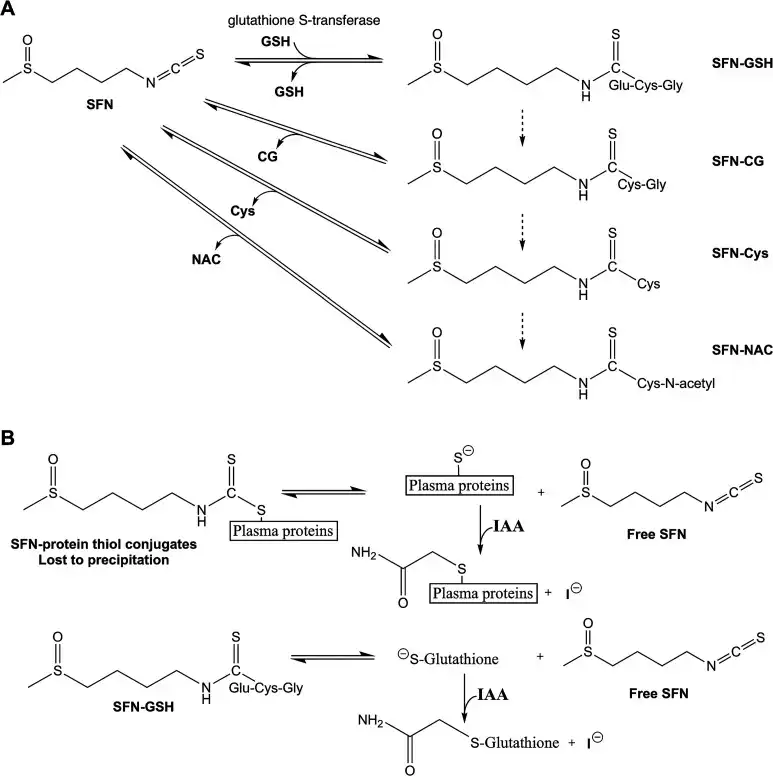
This approach effectively eliminates matrix effects, achieving a reliable lower limit of quantification (LLOQ) sufficient for characterizing the full PK profile. For a comparable demonstration of this analytical methodology, refer to the peer-reviewed study: Bioavailable Sulforaphane Quantitation in Plasma by LC-MS/MS Is Enhanced by Blocking Thiols.
Frequently Asked Questions

1. What is required to initiate a de novo method development project?

We typically require the chemical structure of your compound, the expected concentration range, the specific biological matrix, and a small aliquot of the pure reference standard to optimize mass transitions and chromatographic conditions.

2. How do you handle severe matrix effects in complex samples like liver tissue?

We utilize stable isotope-labeled internal standards (SIL-IS) whenever possible, combined with advanced sample clean-up techniques such as SPE or LLE, to accurately compensate for ion suppression or enhancement.

Ready to Quantify Your Lead Compound or Metabolite?

Share your matrix type, sample count, and expected range—feasibility routing will confirm whether direct quantification is fit-for-purpose or method development is recommended.

inquiry
Online Inquiry