Bench-Top and Processed Sample Stability Study Services

Reliable bioanalytical data begins with ensuring sample integrity from the moment of collection to the final LC-MS/MS injection. Bench-top and processed sample stability studies are critical pillars of bioanalytical method validation (BMV). They evaluate how biological analytes withstand room temperature exposure during preparation and how stable they remain in the autosampler after extraction. At Creative Proteomics, we provide high-throughput stability assessments designed to ensure your discovery data is both accurate and reproducible, even for the most sensitive novel chemical entities (NCEs).

Chemical-Specific Stabilization

Expert design of stabilization protocols (e.g., acidification, enzyme inhibition) tailored to the unique degradation pathways of your target analytes.

ICH M10 Alignment

Stability protocols strictly engineered to meet global bioanalytical guidelines, ensuring data acceptance for early-stage R&D milestones.

High-Throughput Batch Consistency

Robust infrastructural capacity designed to process large-scale stability batches with absolute temporal control and batch-to-batch precision.

The Critical Role of Stability Our Comprehensive Workflow Specialized Assessments Demo Results Showcase Technical Excellence Sample Requirements Explore Related Services Proven Success FAQ

The Critical Role of Stability in Bioanalytical Method Validation

In the high-pressure environment of drug discovery, failing to account for analyte degradation can lead to significant quantitative bias. "Bench-top stability" refers to the period a sample remains at room temperature during thawing and processing, while "processed sample stability" focuses on the integrity of the analyte in the final extract ready for injection.

If an analyte degrades on the bench, the resulting concentration data will be artificially low, potentially leading to the premature rejection of a promising lead. Conversely, if an extract is unstable in the autosampler during a 48-hour high-throughput run, the final samples in the batch will show higher degradation than the first, compromising the entire study's precision. Our platform addresses these risks through inquiry-driven custom delivery, ensuring that every molecule—regardless of its chemical fragility—is accurately measured.

Our Comprehensive Stability Study Workflow

To ensure longitudinal data stability and accurate delivery for hundreds of samples, our bioanalytical workflow incorporates stringent quality control checkpoints at every critical juncture.

  • Step 1: Protocol Design & Method Selection
    We evaluate the physicochemical properties of your compound to determine if a pre-validated assay or de novo method development is required. We select optimal internal standards (SIL-IS) to compensate for potential stability fluctuations.
  • Step 2: Sample Thawing & Bench-top Exposure
    Biological samples (e.g., plasma, liver homogenate) are thawed and maintained at room temperature or on an ice bath for specific durations (e.g., 4h, 8h, or 24h) to simulate laboratory handling.
    QC Checkpoint: Precision verification using freshly prepared Quality Control (QC) samples as the baseline for stability calculation.
  • Step 3: Extraction & Processed Sample Prep
    Samples are processed using optimized Protein Precipitation (PPT), Liquid-Liquid Extraction (LLE), or Solid-Phase Extraction (SPE) to strip away the biological matrix while preserving the analyte.
  • Step 4: LC-MS/MS Autosampler Testing
    The resulting extracts are stored in the autosampler (typically at 4°C or room temperature) for extended periods (e.g., 48h to 72h). We perform re-injection reproducibility tests to verify if a batch can be successfully re-run following an instrument interruption.
    QC Checkpoint: Continuous monitoring of internal standard (IS) response stability to ensure no extraction or ionization drift occurs during the run.
  • Step 5: Data Interpretation & Reporting
    Stability is confirmed if the mean concentration at each level is within ±15% of the nominal concentration or the freshly prepared baseline.

Specialized Assessments for Bench-Top & Processed Samples

Bench-Top Stability (Short-Term Matrix Stability)

This assessment simulates the "real-world" time a sample spends on the laboratory bench. We identify if specific enzymes in the matrix (e.g., esterases in plasma) accelerate degradation. For compounds prone to oxidation or hydrolysis, we implement rapid stabilization protocols immediately upon thawing.

Processed Sample & Extract Stability (Autosampler Stability)

Once extracted, the analyte's environment changes from a biological matrix to an organic solvent. We verify that the solvent composition in the vial maintains the analyte in solution without degradation or precipitation over the course of a multi-day high-throughput sequence.

High-Resolution Demo Results Showcase

We provide objective experimental evidence of our analytical rigor. Our standard data packages include the visual metrics required to verify the success of a stability study with absolute confidence:

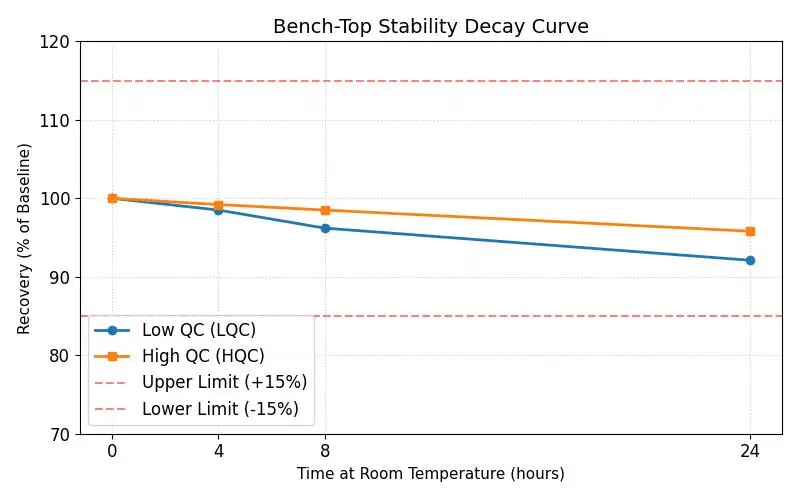
1. Stability Decay Plots (Visual 1)
Visual tracking of analyte recovery rates over time (0–24 hours). This graph identifies the exact "safety window" for sample processing before significant degradation occurs, allowing researchers to optimize their prep-time.

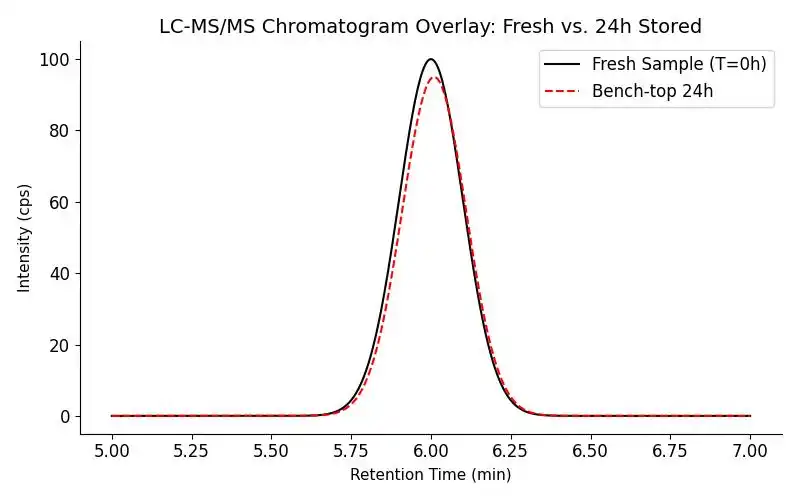
2. Chromatogram Overlays (Visual 2)
Visual confirmation demonstrating that no new interfering degradation peaks have emerged and that peak shape, retention time, and intensity remain consistent even after prolonged bench-top exposure.

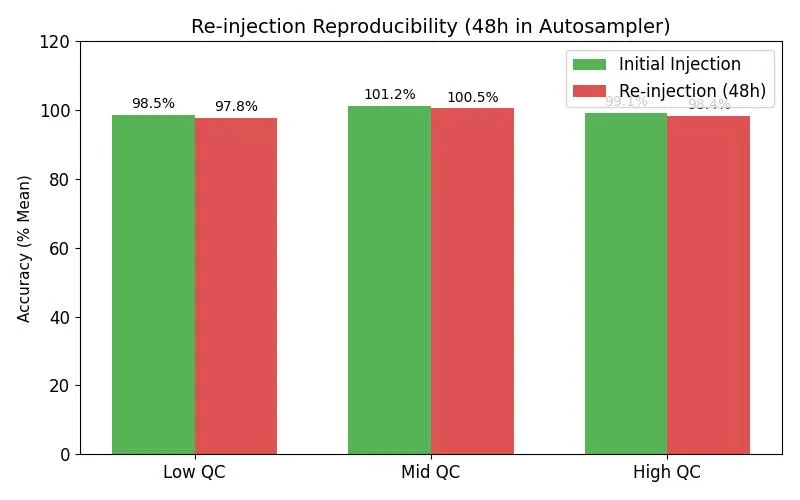
3. Re-injection Reproducibility Comparison (Visual 3)
Scientific proof that processed samples in the autosampler remain stable enough to be re-analyzed in case of instrument downtime, ensuring no loss of precious research samples.

Stability Decay Plot showing % remaining analyte over time at room temperature
LC-MS/MS Chromatogram Overlays comparing fresh vs 24h bench-top samples
Re-injection Reproducibility bar chart after 48h in autosampler

Technical Excellence: Chemical-Specific Stabilization Logic

Beyond standard validation, our platform excels in resolving the most challenging stability bottlenecks. We believe that reporting a "failed" stability test is only half the job; the other half is engineering a chemical solution.

Our Approach to Analyte Fragility
Many novel chemical entities (NCEs) are inherently unstable in biological matrices due to enzymatic hydrolysis, oxidation, or pH-dependent degradation. Our scientific team utilizes a Chemical-Specific Stabilization Logic to lock these molecules in their stable state:

  • Targeted Enzyme Inhibition: Strategic addition of specific inhibitors (e.g., esterase or protease inhibitors) during sample collection or homogenization to halt biological degradation instantly.
  • Precision pH Control: For compounds sensitive to acid or base-catalyzed hydrolysis, we engineer specialized buffering or acidification protocols (e.g., using formic acid or ammonium acetate) to maintain optimal stability.
  • Oxidation Mitigation: Implementing antioxidants or inert gas displacement for compounds prone to rapid atmospheric degradation.
  • Low-Temperature Processing: Executing the entire extraction workflow at 4°C to minimize thermal energy and suppress kinetic degradation rates.

Selection Strategy: Choose our specialized bioanalytical platform when working with novel molecules that lack established stability profiles, or when high-throughput batch runs require absolute confidence in extract integrity over extended periods.

Sample Submission Requirements

Analyte stability is highly matrix-dependent. To maintain structural integrity and ensure highly accurate quantification, we enforce specific guidelines for sample preparation and shipping.

Matrix Type Minimum Volume Preparation Instruction Shipping Condition
Plasma / Serum 100 µL Use EDTA/Heparin. Centrifuge promptly to avoid hemolysis. Ship on Dry Ice
Whole Blood 200 µL Specify anticoagulant used. Do not freeze if whole blood analysis is required. Ship on Dry Ice
Tissue Homogenate 50 mg (Equiv.) Snap-freeze in liquid nitrogen immediately after collection. Ship on Dry Ice
Cell Lysates 100 µL Use MS-compatible lysis buffers (avoid SDS/Triton X-100). Ship on Dry Ice

Proven Success: Stability and Selectivity Validation of Entrectinib in Plasma

Background: Therapeutic Drug Monitoring (TDM) and preclinical PK studies of Entrectinib require an analytical method that can maintain absolute analyte integrity across long processing windows. The primary challenge lies in ensuring that neither room-temperature bench-top handling nor extended autosampler storage introduces quantitative bias due to matrix-induced interference or analyte degradation.

Methods: A high-sensitivity UPLC-MS/MS method was developed specifically for Entrectinib quantification in human plasma. To isolate the analyte from complex plasma proteins and lipids, a targeted Liquid-Liquid Extraction (LLE) was implemented using tert-butyl methyl ether. This Chemical-Specific Stabilization approach ensured the analyte remained stable and concentrated. Method validation included rigorous testing of bench-top stability (6 hours at room temperature) and processed sample stability (48 hours in the autosampler at 4°C).

Results: The extraction strategy achieved exceptional selectivity and stability. The stability tests confirmed that Entrectinib remained within the strict ICH-mandated accuracy window (82.24–93.33% recovery) throughout all handling stages.

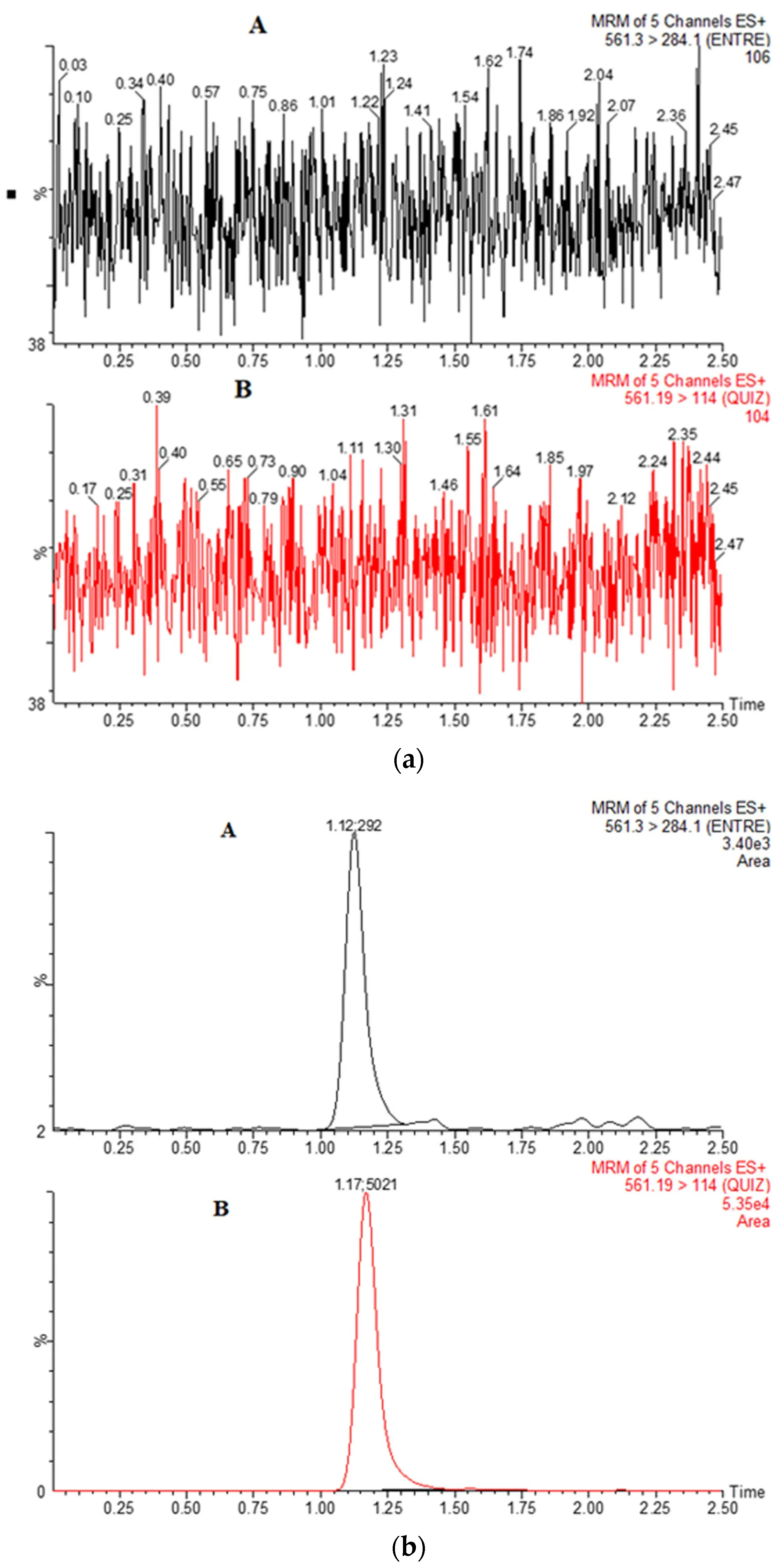
Crucially, as demonstrated in the Representative MRM Chromatograms (Figure 3), the method effectively bypassed all endogenous matrix interferences. Figure 3(a) shows a clean baseline in blank plasma, while Figure 3(b) illustrates the sharp, distinct peak of Entrectinib at the Lower Limit of Quantification (LLOQ) of 0.5 ng/mL. This visual evidence confirms that the stabilized extracts remain highly sensitive and free from co-eluting background noise even at trace concentrations.

Conclusion: The successful validation of Entrectinib in human plasma proves that our de novo extraction and stabilization protocols can secure the precise "safety window" required for high-throughput bioanalysis. By delivering robust, interference-free data, we enable researchers to execute large-batch discovery runs with absolute confidence in their quantitative results.

Representative MRM chromatograms showing baseline separation and LLOQ sensitivity for Entrectinib

Frequently Asked Questions

1. What is the typical acceptance criterion for bench-top stability?

Following ICH M10 guidelines, the stability is considered acceptable if the mean concentration at each level is within ±15% of the nominal value (or freshly prepared baseline).

2. How do you handle compounds that are highly unstable at room temperature?

We implement immediate stabilization strategies, such as performing all preparation on an ice bath (0°C), adjusting the matrix pH to inhibit hydrolysis, or adding specific enzyme inhibitors during the homogenization phase.

3. Can you test stability for processed samples stored at room temperature instead of 4°C?

Yes. While 4°C is standard for autosamplers, we can customize the storage temperature to match your specific laboratory workflow or to test the limits of your compound's extract stability.

4. Why is "Re-injection Reproducibility" part of processed sample stability?

Instrument failures (e.g., a power surge or solvent depletion) can stop a run halfway. Re-injection reproducibility proves that your processed samples remain stable enough to be re-analyzed 24–48 hours later without losing data integrity.

Ready to Quantify Your Lead Compound or Metabolite?

Share your matrix type, sample count, and expected range—feasibility routing will confirm whether direct quantification is fit-for-purpose or method development is recommended.

inquiry
Online Inquiry