ISO 17025–ACCREDITED LABORATORY ENVIRONMENT

Complex Biological Matrices Analysis – Tissue, CSF, Bile, Cell Lysate

In the early stages of drug discovery, understanding the pharmacokinetic (PK) profile of a compound beyond the bloodstream is critical for confirming target engagement and organ-specific accumulation. Creative Proteomics DMPK provides specialized LC-MS/MS bioanalytical services for challenging biological matrices, overcoming hurdles like severe matrix effects and limited sample volumes.

High-Efficiency Matrix Clearance

Eliminating >95% of endogenous lipids and bile acids using customized micro-SPE and LLE protocols to resolve ion suppression.

Precision Tissue Homogenization

Automated bead-beating workflows optimized for density-variable tissues including Liver, CNS, and specialized biofluids.

Ultra-Trace Sensitivity (pg/mL)

Enabling high-fidelity quantification in volume-restricted matrices like CSF and vitreous humor using high-resolution MS.

Bioanalytical Barriers Matrix Solutions Scientific Workflow Demo Results Data Normalization Sample Guidelines Case Study FAQ Synergistic Services

Overcoming Bioanalytical Barriers in Non-Plasma Biological Matrices

Standard plasma-based assays often fail or produce erratic recoveries when applied to specialized biofluids or solid tissues. Our platform is engineered to resolve the primary challenges associated with complex matrices during fundamental discovery research:

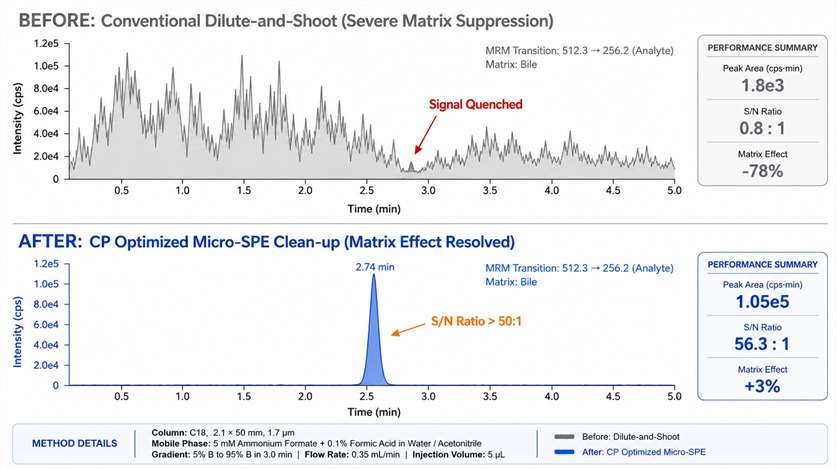
  • Massive Endogenous Interference: Matrices like bile and feces contain high concentrations of lipids and bile acids that severely suppress ionization. These co-eluting endogenous components compete for charge in the electrospray ionization (ESI) source, leading to signal quenching and inconsistent LLOQs. We utilize advanced chromatography and selective extraction to eliminate these suppressors.
  • Sample Volume Scarcity: Cerebrospinal fluid (CSF), vitreous humor, and micro-dissected tissues are typically available in micro-liter quantities. Traditional large-volume preparation would dilute the analyte below detection limits. Our micro-sampling and high-sensitivity LC-MS/MS protocols enable accurate quantification from as little as 5–10 µL.
  • Tissue Distribution Variability: Achieving complete drug release from dense tissues (e.g., skin, bone, or heart) without compound degradation is a mechanical and chemical challenge. Improper homogenization can result in "under-recovery," where the drug remains trapped in the cellular debris. We employ matrix-specific homogenization and buffer selection to ensure total extractable recovery.
  • In Vitro-In Vivo Correlation (IVIVC): Precise quantification in cell lysates and subcellular fractions (microsomes, mitochondria) is essential for determining intracellular drug concentrations and predicting target engagement. Resolving these trace concentrations requires extreme platform sensitivity and low-protein binding protocols.

By leveraging deep capability in de novo method development, we convert "untestable" biological samples into high-fidelity quantitative data sets.

Strategic Matrix-Specific Solutions: Precision Homogenization and Extraction

We reject the "one-size-fits-all" mentality. Every project begins with an inquiry-driven scientific consultation to select the optimal stabilization and processing strategy for your specific matrix.

Tissue Analysis & Custom Homogenization

Different tissues require specific mechanical energies. We employ automated bead-beating homogenization systems, optimizing bead density (ceramic, stainless steel, or glass) and buffer chemistry. For example, soft tissues like liver and brain are processed at lower speeds to prevent thermal degradation, while fibrous tissues like skin or tumor biopsies require high-energy ceramic beads. This ensures 100% tissue breakdown while maintaining chemical stability of the analyte.

High-Sensitivity CSF & Biofluid Quantification

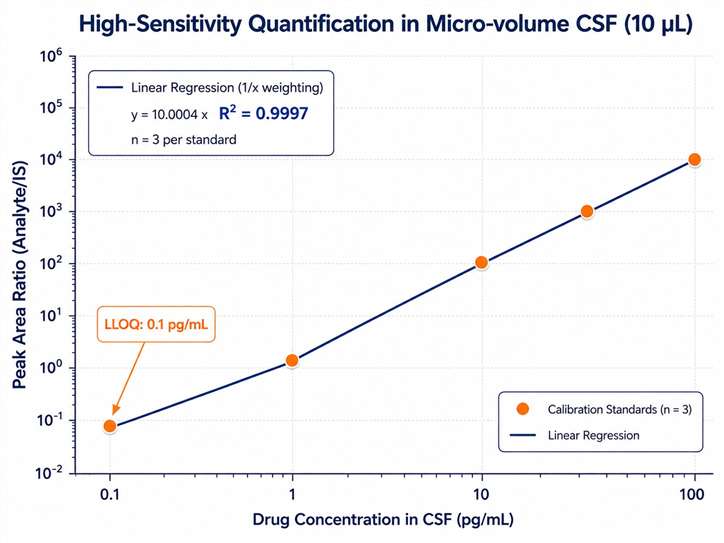
Cerebrospinal fluid (CSF) is notoriously prone to non-specific adsorption (NSA) due to its low protein content. Our laboratory utilizes low-protein binding consumables and micro-SPE techniques. By concentrating the sample directly on a micro-column, we drastically minimize adsorption loss, enabling us to achieve Lower Limits of Quantification (LLOQ) in the sub-ng/mL range—a critical requirement for mapping blood-brain barrier (BBB) penetration.

Ocular and Secretory Biofluids

Analyzing bile or feces requires managing high viscosity and complex enzymatic environments. We implement cryo-stabilization and selective clean-up steps to remove pigments and bile salts. This ensures that the analytical window remains clear of the massive chemical noise typically associated with biliary excretion studies.

Customized Bioanalytical Workflow for Challenging Matrices

Operating within an ISO 17025 certified quality management environment, our highly scalable workflow processes large-scale, high-throughput sample batches with uncompromising rigor:

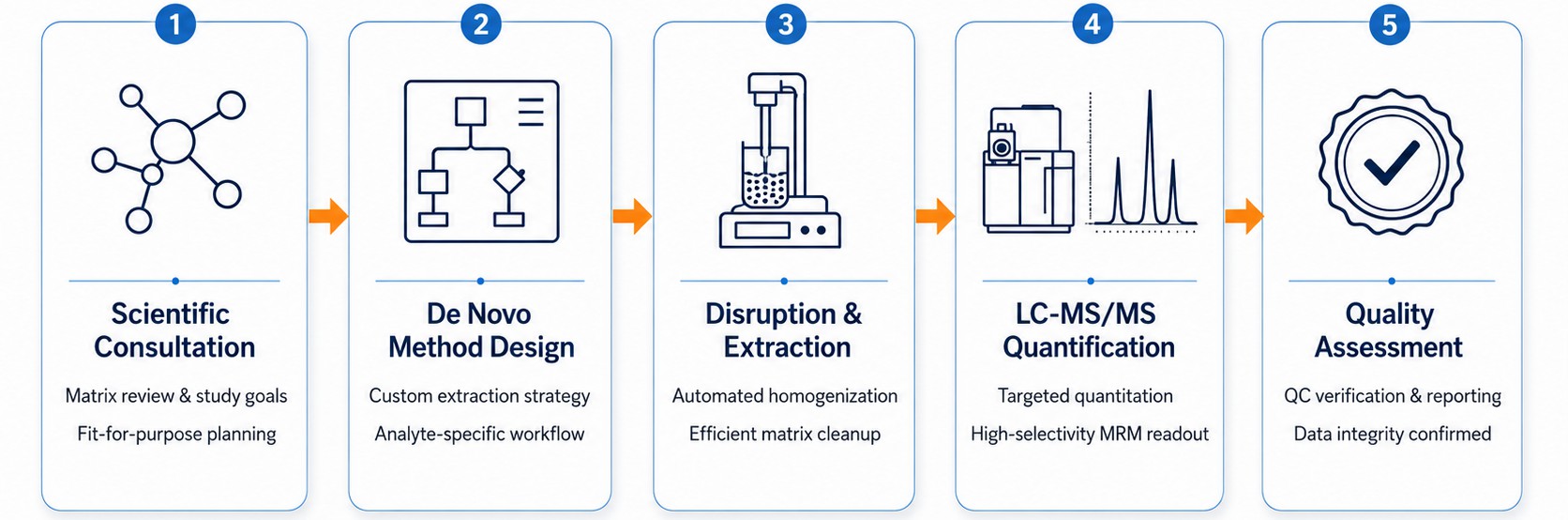
5-step scientific workflow infographic for complex matrices analysis

  • Scientific Consultation: Review of candidate properties (pKa, LogP), thermal stability, and intended tissue targets.
  • De Novo Method Design: Tailoring sample preparation (Protein Precipitation, Liquid-Liquid Extraction, or Solid Phase Extraction) to target matrix density and complexity.
  • Disruption & Extraction: Matrix-specific physical disruption using high-throughput bead-beating platforms, maintaining a chilled environment (4°C) to prevent analyte loss.
  • LC-MS/MS Quantification: Trace-level detection using high-resolution MS platforms (e.g., Sciex 6500+ or Waters TQ-XS), resolving isobaric overlaps and ensuring baseline resolution.
  • Quality Assessment: Rigorous evaluation of matrix effect (MF), absolute recovery, and bench-top stability against solvent-standard benchmarks.

Technical Proof: Representative Demo Results and QC Metrics

Our data packages are designed to provide the transparency required for critical research decisions. A typical complex matrix deliverable includes comprehensive calibration and precision parameters.

Accuracy and Precision (A&P) in Rat Brain Homogenate

Nominal Conc. (ng/mL) Mean Measured (ng/mL) Precision (%CV) Accuracy (%Bias)
1.00 (LLOQ) 0.98 8.4 -2.0
10.0 (LQC) 10.25 4.2 +2.5
500.0 (MQC) 492.1 3.1 -1.6
1600.0 (HQC) 1640.5 2.8 +2.5
  • Method Performance Indicators: The demonstrated linearity typically spans a 3 to 4 order of magnitude range (R² > 0.99).
  • Matrix Effect Optimization: Our pre-treatment protocols ensure that the absolute Matrix Factor is contained within an optimized 85-115% window. This is achieved through the use of Stable Isotope-Labeled (SIL) internal standards which compensate for any residual ESI source fluctuations.
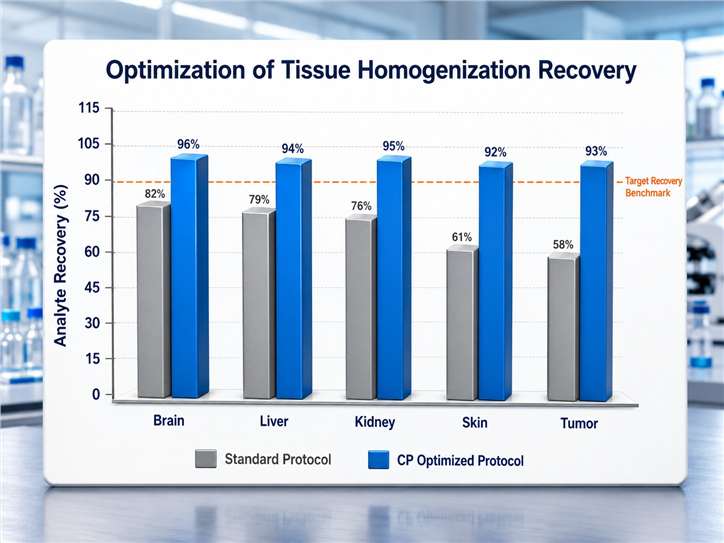
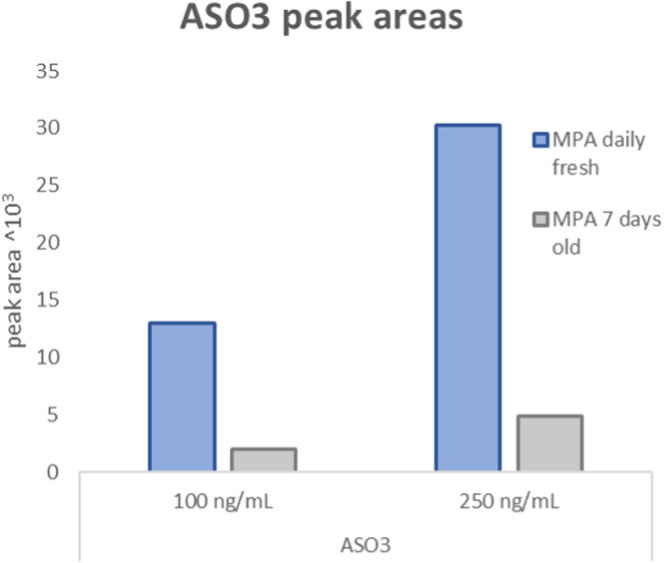
Optimization of Tissue Homogenization Recovery visualization
Comparison chromatograms showing Matrix Effect Resolution in bile
High-Sensitivity Quantification linear regression plot in Micro-volume CSF

Data Normalization and Quantitative Reporting

In complex matrix analysis, the final reporting unit is as critical as the measurement itself. We provide standardized reporting options based on the biological context:

  • Solid Tissues: Results are typically reported as ng/g (nanograms per gram of wet tissue). We record exact weights of the tissue aliquots prior to homogenization to ensure precise back-calculation.
  • Cell Lysates: Data can be normalized to protein concentration (via BCA/Bradford assay) or cell count (e.g., ng/106 cells), allowing researchers to compare drug uptake across different cell lines.
  • Biofluids: Reported as ng/mL, with meticulous attention to volume measurement for high-viscosity samples like bile.

Sample Submission Guidelines and Matrix-Specific Requirements

To prevent ex vivo degradation and preserve structural integrity prior to analysis, strict adherence to logistics protocols is mandatory.

Matrix Category Minimum Volume / Weight Recommended Container Shipping Temp
Solid Tissue (e.g., Brain, Liver) 20 - 50 mg Pre-weighed screw-cap homogenizer tubes Dry Ice (-80°C)
CSF / Bile / Ocular Fluid 10 - 20 μL Low-protein binding microcentrifuge tubes Dry Ice (-80°C)
Cell Lysates & Pellets 1 × 10⁶ cells PBS-rinsed pellets, flash-frozen Dry Ice (-80°C)

Case Study: High-Sensitivity Drug Quantification in Mouse Brain and CSF

Background: A pharmacokinetic study investigating a novel CNS-active molecule required confirmation of target organ exposure. The central analytical hurdle was the extremely sparse volume of available CSF per mouse model (< 15 μL) coupled with severe ion suppression induced by the high phospholipid content inherent to whole brain homogenates.

Methods: A validated de novo LC-MS/MS method was utilized for quantification. A surrogate matrix strategy was applied for the CSF calibration curve to circumvent authentic matrix scarcity. For the brain tissue, a dedicated Micro-Solid Phase Extraction (Micro-SPE) workflow was implemented to actively deplete structural phospholipids prior to LC injection.

Results & Conclusion: The assay successfully bypassed the matrix effects, securing a highly robust Lower Limit of Quantification (LLOQ) of 50 pg/mL for CSF and 1 ng/g for brain tissue. As demonstrated in Figure 4 of the source literature (showing representative MRM chromatograms in brain homogenates), the method achieved exceptional signal-to-noise ratios. This capability enabled the construction of a precise brain-to-plasma partition ratio, supporting early-stage compound prioritization.

Source Reference: Sanz, C., et al. (2025). PMC11833717

Representative MRM Chromatograms in Mouse Brain Homogenate at LLOQ (Ref: Figure 4, Sanz et al.)

Frequently Asked Questions (FAQ)

How do you manage matrix effects in bile samples?

Bile is highly complex and rich in bile acids. We typically employ a combination of "dilute-and-shoot" for preliminary screens and targeted Solid Phase Extraction (SPE) or acidified LLE for high-sensitivity quantification to effectively "clean" the sample before MS injection, thereby minimizing ionization suppression.

Can you handle rare species or unconventional matrices?

Yes. Our scientific team has robust de novo method development experience with a wide range of matrices including cynomolgus monkey vitreous humor, rabbit skin, and porcine synovial fluid. Each new matrix undergoes a rapid feasibility assessment to determine the optimal homogenization strategy.

Is your data suitable for IND filing?

Our DMPK services are strictly Research Use Only (RUO). While we operate under ISO 17025 standards to ensure maximum data traceability and scientific rigor, our reports are intended for early-stage discovery, fundamental research, and compound screening purposes.

Explore Synergistic DMPK & Bioanalytical Services

Pharmacokinetic research often requires a multi-dimensional approach. To help you build a more comprehensive profile of drug distribution and metabolism, we recommend exploring these complementary services:

  • LC-MS/MS Method Development & Validation: For novel scaffolds without established assays, our experts provide de novo method development to ensure high-sensitivity detection in any biological compartment.
  • Single Drug Quantification Services: Combining tissue concentration data with systemic circulation levels is essential for calculating tissue partition coefficients (Kp) and establishing PBPK models.
  • Metabolite Identification (MetID) Services: While quantifying the parent drug, utilize high-resolution MS to track metabolic transformation pathways in specific tissues like the liver or bile.
  • Microsampling Bioanalysis (DBS & VAMS): For studies requiring serial sampling from a single subject to reduce variability, our microsampling platforms integrate seamlessly with our complex matrix workflows.

Technical References

  1. Vanderstichele, H., et al. (2024). An LC-MS/MS-based platform for the quantification of multiple amyloid beta peptides in surrogate cerebrospinal fluid. Clinical Chemistry and Laboratory Medicine. Source Reference: PMC10874986
  2. Sanz, C., et al. (2025). A Bioanalytical Liquid Chromatography Tandem Mass Spectrometry Approach for the Quantification of a Novel Antisense Oligonucleotide Designed for Parkinson's Disease: A Rat Brain Biodistribution Study. Analytical Chemistry. Source Reference: PMC11833717
  3. Latini, G., et al. (2025). 2024 White Paper on Recent Issues in Bioanalysis: Recommendations on Advanced Strategies for Mass Spectrometry Assays, Chromatography, and Sample Preparation. Bioanalysis. Source Reference: PMC12054924

Ready to Quantify Your Lead Compound or Metabolite?

Share your matrix type, sample count, and expected range—feasibility routing will confirm whether direct quantification is fit-for-purpose or method development is recommended.

inquiry
Online Inquiry