ISO 17025–ACCREDITED LABORATORY ENVIRONMENT

Advanced Drug Metabolite Identification (MetID) Services

Drug Metabolite Identification (MetID) is the analytical process of discovering and determining the precise chemical structures of drug metabolites formed during biotransformation. Utilizing high-resolution mass spectrometry (HRMS) and advanced bioinformatics, MetID helps researchers identify clearance mechanisms, map complex metabolic pathways, and flag potentially toxic substructures early in the drug discovery pipeline.

De Novo Method Development

Specialized in overcoming severe matrix interference for novel or complex chemical entities.

High-Resolution Platforms

Combining automated screening capacity with precise structural elucidation.

Bioinformatics-Driven Insights

Seamlessly translating raw mass-spec data into actionable structural and DDI risk assessments.

Navigating Metabolic Complexity Comprehensive MetID Workflow Bioinformatics Analysis Case Study Sample Requirements Expected Deliverables Why Partner With Us FAQ

Comprehensive MetID Workflow & QC Checkpoints

We utilize a highly streamlined, stringently controlled analytical workflow to ensure uncompromised data reliability and batch-to-batch consistency. Our process features strict quality control (QC) checkpoints at every critical phase.

  • In Vitro Incubation Protocols: Dosing target compounds in carefully selected biological test systems (e.g., liver microsomes, hepatocytes, S9 fractions). QC Checkpoint: Rigorous viability and core enzyme activity verification.
  • Sample Quenching & Matrix Cleanup: Terminating metabolic reactions and removing endogenous matrix proteins to minimize ion suppression. QC Checkpoint: Strict assessment of processed sample stability prior to analytical injection.
  • HR-LC-MS/MS Data Acquisition: Running prepared samples through ultra-high-performance liquid chromatography coupled with state-of-the-art high-resolution mass spectrometers (such as Q-TOF or Orbitrap). QC Checkpoint: Daily mass accuracy calibration.
  • Bioinformatics Data Processing: Applying advanced software algorithms to filter out intense matrix noise and extract true, drug-related metabolite signals. QC Checkpoint: Algorithmic false-positive elimination.
  • Expert Structural Elucidation: Our senior analytical scientists manually review MS/MS fragmentation patterns to propose exact molecular structures. QC Checkpoint: Comprehensive isotope pattern matching and fragmentation logic review.

High-Resolution Platforms & Bioinformatics Analysis

Generating raw high-resolution mass spectrometry data is only half the battle. Biological matrices like hepatocytes or liver microsomes generate massive amounts of background noise. To solve this, we deploy powerful, multi-layered bioinformatics pipelines designed to decode complex, multidimensional metabolic data rapidly and accurately.

Our primary analytical strategy leverages advanced Mass Defect Filtering (MDF). The mass defect is the mathematically defined difference between a compound's exact monoisotopic mass and its nominal mass. Because derived metabolites retain the core chemical skeleton of the parent drug, their mass defects fall within a highly predictable, narrow window—typically within a ± 50 mDa tolerance. By setting customized MDF templates based on the parent compound's precise chemical formula, our software mathematically subtracts thousands of endogenous lipid and protein interferences. This clean separation highlights only the drug-related peaks for further structural interrogation, uncovering even trace-level biotransformations.

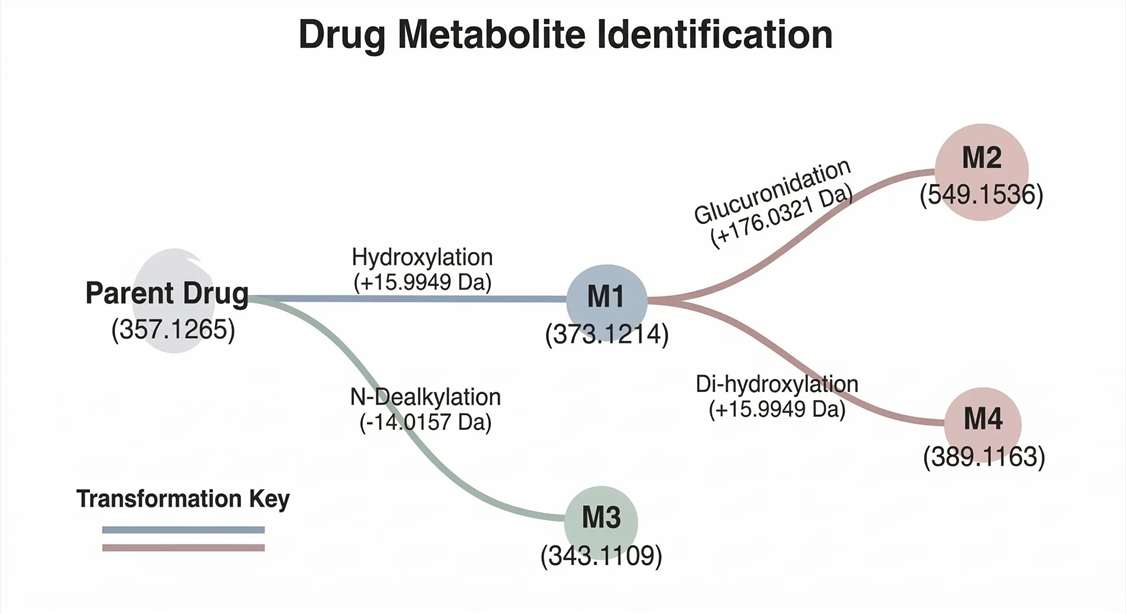
Beyond simple defect filtering, our platform utilizes Exact Mass Shift Alignment. We rapidly categorize major biotransformations by screening for predictable high-resolution mass additions. For instance, single hydroxylations yield a highly specific shift of +15.9949 Da, while Phase II glucuronidation yields +176.0321 Da.

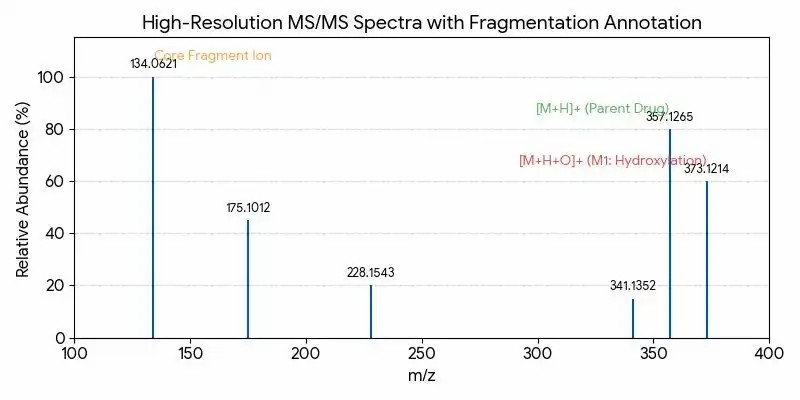
Once targets are isolated, our data analysis pipeline rapidly constructs clear MS/MS Fragmentation Trees. By comparing the fragmentation logic of the parent drug to its newly formed metabolites, we can precisely localize the exact site of biotransformation. These deep structural insights are then used to build comprehensive biotransformation maps and evaluate early Drug-Drug Interaction (DDI) risks. If our analysis detects unusually high levels of specific active or long-lasting metabolites, we can immediately initiate a parent-metabolite ratio analysis to further quantify systemic exposure risks.

Case Study: Structural Elucidation of Drug Metabolites via HRMS

Background: Analyzing the biotransformation of structurally complex drugs requires extreme analytical sensitivity. Standard workflows struggle to distinguish minor Phase I and Phase II metabolites from severe biological background noise. This study demonstrates a highly effective, metabolomics-based data analysis approach for robust, high-confidence MetID. Pioglitazone (PIO), a thiazolidinedione derivative known for its extensive hepatic metabolism and multiple active metabolites, was selected as the rigorous model compound.

Methods: Researchers utilized high-resolution liquid chromatography-mass spectrometry (HR-LC-MS/MS) via an advanced Orbitrap platform to investigate PIO and its subsequent metabolites in vitro. Data was acquired using sophisticated Data-Dependent Acquisition (DDA) modes, rapidly capturing both full-scan MS1 high-resolution profiles and targeted MS2 fragmentation spectra. Advanced data processing algorithms, prominently featuring multiple-template mass defect filtering and control-sample background subtraction, were applied sequentially to extract genuine drug-related ion peaks from the complex microsomal matrices.

Results: The analytical approach successfully pinpointed multiple key oxidative and conjugated metabolites that were previously obscured. The parent compound, Pioglitazone, exhibited an exact protonated mass [M+H]+ of m/z 357.1265. By aligning the exact mass shifts, analysts rapidly categorized the biotransformations. For example, major oxidative metabolites displayed a mass of m/z 373.1214, representing a highly precise mass shift of +15.9949 Da (indicative of single hydroxylation). Furthermore, detailed MS/MS fragmentation logic was deployed to deduce the specific localized sites of metabolism. The parent drug typically fragments to yield a dominant structural ion at m/z 134.06. By observing whether this core m/z 134.06 fragment remained intact or was altered in the metabolite spectra, scientists could clearly distinguish whether the hydroxylation occurred on the aliphatic chain or the aromatic ring system. For a visual representation of the identified metabolic pathways, exact mass tables, and detailed MS/MS spectra mapping, please refer to Figure 3 in the published paper: Development of a metabolomics-based data analysis approach for identifying drug metabolites based on high-resolution mass spectrometry.

Conclusion: This detailed methodology confirms that combining advanced HRMS platforms with specialized, multi-layered bioinformatics workflows provides exceptional accuracy in structural elucidation. It moves beyond mere detection, enabling researchers to make faster, more confident decision-making in early lead optimization and toxicity prediction.
Case Study: Structural Elucidation of Drug Metabolites via HRMS for Pioglitazone

Sample Requirements for MetID Studies

Proper sample preparation and strictly controlled shipping conditions are critical to prevent compound degradation before the analysis even begins. Please follow these baseline requirements to ensure optimal data integrity:

Test System / Matrix Minimum Volume/Amount Preparation Instructions Shipping Conditions
Liver Microsomes / S9 100 µL per sample Quench with cold acetonitrile, centrifuge, separate supernatant Dry ice (-80°C)
Hepatocytes 200 µL per sample Lyse cells, precipitate proteins, extract supernatant Dry ice (-80°C)
Test Article (Parent Drug) 1 mg (Solid) or 50 µL (Stock) Provide at >98% purity, note solubility constraints Dry ice or ambient (if stable)

Expected Deliverables & Demo Results

We deliver transparent, highly visual, and highly organized data packages. Your comprehensive technical report will include objective structural evidence and interpretive summaries, not just massive spreadsheets of raw data points.

  1. High-resolution MS/MS spectra: Detailed, fully annotated fragmentation spectra for all target metabolites, showing exactly how each structure was deduced based on the cleavage patterns.
  2. Proposed metabolic pathway network: A clear, visually intuitive biotransformation tree mapping exactly how the parent drug evolves over time, detailing primary and secondary metabolic routes.
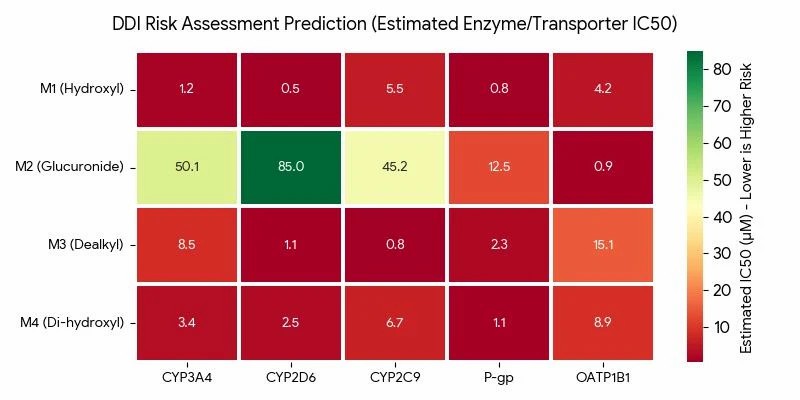
  3. DDI risk assessment prediction: A specialized summary table evaluating potential CYP or transporter interactions based on the identified structural motifs, integrating seamlessly with our reactive metabolite screening capabilities for a holistic safety overview.
High-resolution MS/MS spectra with fragmentation annotation
Proposed metabolic pathway network and biotransformation tree
DDI risk assessment prediction summary table

Why Partner with Us for Metabolite Characterization

We distinguish our DMPK services by combining raw analytical instrument power with deep, specialized structural chemistry expertise. We deliver actionable intelligence rather than just analytical noise.

  • Advanced Matrix Background Subtraction: Biological matrices hide low-abundance, potentially toxic metabolites. We combine optimized multi-dimensional liquid chromatography with proprietary bioinformatics background-subtraction algorithms to reveal trace-level biotransformations that standard, low-resolution CROs frequently miss.
  • Sub-ppm Mass Accuracy for Structural Certainty: We do not rely on analytical guesswork. Utilizing meticulously calibrated Orbitrap and Q-TOF mass spectrometers, we achieve sub-ppm mass accuracy on every run. This extreme precision completely eliminates ambiguity when distinguishing between closely related isobaric interferences or complex isomeric metabolites in complex mixtures.
  • Actionable Metabolic "Soft-Spot" Mapping: We deliver more than a spreadsheet of molecular weights and retention times. Our senior analytical scientists visually map the metabolic soft spots directly onto your candidate molecule's chemical structure. This provides your medicinal and synthetic chemistry teams with direct, actionable guidance to rationally optimize the compound, block rapid clearance pathways, and structurally improve its overall pharmacokinetic profile.

Frequently Asked Questions

How do you handle severe endogenous matrix interference during structural elucidation?

We apply powerful orthogonal approaches to isolate your compound. First, we optimize chromatographic separation, sometimes utilizing 2D-LC for heavily complex matrices. Second, we utilize advanced Mass Defect Filtering (MDF) and isotope pattern matching algorithms to mathematically subtract the biological background, pulling out hidden metabolite signals.

Can your high-resolution platform differentiate between isomeric metabolites?

Yes. While standard MS simply identifies molecular weight, differentiating precise structural isomers (such as identical hydroxylations occurring at different ring positions) requires analyzing highly unique MS/MS fragmentation patterns. In difficult cases, we optimize collision energies to intentionally force distinct fragmentation pathways, allowing us to pinpoint the exact site of modification.

Do you accept in vivo samples for metabolite identification?

Yes. While this specific page focuses heavily on in vitro biotransformation systems, our underlying analytical workflow and bioinformatics pipelines are fully capable of analyzing complex plasma, urine, feces, and bile samples collected from early preclinical models using the exact same high-resolution principles.

Ready to Quantify Your Lead Compound or Metabolite?

Share your matrix type, sample count, and expected range—feasibility routing will confirm whether direct quantification is fit-for-purpose or method development is recommended.

inquiry
Online Inquiry