ISO 17025–ACCREDITED LABORATORY ENVIRONMENT

High-Sensitivity Multiplex Quantification Services (LC-MS/MS)

Accelerate your early-stage discovery and combination therapy research with our High-Sensitivity Multiplex Quantification Services. Utilizing high-resolution LC-MS/MS, we provide simultaneous, high-precision analysis for 5 to 50+ analytes within complex biological matrices. Our expertise focuses on achieving pg/mL-level sensitivity and absolute peak purity for multi-drug panels, delivering robust data for pure scientific research and pharmacokinetic evaluation.

Sub-nanogram Sensitivity

Achieve LLOQs as low as 0.1–10 pg/mL for trace analytes.

Ultra-Microsampling

Robust quantification from as little as 5 µL of plasma or CSF.

Chemical Diversity

Simultaneous analysis of acidic, basic, and neutral compounds.

De Novo Development

Bespoke method deconvolution for novel compound libraries.

Technical Paradox Core Advantages Performance Benchmarks Workflow & QC Deliverables Strategy Selection Sample Requirements Case Study FAQ

Navigating the Technical Paradox of Multiplexed Bioanalysis

In high-throughput drug screening, the demand for quantifying multiple compounds in a single analytical run often conflicts with the need for extreme sensitivity. As the number of analytes in a panel increases, issues such as ion suppression, matrix interference, and signal cross-talk typically degrade the detection limits for trace-level metabolites. Our bioanalytical platform is specifically engineered to resolve these challenges through advanced chemical deconvolution and customized matrix enrichment, ensuring each analyte reaches its optimal Lower Limit of Quantitation (LLOQ).

  • Solving Ion Suppression: Multiplexing can lead to competition for ionization in the mass spec source. We utilize high-resolution chromatography to temporally resolve co-eluting compounds, ensuring that each analyte is ionized with maximum efficiency without interference from co-dosed drugs.
  • Mitigating Signal Cross-talk: For panels containing structural isomers or compounds with shared fragment ions, we apply rigorous Multiple Reaction Monitoring (MRM) scheduling. By optimizing collision energy signatures for each precursor-product pair, we eliminate false-positive signals and ensure absolute quantification purity.
  • Managing Wide Dynamic Range: Our optimized workflows are capable of capturing parent drugs at microgram levels alongside trace metabolites at picogram levels in the same injection, maintaining a linear response across 4.5 to 5 orders of magnitude.

Core Service Advantages: Technical Ingenuity for Complex Research

Our service excellence is built on scientific expertise in handling the most challenging bioanalytical scenarios. We prioritize technical breakthroughs that solve the specific bottlenecks encountered by PK project leads and discovery scientists.

1. Ultra-Microsampling Expertise (<10 µL)

Traditional multiplexing methods often require significant sample volumes to maintain sensitivity across all analytes. We have developed specialized micro-extraction protocols that allow for the simultaneous quantification of 10+ analytes from as little as 5 µL of serum or plasma. This capability is essential for longitudinal mouse studies, pediatric pharmacokinetic research, and cerebrospinal fluid (CSF) analysis where total sample volume is extremely restricted.

2. Specialized Matrix-Specific Sample Enrichment

Simple protein precipitation is often insufficient for high-sensitivity multiplexing in complex matrices. We offer customized Solid-Phase Extraction (SPE) and Supported Liquid Extraction (SLE) methods. These techniques are specifically tuned to remove interfering phospholipids and endogenous proteins from "dirty" matrices such as brain homogenates, bone marrow, and bile. This targeted enrichment significantly improves the signal-to-noise (S/N) ratio for trace-level analytes.

3. Comprehensive Chemical Diversity Compatibility

Early-stage compounds often exhibit vastly different physicochemical properties, making a "one-size-fits-all" method impossible. Our team excels at developing de novo methods for panels that span multiple chemical classes—addressing acidic, basic, and neutral molecules in a single analytical window. We utilize synchronized polarity switching and gradient optimization to capture diverse analytes without the need for separate analytical runs.

4. Automated Post-Analytical Deconvolution & Data Integration

High-sensitivity multiplexing generates high-dimensional data that can overwhelm traditional analysis pipelines. Our automated bioinformatics pipeline provides rapid peak integration, multi-component correlation analysis, and foundational PK parameter modeling. We deliver clean, integrated datasets that are ready for immediate use in internal research reports or peer-reviewed academic publications.

Performance Benchmarks & Analytical Capabilities

Our multiplex panels are engineered to deliver the precision and sensitivity typically reserved for specialized single-analyte assays, providing a comprehensive view of compound behavior in a single run.

Technical Parameter Benchmark Capability
Detection Limits (LLOQ) 0.1 pg/mL to 5 ng/mL (Matrix & Analyte dependent)
Multiplex Capacity 5 – 60+ Analytes per analytical run
Precision (CV%) <10% at Med/High levels; <15% at LLOQ
Accuracy (RE%) 85% – 115% across the linear dynamic range
Sample Consumption 5 µL to 50 µL (Optimized for microsampling)
Linear Dynamic Range 104 to 105 for simultaneous parent/metabolite tracking

High-Throughput Multiplexing Workflow & QC Strategy

Our ISO 17025-certified laboratory follows a rigorous 5-stage methodology to ensure every panel is robust, reproducible, and ready for large-scale screening batches.

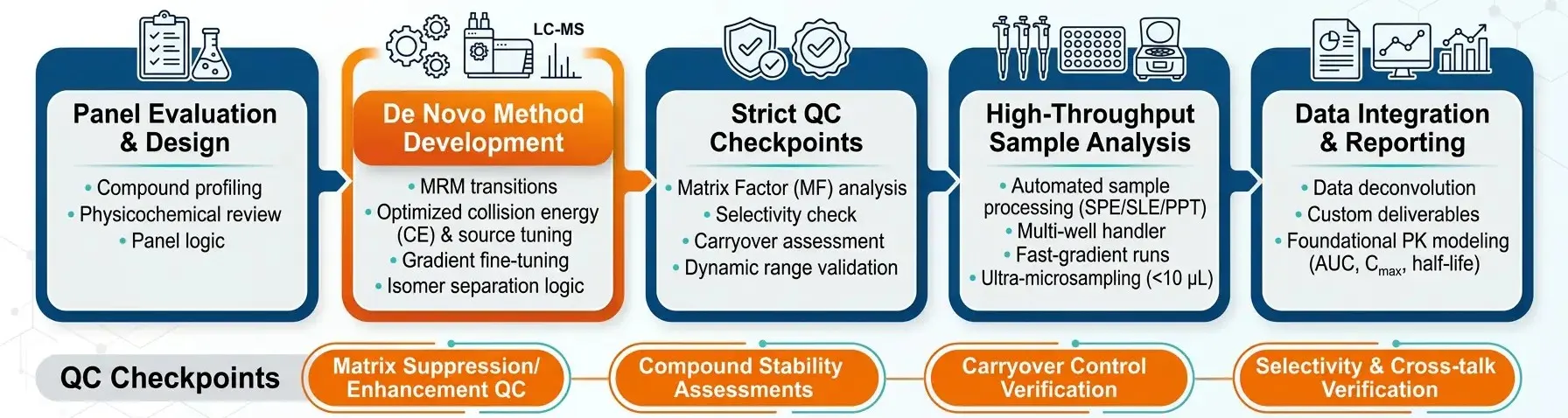
5-step technical workflow for high-sensitivity multiplexed LC-MS/MS bioanalysis

  1. Panel Evaluation & Design: We analyze the pKa, LogP, and molecular structures of your target compounds to determine the optimal chromatographic column chemistry (e.g., C18, HILIC, PFP) and mobile phase additives.
  2. De Novo Method Development:
    • MRM Optimization: Identifying the most stable and sensitive precursor-product ion transitions.
    • Gradient Fine-Tuning: Ensuring peak resolution for critical isomers and minimizing matrix effects through retention time management.
  3. Strict QC Checkpoints:
    • Matrix Factor (MF) Analysis: Verifying ionization efficiency across multiple biological lots.
    • Selectivity Assessment: Ensuring zero interference from blank matrix or internal standards.
    • Carryover Control: Optimization of needle wash cycles to prevent high-concentration samples from affecting subsequent trace-level samples.
  4. High-Throughput Batch Analysis: Processing of large sample cohorts using automated liquid handling and synchronized data acquisition to maintain continuous stability.
  5. Data Reporting: Delivery of comprehensive CSV/PDF reports including fully integrated concentrations, calibration curves, and basic PK parameters.

Deliverables & Demo Results Showcase

We provide researchers with a complete bioanalytical data package, offering clear visual and quantitative evidence of method performance.

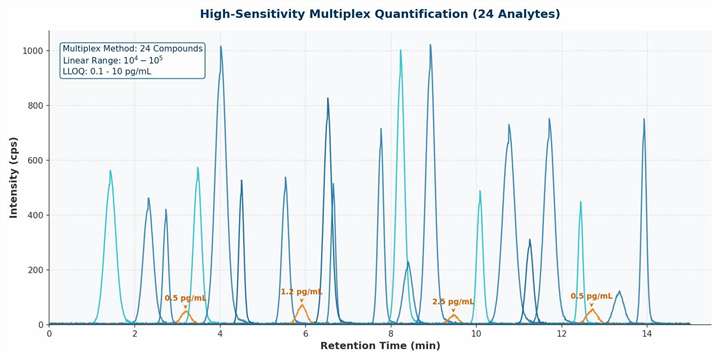
  • Stacked MRM Chromatograms: High-resolution overlays demonstrating clear baseline separation for up to 30 simultaneous analytes.
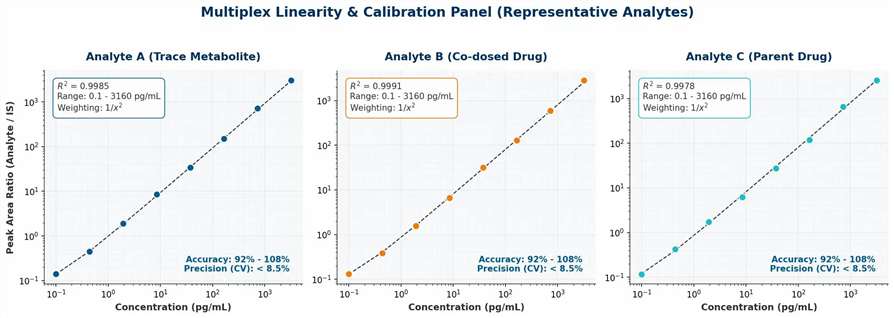
  • Calibration Linearity Profiles: Detailed summaries showing R² values (>0.995) and the accuracy of the regression model for each compound.
  • Stability Assessments: Data confirming the stability of the multiplexed analytes in the biological matrix during storage, processing, and bench-top handling.
  • Calculated PK Parameters: Automated delivery of AUC, Cmax, Tmax, and half-life for all panel components.
Overlaid MRM chromatogram demonstrating baseline resolution of 20+ analytes at pg/mL concentrations
Calibration curve panel showing R² > 0.995 and 4.5 orders of dynamic range for multiplexed compounds

Analytical Strategy: When to Leverage Multiplex Panels

Multiplexing is a strategic choice that optimizes both scientific output and research resources.

  • Combination Therapy Research (TACTs/Cocktails): Ideal for studying drug-drug interactions (DDI) or assessing the simultaneous efficacy of multi-drug regimens in a single biological aliquot.
  • Volume-Limited Preclinical Studies: Essential when working with limited sample volumes from mice, pediatric subjects, or CSF, where sequential single assays are physically impossible.
  • Early Discovery Screening: Drastically reduces the per-analyte cost and total time-to-result compared to developing and running separate methods for each compound.
  • Scientific Continuity: Analyzing all analytes in the same matrix aliquot eliminates the variability introduced by separate sample preparation runs and instrument sessions.

Standardized Sample Requirements for Multiplexing

To ensure the highest sensitivity for your multiplex panel, we recommend following these collection and shipping protocols.

Matrix Type Minimum Volume Preferred Volume Storage & Logistics
Plasma / Serum 5 µL 50 µL Snap-frozen, Dry Ice shipping
Tissue Homogenate 10 mg 50 mg Snap-frozen, ship on Dry Ice
Cerebrospinal Fluid 5 µL 20 µL Avoid freeze-thaw; ship at -80°C
Cell Lysates 1 x 10⁶ cells 5 x 10⁶ cells In MS-compatible lysis buffer

Case Study: 2025 Bioanalytical Evaluation of an Antimalarial Multiplex Panel

Background: A global research consortium required the simultaneous, high-sensitivity quantification of a novel Triple Artemisinin-based Combination Therapy (TACT). The project demanded the measurement of six chemically diverse analytes—Artesunate, DHA, Pyronaridine, Proguanil, Cycloguanil, and Clindamycin—with sensitivities sufficient to support field-based pharmacokinetic studies.

Methods: A high-sensitivity multiplex LC-MS/MS method was developed using an optimized UPLC gradient coupled to a Triple Quadrupole MS platform. A rapid protein precipitation protocol was utilized for high-throughput sample clean-up, and the 16-minute gradient was specifically tuned to ensure the resolution of artemisinin derivatives from their co-dosed partners.

Results:

  • Sensitivity: LLOQs of 0.2 ng/mL were achieved for all six analytes, providing the necessary depth for capturing terminal elimination phases.
  • Efficiency: The team achieved a 6-fold increase in analytical throughput compared to traditional sequential methods, reducing both labor and instrument time.
  • Data Quality: The assay demonstrated an intra-day precision of <10%, meeting the rigorous technical requirements for large-scale clinical sample monitoring.

Conclusion: This multiplex approach provided the comprehensive, high-quality data necessary for assessing drug exposure and efficacy in complex multi-drug regimens, directly accelerating the development of novel antimalarial treatment strategies.

Source: Multiplex LC–MS/MS assay for simultaneous quantification of artesunate and its active metabolite dihydroartemisinin... (2025)
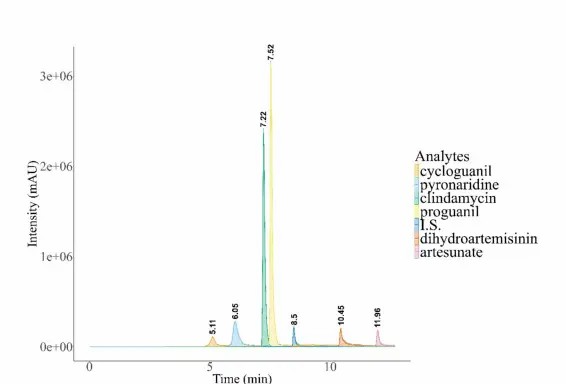
Figure Reference: Figure 1 (Representative chromatogram of a QCM sample showing each analyte and its respective retention time).

Figure 1 from the 2025 antimalarial study showing multiplexed quantification of 6 drug analytes

Frequently Asked Questions

How do you prevent interference between a parent drug and its own metabolites?

We utilize high-resolution chromatography to ensure baseline separation of isomers and metabolites before they enter the MS source. This prevents in-source fragmentation or isobaric interference from affecting the accuracy of the parent drug's quantification.

Is sensitivity lost when adding more analytes to a multiplex panel?

While adding analytes increases the duty cycle, we use "Scheduled MRM" logic to monitor each analyte only during its expected retention window. This ensures maximum dwell time for each transition, maintaining high sensitivity even in panels containing 50+ compounds.

Can you develop panels for proprietary or novel compounds?

Yes. We specialize in de novo method development. We can evaluate your unique molecular structures and integrate them into a customized panel after a brief feasibility study to ensure no cross-talk or interference exists with existing analytes.

What is the impact of matrix effects on multiplexed assays?

We conduct rigorous matrix factor (MF) evaluations during method development. By using stable-isotope-labeled (SIL) internal standards for each major analyte and optimizing extraction protocols, we mitigate ion suppression to ensure reliable results across different biological lots.

Ready to Quantify Your Lead Compound or Metabolite?

Share your matrix type, sample count, and expected range—feasibility routing will confirm whether direct quantification is fit-for-purpose or method development is recommended.

inquiry
Online Inquiry