Forced Degradation Studies Services

Identifying structural vulnerabilities early in drug discovery dictates the ultimate success of a novel molecule. When active pharmaceutical ingredients (APIs) are exposed to environmental stress, they often break down into transient, uncharacterized impurities. We provide specialized, high-resolution forced degradation studies services to solve this exact analytical bottleneck.

Utilizing advanced Liquid Chromatography-High Resolution Mass Spectrometry (LC-HRMS), we deliver rapid de novo structural elucidation and precise mass balance assessments, empowering medicinal chemists to confidently optimize API stability before preclinical transition.

Micro-Scale Stress Profiling

Comprehensive light, thermal, acidic, basic, and oxidative stress evaluations engineered for precious early discovery compounds, requiring extremely low API input (<1 mg).

De Novo Degradant ID

Utilizing Orbitrap and Time-of-Flight (TOF) exact mass tracking alongside MS/MS fragmentation trees to deduce unknown impurity structures without requiring synthetic reference standards.

Mass Balance Closure

Deploying omnidirectional electrospray ionization and mass defect filtering to capture hidden, non-chromophore degradants, effectively eliminating the "missing mass" phenomenon common in conventional testing.

Scientific Necessity Blind Spots Chemistry Pathways Workflow Demo Results Technical Strengths Sample Requirements Related Services Case Study FAQ

The Scientific Necessity of Forced Degradation in Early Discovery

In the earliest phases of drug development, a molecule’s intrinsic chemical stability is a primary determinant of its overall developability. Forced degradation, also known as stress testing, is not merely a task to satisfy curiosity; it is a rigorous, highly controlled scientific process used to deliberately induce bond cleavage and reveal the degradation pathways of a lead compound. By subjecting an API to conditions far more severe than standard physiological or storage environments, researchers can predict its kinetic behavior over years within a matter of days.

Understanding these pathways allows research teams to identify "hot spots" within the molecular structure—specific functional groups that are uniquely prone to hydrolysis, oxidation, or photolysis. This structural intelligence is invaluable for medicinal chemists, enabling them to strategically modify the molecular backbone to improve stability. Similarly, it empowers formulation scientists to select appropriate excipients, buffers, and packaging that shield the compound from environmental stressors. Our high-resolution LC-MS/MS platform is specifically designed to navigate this complex chemical landscape, ensuring that absolutely no degradation product remains undetected or uncharacterized.

Overcoming "Blind Spots" in Early-Stage Chemical Degradation

The traditional approach to forced degradation relies heavily on High-Performance Liquid Chromatography (HPLC) coupled with UV/Vis or Diode Array Detectors (DAD). While this may be sufficient for monitoring the quantitative decline of a well-characterized parent drug in a controlled environment, this legacy methodology creates massive analytical blind spots during the exploratory phases of novel drug discovery.

The most significant analytical challenge is the "Invisible Impurity" problem. If a degradation product loses the parent molecule's core chromophore during a chemical cleavage event—a very common occurrence in intense photolytic or oxidative reactions—it becomes entirely invisible to a UV detector. Consequently, the resulting chromatogram shows a sharp decrease in the parent compound's concentration with no corresponding emergence of impurity peaks. This leads to a critical failure in mass balance and provides the researcher with zero insight into the underlying degradation mechanism. Furthermore, structurally similar degradants or positional isomers frequently co-elute with the parent API on standard C18 columns, leading to false stability readings where the compound appears stable simply because the degradant's signal is hidden beneath the massive parent peak.

Our platform permanently eliminates these blind spots. By replacing standard optical detectors with High-Resolution Mass Spectrometry (HRMS), we utilize universal electrospray ionization (ESI) and advanced mass defect filtering. This allows our analytical scientists to track every single molecular fragment based on its exact mass-to-charge (m/z) ratio, completely regardless of its optical properties or chromophore retention. We bring every hidden degradation pathway into full view, providing actionable structural targets for molecular optimization and ensuring that your mass balance calculations are mathematically sound and scientifically defensible.

Deep-Dive: The Chemistry of Degradation Pathways

To provide truly comprehensive forced degradation studies services, we explore the fundamental chemical mechanisms triggered by different severe stressors:

Hydrolytic Degradation (Acidic & Basic Stress)

Hydrolysis is one of the most common degradation pathways for pharmaceutical compounds containing esters, amides, carbamates, or lactones. Acidic stress (typically executed using 0.1 N to 1.0 N HCl) can rapidly catalyze the cleavage of sensitive bonds, while basic stress (using 0.1 N to 1.0 N NaOH) often accelerates the degradation of molecules with specific leaving groups. We monitor these reactions in real-time to determine if the hydrolysis is reversible and to identify the resulting carboxylic acids, alcohols, or primary amines using high-resolution mass tracking.

Oxidative Degradation

A vast majority of APIs are highly susceptible to oxidation, particularly those containing sulfur atoms (forming sulfoxides or sulfones), susceptible nitrogen groups (forming N-oxides), or electron-rich aromatic rings. We utilize hydrogen peroxide (H2O2) or specific free-radical initiators to heavily simulate autoxidation processes. Because these oxidative products can be significantly more polar than the parent drug, our ultra-high-performance chromatography is specifically tuned to retain and clearly separate these polar metabolites for precise structural identification.

Photolytic and Thermal Degradation

Light-sensitive molecules, especially those with extended conjugation, multi-ring structures, or nitro groups, undergo complex free-radical reactions when exposed to intense UV or visible light. Thermal stress (typically applied between 60°C and 80°C) significantly accelerates the kinetic energy within the molecular system, revealing critical vulnerabilities in thermolabile bonds. Our strictly controlled environmental chambers are precisely calibrated to simulate extreme photostability and thermal aging conditions, providing a robust, data-driven map of how light and heat dictate the compound's ultimate lifespan.

Standardized LC-HRMS Workflow for Forced Degradation

To ensure absolute accuracy and reproducibility across highly complex chemical degradation pathways, our analytical processes are rooted in advanced physical chemistry and strictly governed by stringent quality control frameworks.

Step 1: Controlled Micro-Scale Stress & Rapid Quenching

Process: Pure APIs or formulated solutions are subjected to rigorous physical and chemical stressors. At exact kinetic time points, targeted chemical neutralization buffers or rapid thermal drops are deployed to instantly halt bond cleavage.

QC Checkpoint: Quenching efficiency is rigorously verified using pristine "zero-time point" (T0) controls to ensure the profile is not artificially inflated by unmonitored post-sampling reactions.

Step 2: Stability-Indicating Chromatography Optimization

Process: We develop de novo UHPLC gradients specifically tailored to the stressed sample's unique chemical profile to aggressively force the baseline separation of the parent API from isomeric products.

QC Checkpoint: Initial pilot stress runs are evaluated to verify "Stability-Indicating Power," ensuring the chromatogram can successfully resolve theoretical degradant peaks.

Step 3: High-Resolution MS/MS Acquisition

Process: Samples are injected into the HRMS system utilizing Data-Dependent Acquisition (DDA). The instrument rapidly switches between positive and negative ionization modes to capture all fragments.

QC Checkpoint: Continuous monitoring of stable isotope-labeled internal standards (SIL-IS) to verify absolute ionization stability and confirm mass accuracy.

Step 4: Fragmentation Tree Analysis & Pathway Mapping

Process: Advanced bioinformatics software interprets the complex high-resolution MS/MS spectra to deduce the specific site of molecular cleavage, ring opening, or oxidation.

QC Checkpoint: The exact mass error is strictly restricted to <5 ppm, guaranteeing absolute mathematical confidence when calculating elemental compositions.

High-Resolution Demo Results Showcase

We deliver objective, structural insights rather than simple pass/fail metrics. Understanding that these results directly guide critical medicinal chemistry decisions, our standard analytical reporting packages provide the demonstrative evidence required for compound optimization:

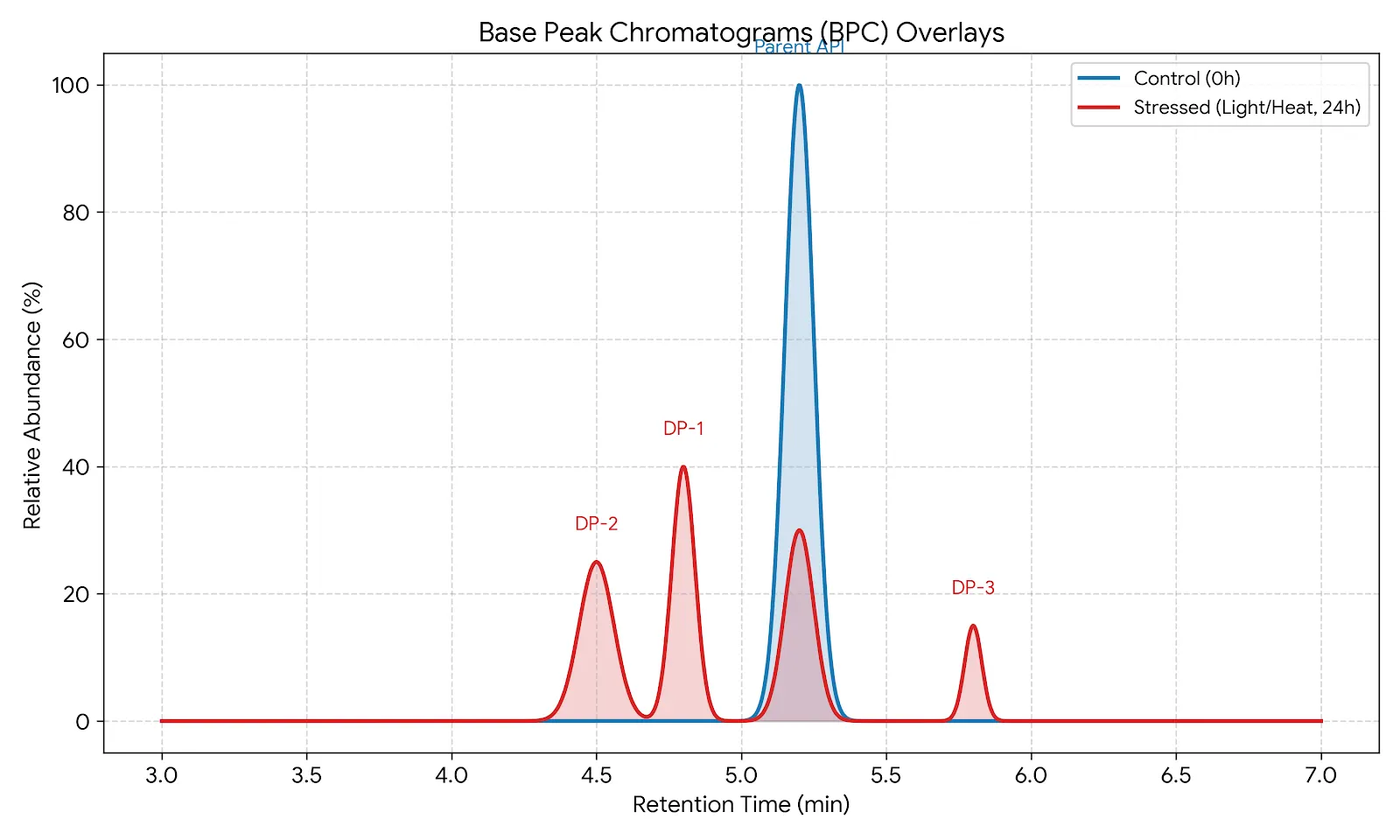
  • Base Peak Chromatograms (BPC) Overlays: High-resolution visual overlays comparing the unstressed T0 control against stressed samples. These chromatograms intuitively display the emergence of distinct, baseline-separated degradation impurities.
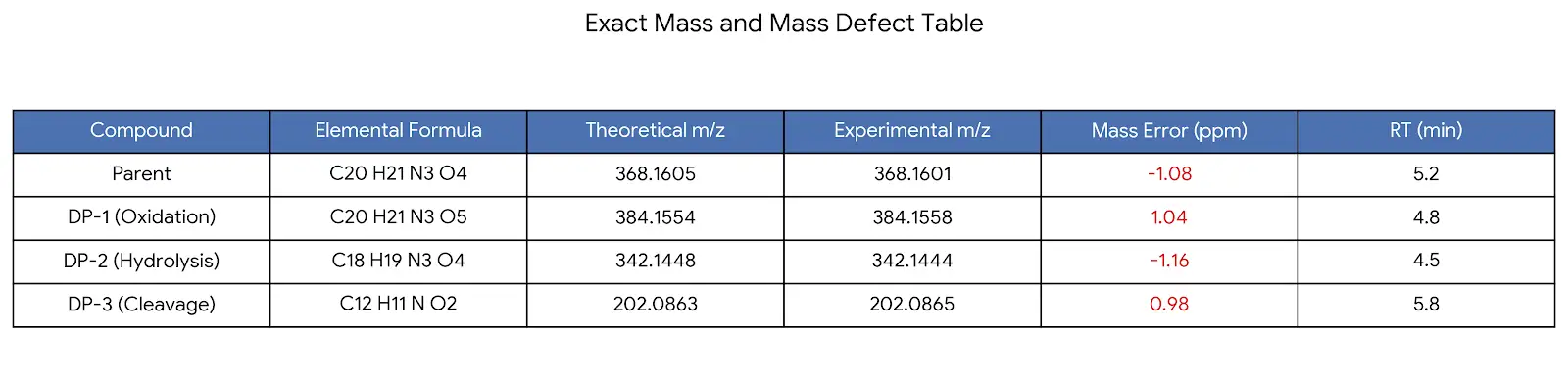
  • Exact Mass and Mass Defect Tables: Tabulated datasets meticulously detailing the experimental exact mass, theoretical mass, mass error (ppm), and deduced chemical formula for every detected impurity.
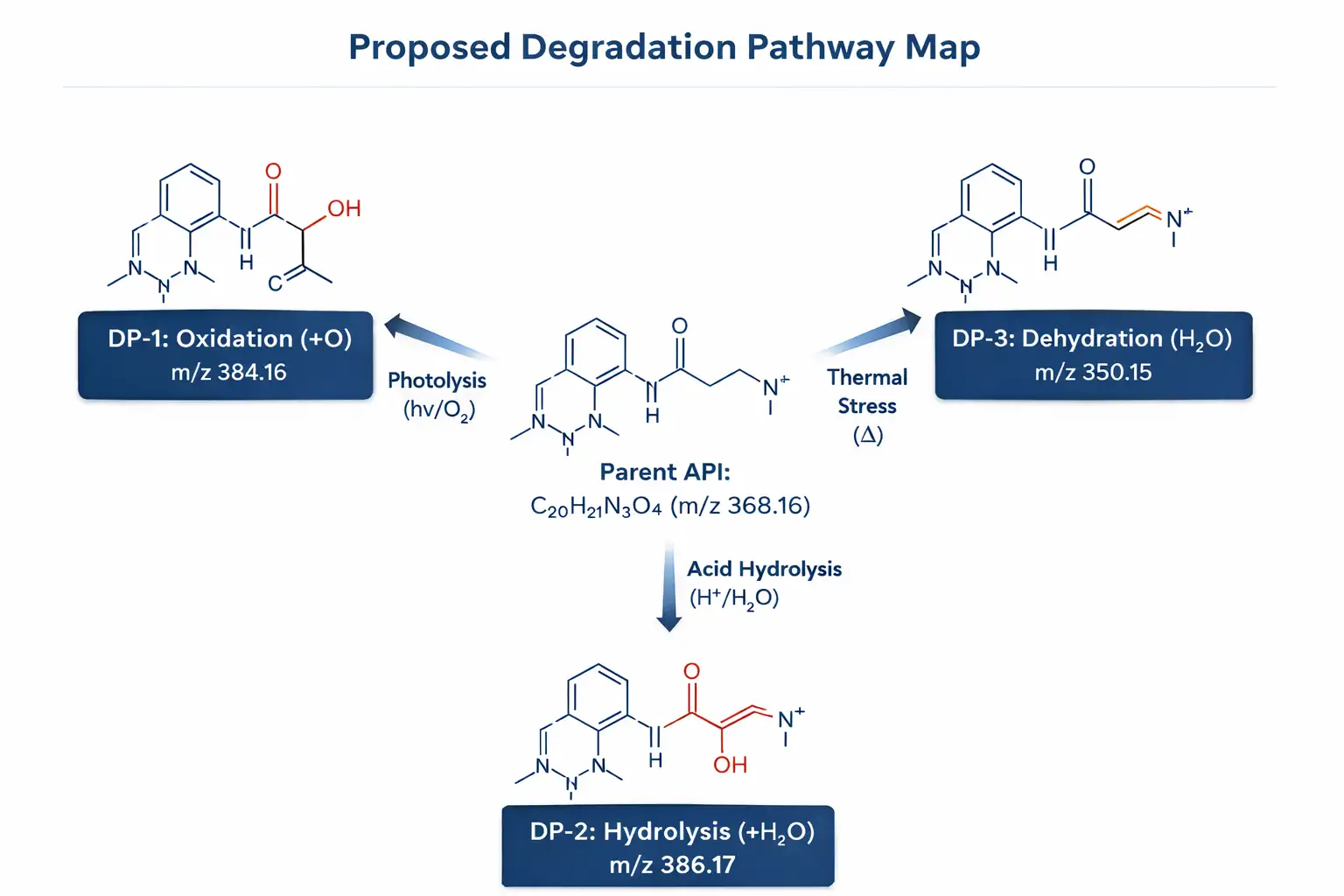
  • Proposed Degradation Pathway Maps: Comprehensive structural flowcharts graphically mapping how the parent molecule fragments under specific environmental stressors, providing an actionable roadmap for structure optimization.
Base Peak Chromatograms Overlays
Exact Mass and Mass Defect Tables
Proposed Degradation Pathway Maps

Technical Strengths: The HRMS-Driven Discovery Advantage

Selecting the right analytical methodology determines whether you merely observe that degradation has occurred, or if you actually understand the structural mechanism behind it.

Analytical Dimension Our LC-HRMS Platform Conventional HPLC-UV Systems
Unknown ID Capability De novo structural elucidation via exact mass and deep MS/MS fragmentation trees. Blind to structure; strictly requires known, previously synthesized reference standards.
Non-Chromophore Detection Universal ionization accurately captures trace degradants entirely lacking UV absorbance. Completely misses impurities that lose their chromophore during the cleavage event.
API Consumption Sub-milligram (<1 mg) scale, perfectly suited for rare, precious early discovery compounds. Requires large, gram-scale batches to support multiple repetitive assays and injections.
Sensitivity Sub-ng/mL detection limits, capable of tracking trace-level degradation even in complex matrices. Severely limited sensitivity; requires high concentrations of API to "see" minor impurities.
Mechanism Insight Direct identification of vulnerable chemical bonds to guide medicinal chemistry redesign. Provides only a binary "pass/fail" result with absolutely no insight into the mode of failure.

Selection Strategy

While standard UV methods may be considered sufficient for the late-stage batch release of well-characterized commercial drugs, they are fundamentally insufficient for novel research molecules. In the early discovery phase, where understanding the exact structural degradation pathway is the primary goal to prevent downstream in vivo failure, high-resolution LC-MS/MS is the only scientifically viable choice.

Sample Submission Requirements for Stress Testing

To successfully prevent unmonitored baseline degradation prior to the formal initiation of the analytical study, we strictly enforce the following sample preservation and submission parameters:

Sample Type Minimum Quantity Shipping Condition Important Notes
API Powder (Solid State) 1 - 5 mg Room Temp or Dry Ice Protect tightly from light using sealed amber vials. Specify known pKa/LogP values if available.
Formulated Solutions 1 - 2 mL Strictly on Dry Ice Specify exact solvent composition. Strictly avoid buffers with high concentrations of non-volatile salts.
Control Samples Matching amount Identical to test article A pristine, unstressed control is absolutely mandatory for background subtraction and accurate mass balance calculation.

A holistic understanding of a molecule requires seamlessly integrating forced degradation structural data with physiological stability metrics and localized tissue distribution. Explore our integrated bioanalytical testing ecosystem:

Case Study: De Novo Structural Elucidation of Hidden Degradation Products

Background

During a critical lead optimization project for a novel heterocyclic compound, a research team observed that their candidate exhibited an exceptionally poor half-life during in vitro screening. Initial in-house HPLC-UV forced degradation testing suggested the API was rapidly degrading under ambient laboratory light and moderate heat. However, the resulting chromatograms showed absolutely no new impurity peaks. Because the primary degradation products had lost the parent molecule's core chromophore during the reaction, they were entirely invisible to UV detection, leaving the medicinal chemists with a severe analytical blind spot.

Methods

To overcome this critical UV limitation, our analytical team initiated a targeted forced degradation study. We deployed a UHPLC-HRMS platform operating in Data-Dependent Acquisition (DDA) mode. By utilizing rapid polarity switching and precise mass defect filtering, we scanned the entire stressed sample matrix for any molecular signals associated with the parent compound's unique isotopic signature, capturing even those at extreme trace concentrations.

Results & Conclusion

The HRMS universal ionization approach successfully captured three trace-level degradation products (DPs) that the conventional UV detector had completely missed. Through highly detailed fragmentation analysis (MS/MS), our scientists deduced that the primary degradation route involved a highly specific photo-oxidative ring cleavage, followed by a subsequent dealkylation. Armed with the exact molecular location of the broken bond and the defined structure of the oxidative degradant, the client's chemistry team successfully swapped the liable functional group for a more resilient analog.

Reference Literature

LC-HRMS-Guided Stress Degradation Studies and Structural Elucidation of novel pharmaceutical compounds. Molecules, 2022. https://www.mdpi.com/1420-3049/27/7/2109 (Open Access, CC-BY 4.0).

Frequently Asked Questions

How do you distinguish between in-source artifacts and true degradation products in the mass spectrometer?

This is a critical analytical challenge in early discovery. Fragile molecules can frequently undergo "in-source fragmentation" during the aggressive electrospray ionization process, creating signals that falsely appear to be degradants but were actually generated inside the instrument's vacuum chamber. We resolve this by rigorously optimizing mass spectrometer source parameters and relying heavily on precise chromatographic separation. If a suspected signal perfectly co-elutes with the massive parent peak, it is highly likely an in-source artifact; however, if it exhibits a distinct, separate chromatographic retention time, it is confidently confirmed as a genuine degradation product.

What happens if the degradation products are highly polar and cannot be retained on a standard C18 analytical column?

Forced degradation pathways very often involve hydrolysis or the addition of hydroxyl groups, which significantly increases the molecule's overall polarity. If standard reverse-phase chromatography (like C18) fails to retain these highly polar fragments, our laboratory swiftly deploys orthogonal Hydrophilic Interaction Liquid Chromatography (HILIC) gradients or specialized polar-embedded columns. This dual-column strategy ensures that even the most extremely polar degradants are successfully separated from the solvent void volume and accurately characterized.

Can you perform structural elucidation if we cannot disclose the exact chemical structure of our proprietary compound?

Yes. While having the exact 2D structure greatly expedites the MS/MS fragmentation tree analysis, we can work effectively under strict confidentiality agreements. If you provide the exact molecular formula, the general drug class, and suspected labile functional groups, our advanced bioinformatics platform can still map exact mass shifts (e.g., a precise +15.9949 Da shift indicating oxidation) to accurately identify the type of degradation occurring and suggest the most highly probable sites of molecular vulnerability.

How do you accurately calculate mass balance when the parent compound degrades into multiple minor fragments?

Mass balance is mathematically calculated by correlating the loss of the parent compound's analytical signal with the cumulative signals of all successfully identified degradants. By utilizing HRMS and optimizing the ionization source for exceptionally broad coverage, we ensure that we capture almost every fragment generated. We then normalize the relative abundances using a rigorous "sum-of-peaks" approach, ensuring the final calculated mass balance falls well within scientifically acceptable limits (typically 90-110%), thereby proving no major degradant was missed.

Is the data generated from a forced degradation study suitable for predicting long-term shelf-life?

Forced degradation is designed exclusively to identify the "how" and "where" of molecular failure by purposefully utilizing extreme, accelerated stressors. While it provides the fundamental, necessary knowledge of potential degradation pathways, it does not directly predict real-time shelf-life under standard storage conditions. To determine an actual shelf-life, our dedicated Short-Term and Long-Term Stability Studies provide the necessary longitudinal tracking at standard temperatures (e.g., 25°C/60% RH) over extended periods.

Ready to Quantify Your Lead Compound or Metabolite?

Share your matrix type, sample count, and expected range—feasibility routing will confirm whether direct quantification is fit-for-purpose or method development is recommended.

inquiry
Online Inquiry